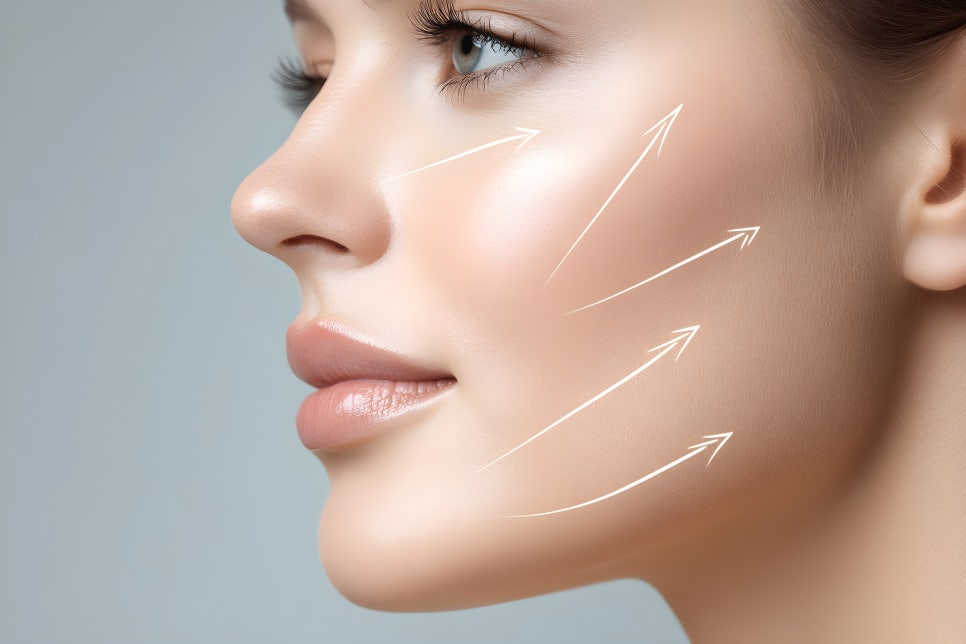
In this post, for those who are considering lifting for the midface,
I’d like to introduce a simple way to check for yourself whether you may need a lifting procedure before visiting a clinic.
However, before getting into that, there can be individual differences,
and there are various cases depending on previous surgeries or procedures.
For more detailed information, it is important to find out whether a surgical method is needed or whether improvement is possible with a procedure alone
through a thorough consultation and examination with a specialist, and to plan the surgery accordingly.
The following is a simple self-check method to understand your condition.
▲ Stage 1: A faint nasolabial fold is visible when smiling, but not clearly visible when not smiling.
▲ Stage 2: A faint nasolabial fold is visible even when not smiling. The fat above the nasolabial fold is not thick.
▲ Stage 3: A distinct nasolabial fold is visible when smiling. The fat above the nasolabial fold is thick.
▲ Stage 4: A distinct nasolabial fold is visible even when not smiling. The fat above the nasolabial fold is thick, and the under-eye area is sunken.
First, in the mild Stage 1 case (refer to the Stage 1 photo), Ulthera lifting can be considered.
Ulthera lifting is a non-invasive procedure that uses high-intensity focused ultrasound,
creating thermal coagulation points in the SMAS layer located deep within the skin
to induce natural recovery.
It improves skin elasticity,
and because it does not irritate the skin surface, it is a highly satisfying procedure with few side effects.
These days, more people are getting lifting procedures in advance to prevent aging as part of slow aging,
or to improve facial sagging caused by excessive dieting.
When the condition progresses to the stage where a faint nasolabial fold is visible even when not smiling, thread lifting can be considered. (See Stage 2 photo)
Thread lifting is a lifting procedure in which medical absorbable barbed threads are inserted into the fat layer
to directly pull up sagging skin.
Among various lifting methods, it can provide immediate effects in a short time by lifting sagging soft tissue.
It is suitable for those who want more noticeable results than non-invasive procedures such as Ulthera lifting,
but find incision surgery such as a facelift burdensome.
The procedure time is also shorter than surgery (about 15 minutes), and there is less concern about swelling, bruising, scars, and recovery time,
so it is a lifting procedure in high demand among office workers in their 20s and 30s who want quick and immediate lifting effects.
In fact, some of our hospital staff recently received thread lifting. Shall we take a look at a case?
This is the appearance before the procedure. You can see that the nasolabial folds are noticeable even without smiling. The fat above the nasolabial folds was not thick, so we expected thread lifting to be effective.
This is the appearance after the procedure. The tissue was pulled further using absorbable barbed threads. After the procedure, the nasolabial folds are no longer noticeable. This is a procedure recommended for those who want to see results quickly.
If skin sagging is severe and the fat above the nasolabial folds is bulging, thread lifting has its limitations.
When aging has already progressed significantly, skin excision is essential to improve sagging.
In such cases, the most effective way to improve overall facial sagging is a facelift.
This surgery focuses on improving skin sagging, deep wrinkles, and changes in the jawline caused by aging. (It is sometimes called the most magical surgery.)
The surgical process involves making incisions in locations that are as inconspicuous as possible,
lifting the sagging soft tissue, and removing excess skin to restore the facial contour.
Although many people think of the term “facelift” as meaning a major surgery,
if you undergo the operation with an experienced specialist, recovery can proceed without major difficulty.
Recovery after surgery varies by individual, but it usually takes 2 to 4 weeks, after which normal daily life is possible.
Shall we also look at a case?
This is a case that is difficult to handle with thread lifting alone. The skin is sagging overall, and the nasolabial folds are deeply etched. In such cases, skin excision must be performed.
By lifting the overall soft tissue, the skin gains more elasticity and the wrinkles improve.
Additionally, if the under-eye fat is very bulging
and the under-eye wrinkles are severe enough that lower blepharoplasty must be performed as well,
performing midface lifting at the same time can lead to better results.
The surgical process involves making an incision in a location that is as inconspicuous as possible near the lower eyelash line,
repositioning the bulging fat and lifting the sagging tissue above the nasolabial fold upward,
restoring a more youthful appearance.
By improving the bulging area under the eyes and naturally connecting it to the midface below,
a natural and appropriate volume can be created.
The case below may make this easier to understand.
The skin is sagging downward overall. Under-eye hollowness and nasolabial folds are also visible. There are also wrinkles under the eyes, so combining this with lower blepharoplasty is expected to produce better results.
The sagging soft tissue has been lifted, improving the skin wrinkles. You can see a noticeable improvement in under-eye hollowness, nasolabial folds, and the skin overall. It looks more lively and elastic.
The best lifting method will inevitably differ depending on each person’s age, skin condition, degree of sagging,
and the areas they want to improve.
However, one thing is clear: the fundamental purpose of lifting is ultimately to move sagging soft tissue caused by aging
in the opposite direction of gravity and restore a younger, more youthful appearance.
At Eton Plastic Surgery, we aim to provide lifting that brings you back to how you looked 10 years ago.
There are many different lifting methods. But the most important thing is to check your current level of sagging.
You should choose a lifting method by considering how much improvement you want and how much time you can allocate for recovery, right?
Above all, the most important thing is to be lifted safely,
and for that, it is best to find the lifting method that is most suitable for you through consultation with a board-certified plastic surgeon
who has in-depth knowledge of soft tissue and extensive clinical experience.