Treatment and Management Methods for Age Spots
Everyone experiences aging, and age spots are a representative symptom that commonly appears in middle-aged and older adults. However, the appearance of age spots does not necessarily mean that a person has entered old age. This is because age spots can also develop from frequent exposure to ultraviolet rays or due to environmental and genetic factors.
Unlike other skin conditions, age spots do not heal naturally, so if they are left untreated, the symptoms may worsen. In particular, they have a tendency to spread to surrounding areas and recur, so prompt treatment is important once they develop. Also, in a very small number of patients, age spots may actually be skin cancer, and although uncommon, symptoms such as itching may accompany them, making prompt response important.
Causes of Age Spots
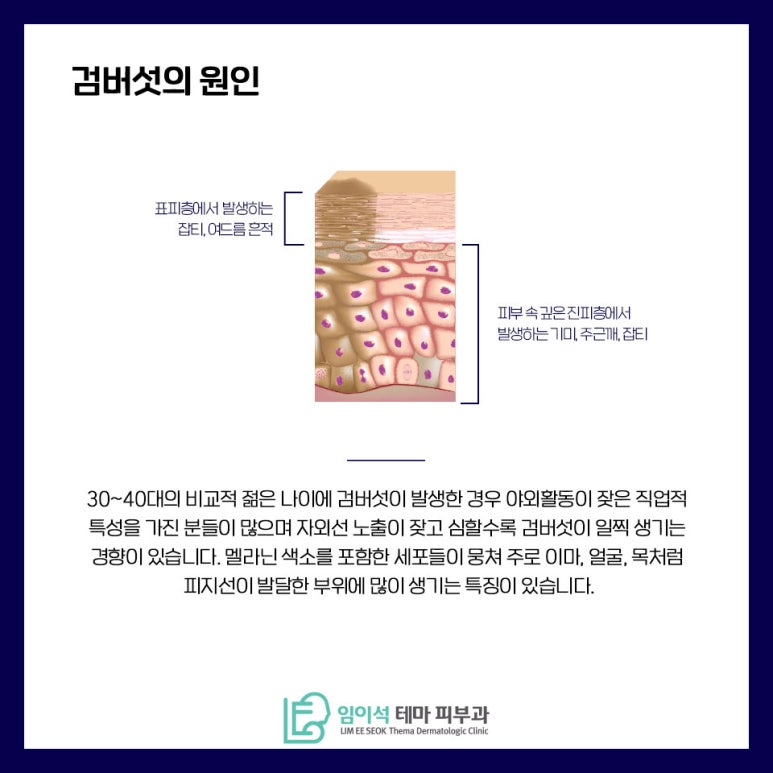
In particular, when age spots appear at a relatively young age in the 30s or 40s, many people have occupations that involve frequent outdoor activity. The more frequent and severe the ultraviolet exposure, the more likely age spots are to appear early. They are characterized by clumps of cells containing melanin pigment, and they commonly develop in areas with well-developed sebaceous glands such as the forehead, face, and neck.
Characteristics of Age Spots

At first, they appear as flat brown spots, but over time the surface becomes uneven, pigment changes occur, and the size increases. They generally appear often after the 50s and may be accompanied by symptoms such as itching. If not treated early, secondary complications may also occur.
-
Broad brown or black spots
-
Raised, protruding shape
-
Appear on the face, scalp, neck, arms, and legs
-
Distributed in the epidermis, the outermost layer of the skin
-
No seasonal changes or distinctive features
Differences Between Age Spots, Melasma, and Freckles

Many people mistake melasma and freckles for age spots, but they are clearly different conditions. Melasma mainly appears only on the face, while age spots are a condition in which pigment is excessively deposited and can occur not only on the face but also on various parts of the body.
Melasma: Freckles may look like black blotches on the face, which is why they are sometimes called black spots. They commonly appear on the forehead and cheeks, and tend to darken in summer and improve in winter. Brown spots symmetrically appear on sun-exposed areas such as the cheeks, temples, forehead, around the mouth, and the chin, and they are common in women after childbirth or during the reproductive age. At first, they appear as brown or gray spots, and over time they tend to merge into a larger area.
Freckles: These are small brown pigmented spots that occur in sun-exposed areas and develop when melanin cells that produce pigment become active. They are also affected by hormonal changes and tend to worsen during puberty, and they most commonly occur in people in their teens and 20s. They appear symmetrically on both cheeks, and unlike melasma, they do not merge over time. They are easily removed with laser treatment, but they recur easily.

“ In the past, age spots were treated surgically. ”
Age spots are benign skin tumors, so surgical removal was, in principle, required. For this reason, in the 1970s and 1980s, when people wanted age spot treatment, they were often removed surgically, or left untreated. However, due to recent advances in medical technology and patients' reluctance to undergo surgery, surgery is now rarely performed.
Since age spots develop only in the epidermis, the outermost layer of the skin, they can be removed through a simple ablative laser procedure. Before laser technology advanced, treatments such as cryotherapy, electrocautery, and chemical peels were also used.
Treatment Methods for Age Spots

Melasma, blemishes, age spots, and dark circles are not simply about removing skin imperfections. They are lesions caused by abnormal cell changes, so proper treatment is necessary. An accurate diagnosis of the form of pigment, the depth of pigmentation, the cause, and the symptoms should be made before treatment is carried out according to the cause. In addition, because each patient differs in skin type, environment, symptoms, and condition, customized treatment should be provided.
<Laser Procedure>
The principle of the laser procedure most commonly used to treat age spots is to apply heat stimulation that does not burn the dermis, thereby regenerating new tissue and creating smoother contours, removing age spots while also helping create more beautiful skin. At Imiseok Thema Dermatology, patient-tailored, high-difficulty treatment is possible with more than 60 state-of-the-art laser devices and advanced premium laser equipment. Pigment disorders are treated using various methods such as pico laser, IPL, radiofrequency, and ultrasound, depending on the individual's skin condition.
How to Manage Age Spots

Once age spots develop, scars may remain even after treatment, and they may recur. Therefore, early prevention is important so that age spots do not develop in the first place.
- Avoid excessive sun exposure
To prevent skin damage, blocking ultraviolet rays is very important. Spending long periods outdoors at midday or in the summer when the sun is very strong can cause spots to appear on exposed areas, and not only age spots but also melasma, blemishes, and skin aging may occur.
- Use sunscreen
In particular, on clear and hot days, the UV index rises, so sunscreen should be used. Even if you have sensitive skin, if you go out on days with strong ultraviolet rays, use a low-irritation product and reapply it every 2 to 3 hours.
- Proper care after going out
After going out, sunscreen should be thoroughly removed, and it is good to use a mask pack that helps balance the skin's oil and moisture after prolonged ultraviolet exposure has damaged the skin. It helps soothe the skin and reduce heat, which helps prevent age spots, skin aging, wrinkles, melasma, and blemishes.
Today, we covered in various ways the causes, characteristics, treatment methods, and management methods of age spots. Since you are exposed to ultraviolet rays throughout all four seasons, be sure to apply sunscreen. If age spots have already developed and need treatment, please visit our clinic and receive professional care. Thank you.