Hyperhidrosis and bromhidrosis caused by problems with sweat regulation
Hello, this is Imi Seok Thema Dermatology.
Today, we would like to talk about hyperhidrosis and bromhidrosis, which cause discomfort because of sweating whether the weather is hot or cold. Hyperhidrosis is not just about sweating a lot. In the case of the underarms, if bromhidrosis is also present, the odor can become stronger, and if it occurs on the face or hands, daily life can become difficult. In the past, surgical treatment was often used, but because of side effects, Botox is now used for treatment. In particular, during hot weather like these days, when sweat pours out even while staying still, those with hyperhidrosis may have even more concerns.
Hyperhidrosis?
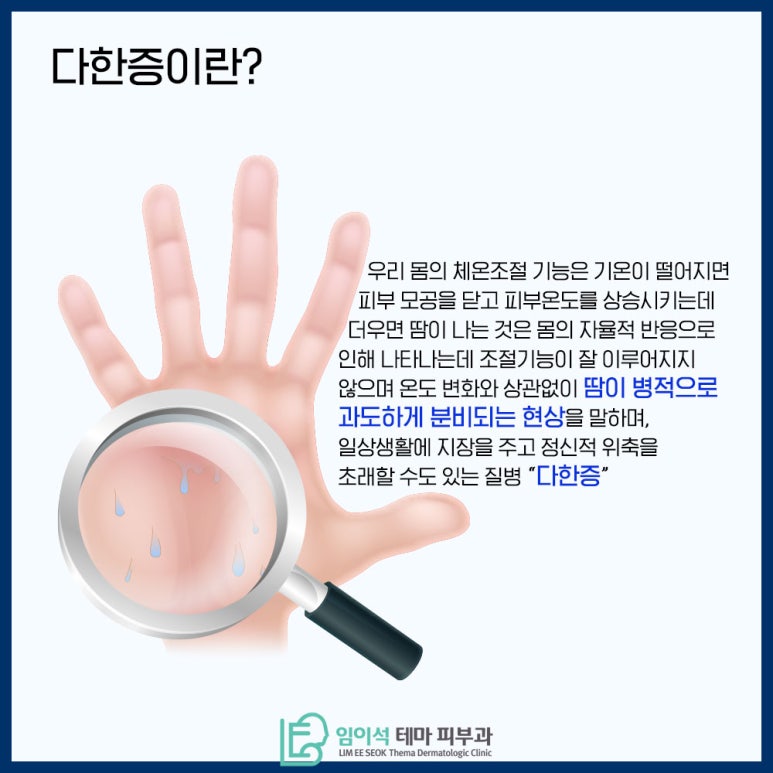
The body’s thermoregulation function closes the skin pores and raises skin temperature when the air temperature drops. Sweating when it is hot is a natural bodily response, but when this regulatory function does not work properly and sweat is abnormally and excessively secreted regardless of temperature changes, this is called hyperhidrosis. Hyperhidrosis interferes with daily life and can also cause psychological withdrawal.
The types of hyperhidrosis also vary by area, and depending on where sweating occurs, it is classified as axillary hyperhidrosis, palmar and plantar hyperhidrosis, facial hyperhidrosis, and so on. Although there are differences by season, an average person sweats 600–700 ml per day, whereas people with hyperhidrosis sweat 2–5 liters per day, which is 3–8 times more than average.
Hyperhidrosis can be treated relatively simply using hyperhidrosis Botox. Compared with other drug treatments or surgical methods, the procedure is simple, and the treatment range is broad enough to treat not only the underarms but also palmar and plantar hyperhidrosis.
Types of hyperhidrosis

There are gustatory hyperhidrosis, olfactory hyperhidrosis, emotional hyperhidrosis, and compensatory hyperhidrosis. Gustatory hyperhidrosis causes sweating on the face and the area around the sternum within a few minutes after consuming hot, spicy foods. It mainly appears in men who tend to have a lot of body heat and a sturdy build. Olfactory hyperhidrosis causes sweating in response to olfactory stimuli from odors. Odors that commonly trigger this include perfume, cigarettes, and exhaust fumes. Emotional hyperhidrosis causes sweating mainly in the hands, feet, or underarms when emotional arousal such as anxiety or fear occurs. Compensatory hyperhidrosis is a case in which, as a side effect of improper hyperhidrosis treatment, sweating occurs in a completely different area after sympathectomy.
In the case of generalized hyperhidrosis, sweat runs down the entire body. For these patients, it is far more distressing and difficult than localized hyperhidrosis, and the treatment process is also more difficult than for localized hyperhidrosis. In addition, although some cases are genetic or constitutional without a specific underlying disease, there are also diseases that cause hyperhidrosis. Hyperthyroidism, pituitary hyperfunction, tuberculosis, diabetes, congestive heart disease, emphysema, and Parkinson’s disease can cause hyperhidrosis.
Among the causes of hyperhidrosis, there are also cases related to problems with the heart. This is because the sympathetic nerves that stimulate the sweat glands are also connected to the heart. When the sympathetic nerves are tense, not only does a lot of sweating occur, but if such a tense state continues for a long time, it can also affect heart function.
What is bromhidrosis?
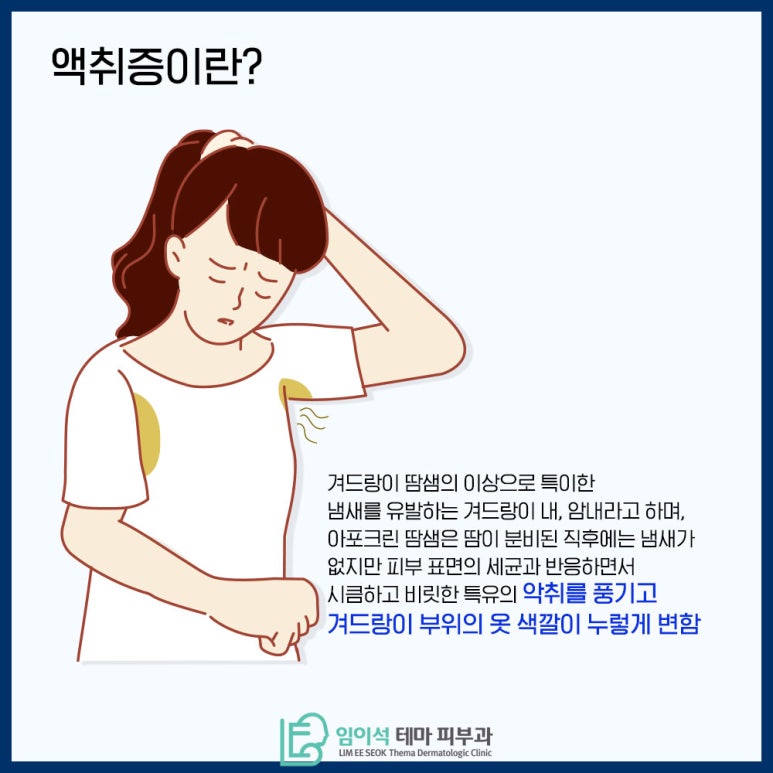
Bromhidrosis is also called underarm odor, a special odor caused by abnormalities in the sweat glands of the underarms. Apocrine sweat glands do not have an odor immediately after sweat is secreted, but as they react with bacteria on the skin surface, they produce a distinctive foul smell that is sour and fishy.
Usually, if the clothes in the underarm area turn yellow and cause a foul odor, this can be considered bromhidrosis, and 50–60% of patients with bromhidrosis also have hyperhidrosis.
There are two types of sweat glands in the underarms: eccrine sweat glands and apocrine sweat glands. Bromhidrosis is related to the function of apocrine sweat glands, which are mainly distributed in the underarms, and are also partially distributed around the nipples, navel, and genital area. In general, it often occurs during puberty when the activity of apocrine sweat glands increases under the influence of hormones.
Hyperhidrosis/Bromhidrosis Botox treatment
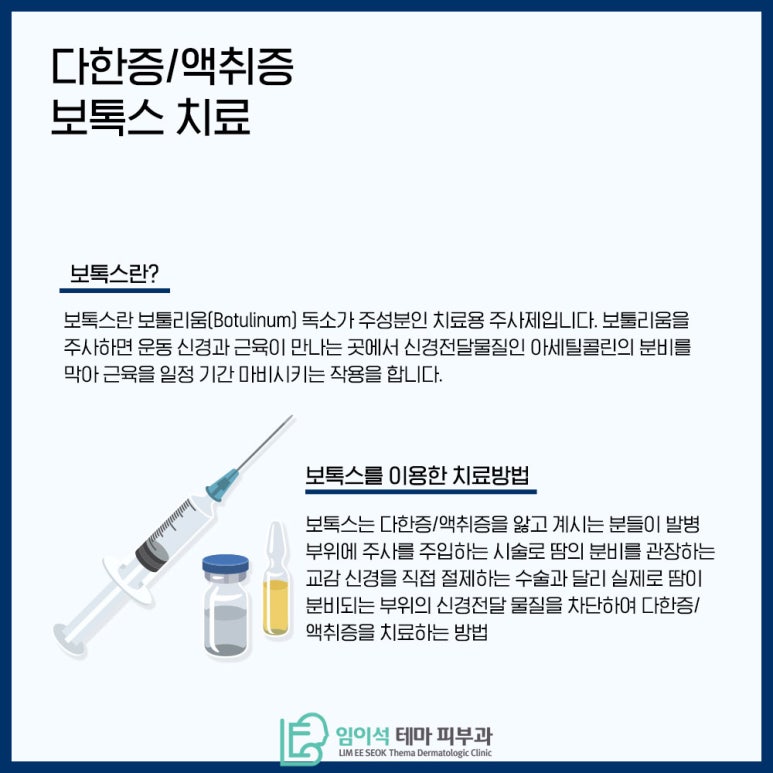
What is Botox?
Botox is a therapeutic injection whose main ingredient is Botulinum toxin. When Botulinum is injected, it blocks the release of the neurotransmitter acetylcholine at the junction between motor nerves and muscles, temporarily paralyzing the muscles.
Hyperhidrosis/Bromhidrosis Botox injection treatment
Hyperhidrosis/Bromhidrosis Botox injections are a procedure in which those suffering from hyperhidrosis/bromhidrosis receive injections in the affected area. Unlike surgery that directly cuts the sympathetic nerves controlling sweat secretion, this method treats hyperhidrosis/bromhidrosis by blocking neurotransmitters in the area where sweat is actually secreted.
Benefits of the Botox procedure

-
It is a simple procedure, not surgery that directly cuts the sympathetic nerves.
-
It is a simple injection procedure, and recovery is possible on the same day.
-
Because it is a direct injection, the onset of effect is fast.
-
Any area such as the hands, feet, or underarms can be treated simply.
Precautions before and after hyperhidrosis/bromhidrosis treatment

-
The effect of Botox varies from person to person, but it usually begins to appear gradually about 3 days after the procedure.
-
Some bruising may occur after the procedure, but it will disappear naturally.
-
To prevent Botox from spreading to surrounding areas, do not touch or press the injection site excessively.
-
Flu-like symptoms or fatigue may occur after the procedure, but these are temporary and will pass.
-
Avoid saunas and jjimjilbangs for about 2 weeks after the procedure.
-
The effect of Botox usually lasts about 3–6 months, and depending on the individual, it may last up to 1 year.
If you think you may have hyperhidrosis or bromhidrosis because of excessive sweating and odor, and you are considering consultation and treatment, it is best to visit a clinic and have a thorough consultation with a doctor.
At Imi Seok Thema Dermatology, we do not focus on merely relieving symptoms in a limited way, but on treating the underlying skin problem. Since opening in 1995, based on more than 600,000 clinical cases, we have made systematic, individualized treatment for skin concerns our principle. We also use more than 60 of the latest laser and medical devices as a way to provide the best treatment service, and through medical skin care, we help resolve a wide range of skin concerns.
If you have questions about skin concerns other than hyperhidrosis and bromhidrosis, please contact Imi Seok Thema Dermatology.