Provider: Lim I-seok Thema Dermatology Clinic
In autumn and winter, when dry winds blow, the skin becomes rough and dry due to the lower temperature and humidity. At this time, if it is simply dryness or mild itching, it can be sufficiently improved by using moisturizer or a humidifier.
However, if the roughness of the skin or the severity of itching increases excessively, you should suspect a skin condition. If white flaking increases significantly or unbearable skin itching continues, it may be psoriasis.
Then, shall we learn what psoriatic skin and psoriatic dermatitis are?

What is psoriatic skin?
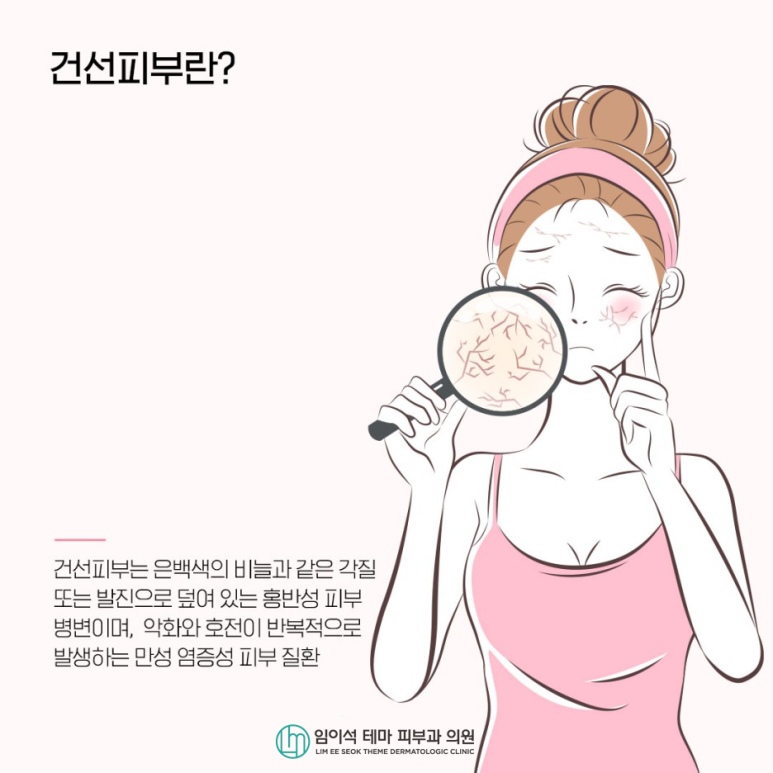
Psoriatic skin is an erythematous skin lesion covered with silvery-white scale-like keratin or rash, and it is a chronic inflammatory skin disease in which exacerbation and improvement repeatedly occur.
Psoriasis develops due to abnormal cell activity, such as skin cells that produce keratin being excessively stimulated and rapidly increasing. It often occurs in areas that are easily irritated, such as the elbows, knees, buttocks, and scalp, and shows various clinical patterns, including small papules, plaque psoriasis, pustular psoriasis, exfoliative psoriasis, and psoriatic arthritis.
Types of psoriasis include plaque psoriasis, guttate psoriasis, erythrodermic psoriasis, and pustular psoriasis. Among them, plaque psoriasis accounts for 80–90% of all cases. It appears as clearly defined red plaques covered with silver scales.
Because it causes itching similar to atopic dermatitis, visitors sometimes mistake it for atopic dermatitis and come to the clinic. However, psoriasis and atopic dermatitis have different characteristics. Atopic dermatitis occurs frequently in children and mainly appears in flexural areas such as the wrists or ankles. It is also accompanied by itching and oozing. In contrast, psoriasis occurs more often in adults and commonly appears on the elbows and knees, with symptoms such as small grain-like rashes and thick scaling.
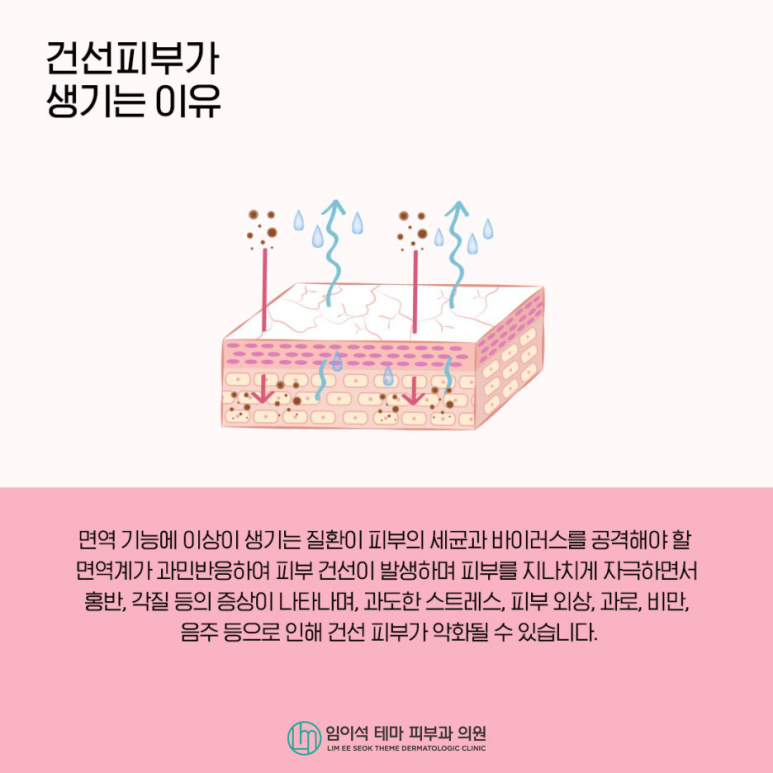
Then why does skin psoriasis develop?
The cause of psoriasis is an "immune abnormality." This does not mean it is caused by weakened immunity, but rather that it is a disease in which the immune function becomes abnormal. In other words, you can understand it as the immune system, which should attack bacteria and viruses on the skin, overreacting and irritating the skin excessively, leading to symptoms such as redness and scaling.
Psoriasis often develops due to factors such as excessive mental stress, skin trauma, overwork, obesity, and alcohol consumption. In particular, as the end of the year approaches and gatherings and drinking occasions increase, psoriasis may worsen due to alcohol, so caution is needed.
If psoriasis develops, you should be careful not to intentionally remove the scales. This is because psoriatic skin tissue does not regenerate normally and is easily damaged, so forcibly removing the scales can also increase the risk of complications.
Scalp psoriasis can also occur
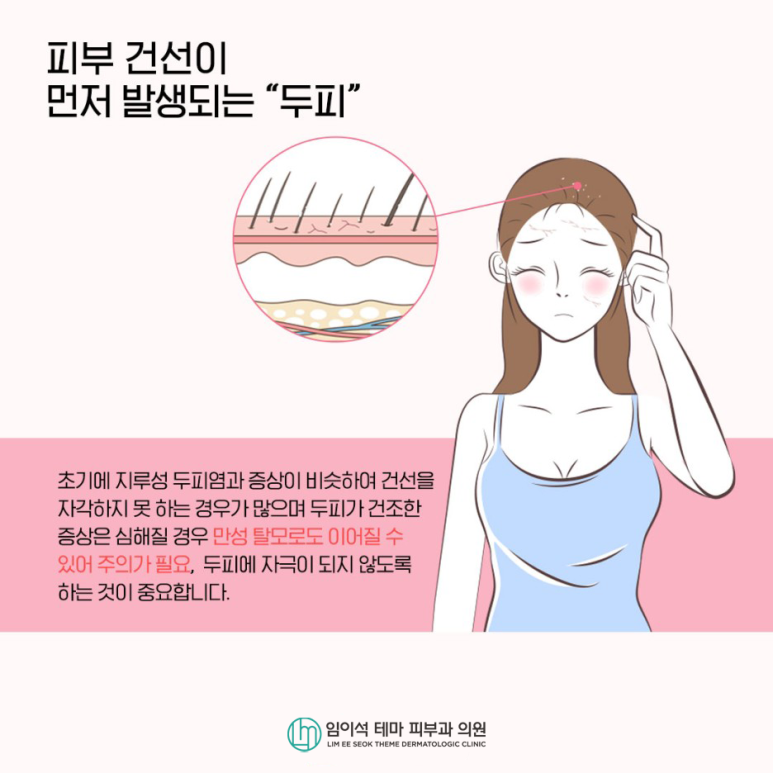
Psoriasis is a chronic inflammatory skin disease in which erythematous skin lesions covered with scale and rash repeatedly worsen and improve. If it occurs on the scalp, it may not be easy to hide and can even lead to hair loss.
The scalp is one of the first areas where psoriasis appears, and more than half of psoriasis patients show scalp psoriasis symptoms. In the early stages, it has symptoms similar to seborrheic dermatitis, so if it occurs only on the scalp, many people do not realize it is psoriasis. When severe, scalp psoriasis can look like dandruff, which can be inconvenient because dark-colored clothing should be avoided.
In particular, if scalp dryness becomes severe, it can even lead to chronic hair loss, so caution is needed. Hair falls out during scratching the scalp due to itching or removing scales. To avoid this and for scalp psoriasis treatment, it is good to keep fingernails short, avoid touching the scalp as much as possible, and maintain scalp cleanliness with gentle brushing. It is also important to use shampoo that excludes irritating ingredients so as not to irritate the scalp as much as possible.
How to treat skin psoriasis

Let me introduce the treatment methods for psoriasis treatment for skin psoriasis.
There are various types of skin regeneration lasers. Representative examples include Harmony, Titan Laser, and Secret Laser.
Harmony is a laser that induces fundamental skin regeneration by promoting collagen regeneration without damaging the skin surface. Titan Laser treats by using the characteristic that human cells regenerate at 60 to 70 degrees Celsius, raising the moisture within the dermis to 60 degrees Celsius to promote regeneration. Secret Laser is a type of laser that delivers radiofrequency energy by directly inserting micro-sized fine needles into the skin. It has the effect of activating collagen and elastin regenerative cells.
Using laser treatment together with medical skin care increases the treatment effect, so we recommend combining them.
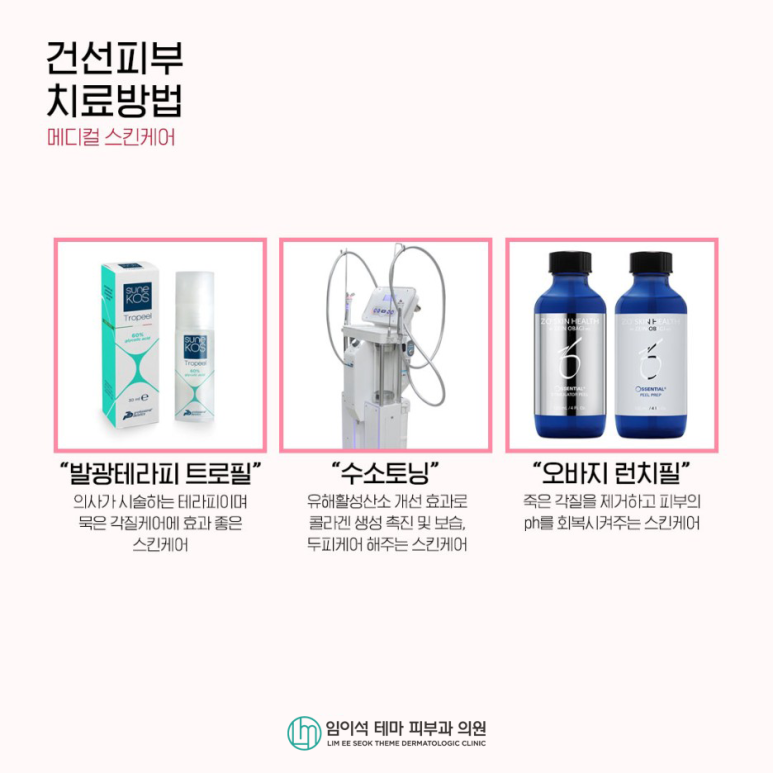
Representative medical skin care treatments include Radiance Therapy Trophyl, Hydrogen Toning, and Obagi Lunch Peel.
Radiance Therapy Trophyl helps reduce flaking by using glycolic acid, and Hydrogen Toning directly penetrates hydrogen capsules into the skin to convert harmful reactive oxygen species into skin moisture. It is a method that regenerates DNA that was difficult to access with lasers. Obagi Lunch Peel is a procedure that can be used even on sensitive skin. It has the effect of removing dead skin cells and restoring the skin's pH.
In addition, improving lifestyle habits is important for treating psoriasis. Avoid excessive heating, and it is good to maintain proper indoor humidity by using a humidifier or a wet towel. In particular, when showering, washing with water that is too hot or using body cleanser too much can remove the skin's natural moisturizing factors, stratum corneum lipids, and sebum more than necessary, which may make the skin even drier, so caution is needed. If you frequently use moisturizer and do not forcibly remove dead skin but instead let it shed naturally, it can help make the skin healthier.
Lim I-seok Thema Dermatology Clinic has various laser devices for treating psoriasis and skin clinics, and has established a ONE-STOP service for effective treatment and care. Through personalized services, we provide comfortable and prompt care, so if you have skin concerns, we recommend visiting a dermatology clinic such as Gangnam Dermatology Clinic or Sinsa Dermatology Clinic for consultation.