Provider: Imi Seok Theme Dermatology Clinic
Hello. This is Imi Seok Theme Dermatology.
Hair loss, which once felt far away,
has now become a condition that can be
easily found around us. In today’s modern society,
the standards of beauty have risen, so skin care,
of course, nail care, and hairstyles are
managed as a basic part of daily life.
People whose hair volume is not abundant or whose hairline has
receded too far often find these symptoms
accompanied by both big and small stress.
Hair loss can occur in people of all ages and genders.
If you are wondering whether you may also have hair loss,
we will explain how to self-diagnose it and how to tell
whether it is alopecia areata or M-shaped hair loss.
Self-diagnosis method for hair loss
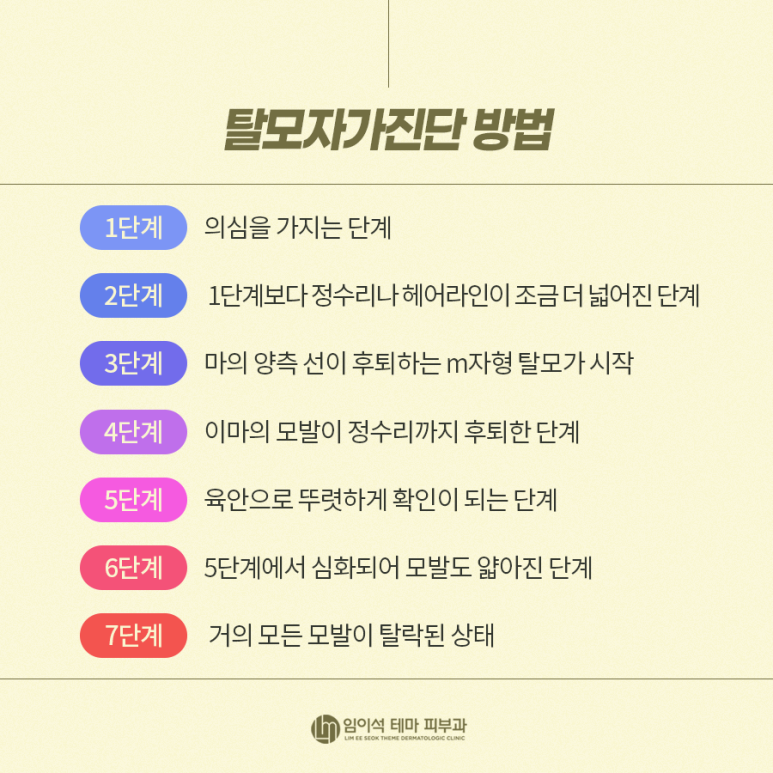
The stages used to self-diagnose hair loss
are divided into a total of 7 stages.
Stage 1 is the stage of suspicion,
and in Stage 2, if you notice that the crown or hairline has
become slightly wider than in Stage 1,
it is advisable to suspect hair loss.
From Stage 3 onward, the hairline on both sides of the forehead
begins to recede in an M shape,
and in Stages 4 and 5, the hair on the forehead
has receded to the crown and is clearly
visible to the naked eye. In Stages 6 and 7,
almost all hair has fallen out, and the remaining hair
is often also thinner.
In Stages 1 and 2, which are early stages,
medication alone can be enough for treatment,
but from Stage 3 onward, it is important to visit a hospital
and establish an appropriate treatment plan in combination
with medication, and if necessary,
hair transplantation can be combined for better treatment
effects.
Hair loss self-diagnosis checklist
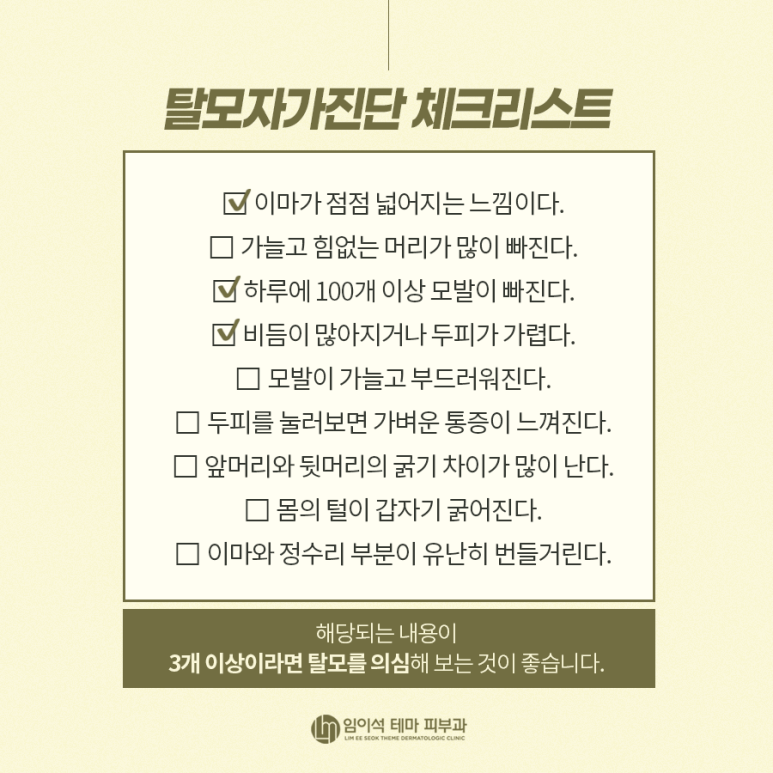
・ My forehead feels like it is gradually getting wider.
・ A lot of fine, weak hair falls out.
・ More than 100 hairs fall out in a day.
・ Dandruff increases or the scalp itches.
・ The hair becomes thinner and softer.
・ When I press on my scalp, I feel mild pain.
・ The thickness of the hair in the front and the back differs a lot.
・ Body hair suddenly becomes thicker.
・ The forehead and crown area become unusually oily.
If it is difficult to confirm my hair loss
condition through a self-diagnosis method,
it is advisable to suspect hair loss if three or more
items on the checklist apply.
Hair loss occurs when nutrients are not properly delivered to the hair,
causing the hair to become thinner
and eventually fall out.
If it is difficult to check whether more than 100 hairs
fall out in a day, it is better to check whether
more hair is falling out than usual,
or whether a large amount of hair is left in the drain after showering.
What is M-shaped hair loss?
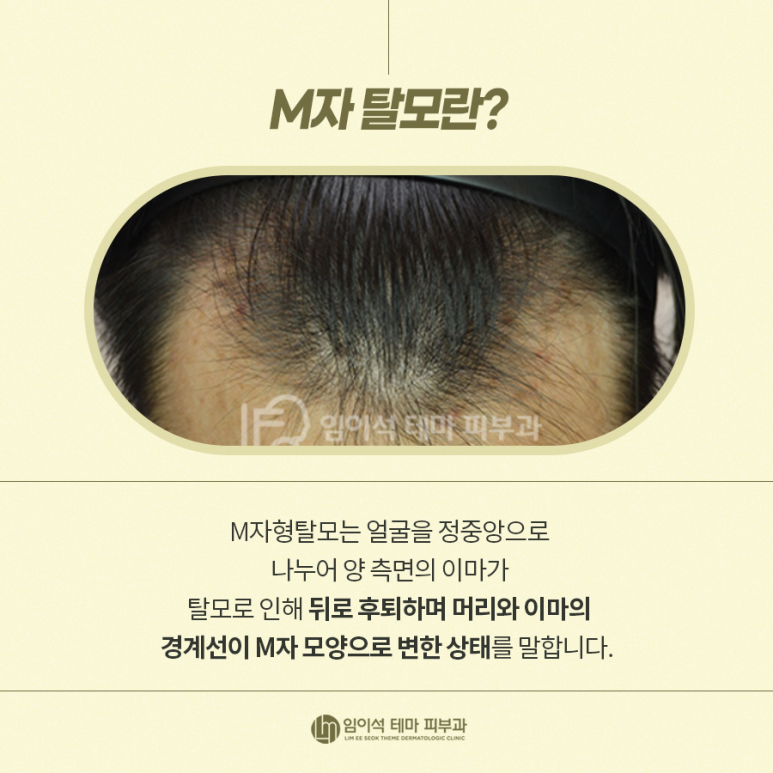
M-shaped hair loss refers to a condition in which the face is divided
into a central line and both sides of the forehead recede due to hair loss,
changing the border between the hair and the forehead into an M shape.
It is a hair loss symptom that mainly appears in men in their 30s and older,
and dihydrotestosterone
(DHT), which is produced by the activation of male hormones, is the main cause of male M-shaped hair loss.
When this hormone (DHT) is excessively secreted,
the hair follicles shrink and the hair becomes thinner,
causing hair loss.
Hair loss can also occur due to poor eating habits and lifestyle habits, alcohol, and smoking,
but genetics and male hormones are major causes.
If the hair on both sides of the forehead gradually becomes thinner
and the amount of hair in the front decreases,
it is good to suspect early symptoms of M-shaped hair loss.
What is alopecia areata?
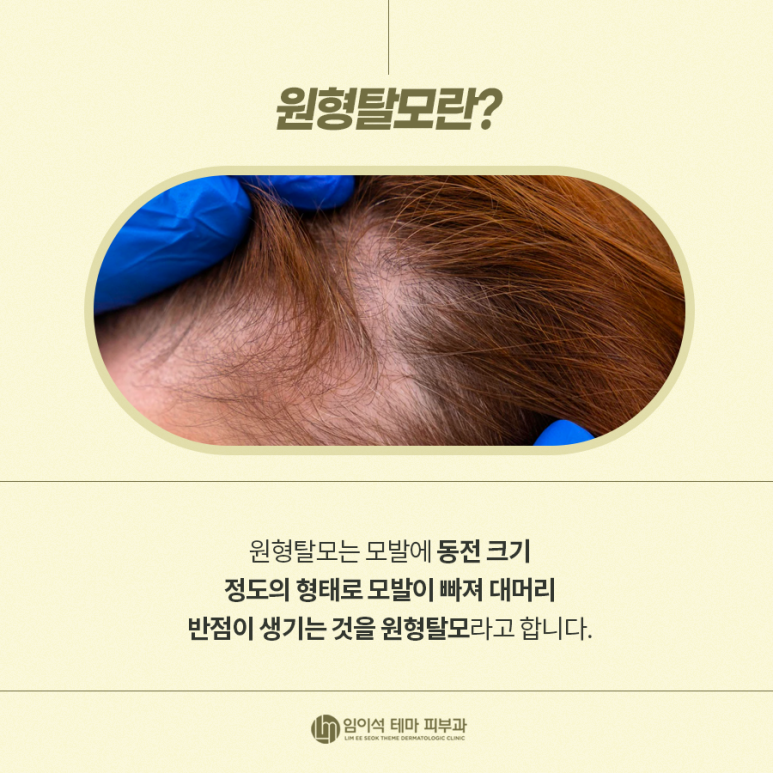
Alopecia areata refers to hair loss in a coin-sized pattern,
creating bald patches.
It is a type of inflammatory disease that affects the hair follicles
and is a non-scarring autoimmune hair loss disorder that can affect
hair and all body hair.
The characteristic of alopecia areata is circular hair loss.
Although the pattern differs from person to person,
in most cases the hair falls out in a round coin shape over a short period,
and unlike other inflammatory conditions, the scalp is clean.
It can be temporary or permanent,
and is a condition that can occur regardless of age or gender,
appearing in various forms such as female alopecia areata and male alopecia areata.
In particular, because women have long hair,
it can be difficult to notice in the early stages, so female alopecia areata
can worsen if left untreated, making it important to check regularly.
M-shaped hair loss treatment methods
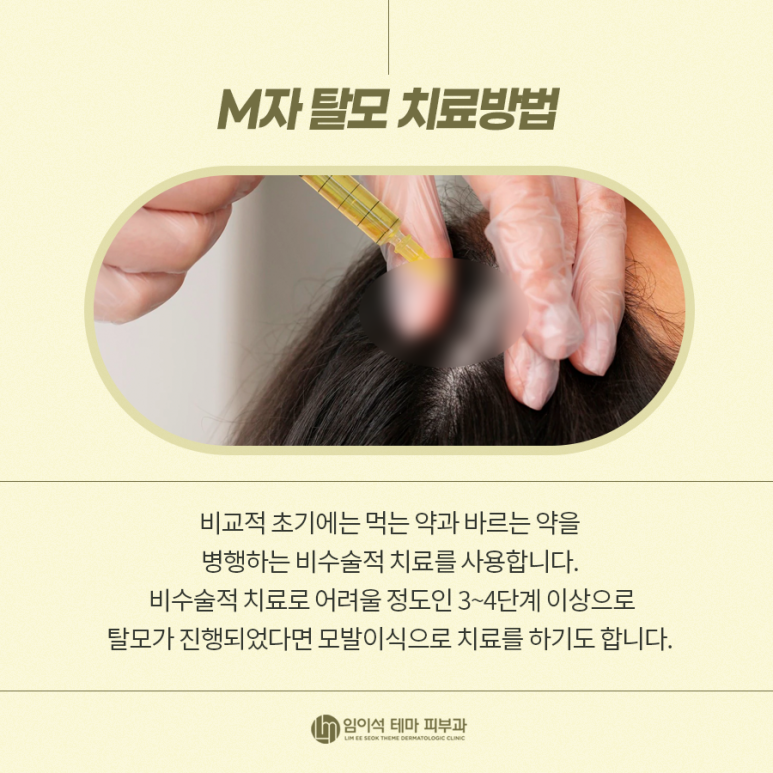
M-shaped hair loss treatment methods vary depending on the stage
of hair loss. In relatively early stages, non-surgical treatment is used,
combining oral medication and topical medication. If the hair loss has
progressed to Stage 3 to 4 or beyond to the point where non-surgical treatment is difficult,
hair transplantation may be used for treatment.
In the case of M-shaped hair loss, even after the stage where hair grows again through treatment has passed,
if left alone, the hair continues to fall out.
Therefore, combining treatment with hair transplantation to prevent further hair loss
can lead to good treatment results.
Depending on the patient’s scalp and hair condition, as well as the number of grafts needed,
incisional and non-incisional hair transplantation are selected and performed.
Because there are many differences, such as scars, pain, graft survival rate, and the price of M-shaped hair loss hair transplantation,
it is better for the medical staff to check my condition and, through sufficient consultation,
choose the method that is right for me.
Treatment methods for alopecia areata
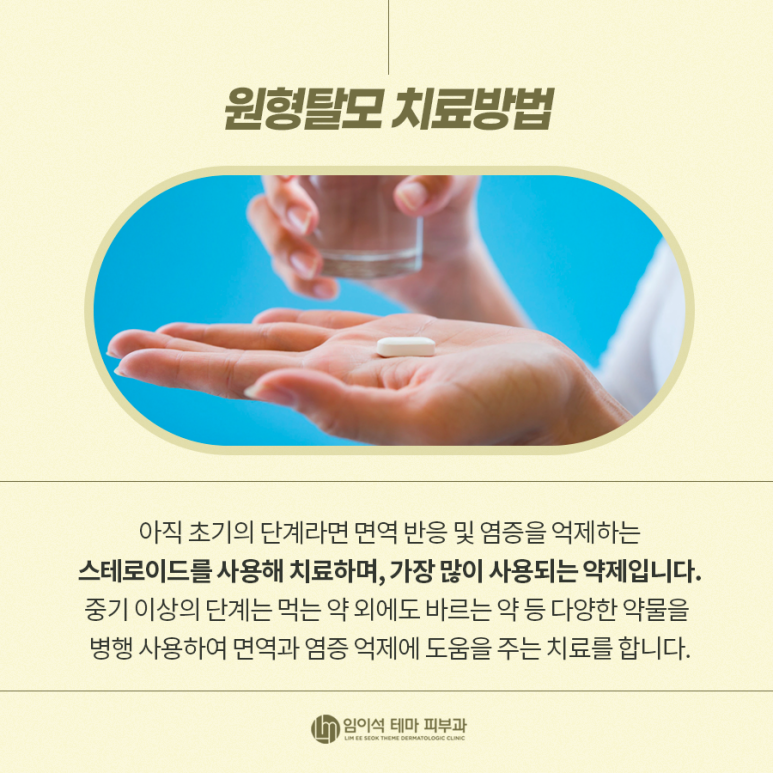
There are various treatment methods for alopecia areata,
and hair loss treatment is carried out using methods appropriate to the patient’s hair loss condition, age,
and stage of hair loss. When treating alopecia areata,
it is good to choose a good alopecia areata treatment clinic
and, after visiting, use the appropriate alopecia areata
treatment method that matches my condition. If it is still an early stage,
treatment is done using steroids that suppress immune responses and inflammation,
and this is the most commonly used medication.
Treatment for alopecia areata may take 2 to 8 weeks or longer,
depending on the patient’s condition. In cases where the hair loss is at a later stage or beyond,
it is good to follow the treatment plan provided by the alopecia areata clinic.
Long-term and mid- to long-term treatment requires consistent care,
so it is important to always check the progress and the treatment status.
The Hair Loss and Hair Transplant Center at Imi Seok Theme Dermatology Clinic
uses various lasers and treatment devices to treat hair loss and create healthy hair.
From the fundamental treatment of hair loss to procedures for fuller hair,
we provide treatment methods tailored to each patient.
If you want naturally full hair and want to properly correct a hairline that has been a concern,
please visit the Hair Loss and Hair Transplant Center at Imi Seok Theme Dermatology Clinic
for a consultation.
At Imi Seok Theme Dermatology Clinic, located near Sinsa Station in Gangnam,
a wide range of equipment is used to provide high-level treatment.
If you have concerns about skin problems, please feel free to make a consultation appointment through the KakaoTalk channel or the website. :-)