
Provider: Imi Seok Thema Dermatology Clinic

During seasons when the temperature difference between day and night is large,
or due to various reasons such as nutritional imbalance in the body
and lack of moisture,
the skin becomes rough and dry.
At times like this, if it is simply dryness or
mild itching,
you can improve it sufficiently
by using moisturizers or a humidifier.
However, if the roughness of the skin
or the degree of itching becomes excessively
severe, it is better to suspect a skin condition.
If there are an unusually large amount of white flakes
or unbearable skin itching continues,
it may be psoriasis.
Imi Seok Thema Dermatology Clinic
will explain what psoriatic skin and psoriatic dermatitis are.
What is psoriatic skin?
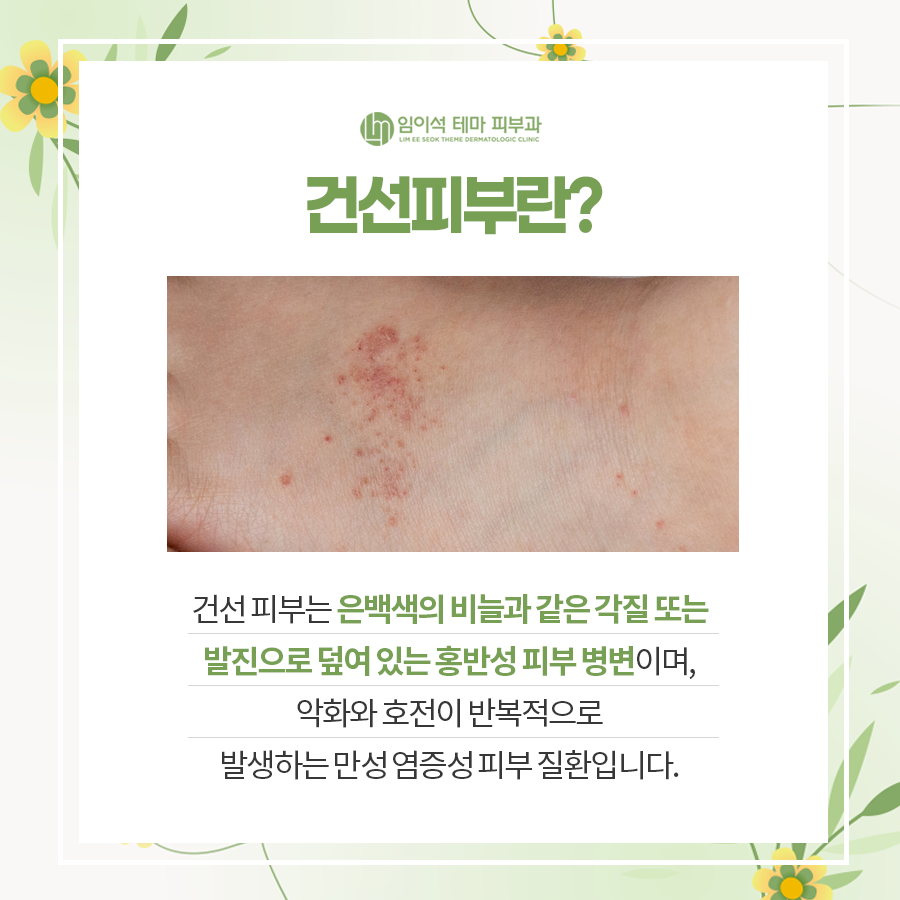
Psoriatic skin is an erythematous skin lesion covered with silvery-white scale-like flakes
or rashes,
and is a chronic inflammatory skin
disease in which flare-ups and improvement
repeatedly occur.
Psoriasis develops due to abnormal cell activity, such as skin cells that produce keratin being overly stimulated and rapidly increasing.
It often occurs in areas that are easily irritated, such as the elbows, knees, buttocks, and scalp,
and presents a variety of psoriasis symptoms,
from small papules to plaque, pustular, exfoliative psoriasis, psoriatic arthritis, and dermatitis.
Types of psoriasis include 'plaque psoriasis',
'guttate psoriasis', 'erythrodermic psoriasis',
and 'pustular psoriasis'.
Among them, plaque psoriasis accounts for 80~90% of all cases.
It appears as a clearly defined red plaque covered with silver-colored scales.
Because it has itching symptoms similar to atopic dermatitis,
patients sometimes visit thinking it is atopic dermatitis.
Psoriasis and atopic dermatitis have different characteristics.
Atopic dermatitis is common in children and mainly occurs in flexural areas such as the wrists or ankles.
It is also accompanied by itching and oozing.
In contrast, psoriasis is common in adults and often occurs on the elbows and knees,
and often shows millet-like rashes and thick scale symptoms.
Why psoriatic skin develops
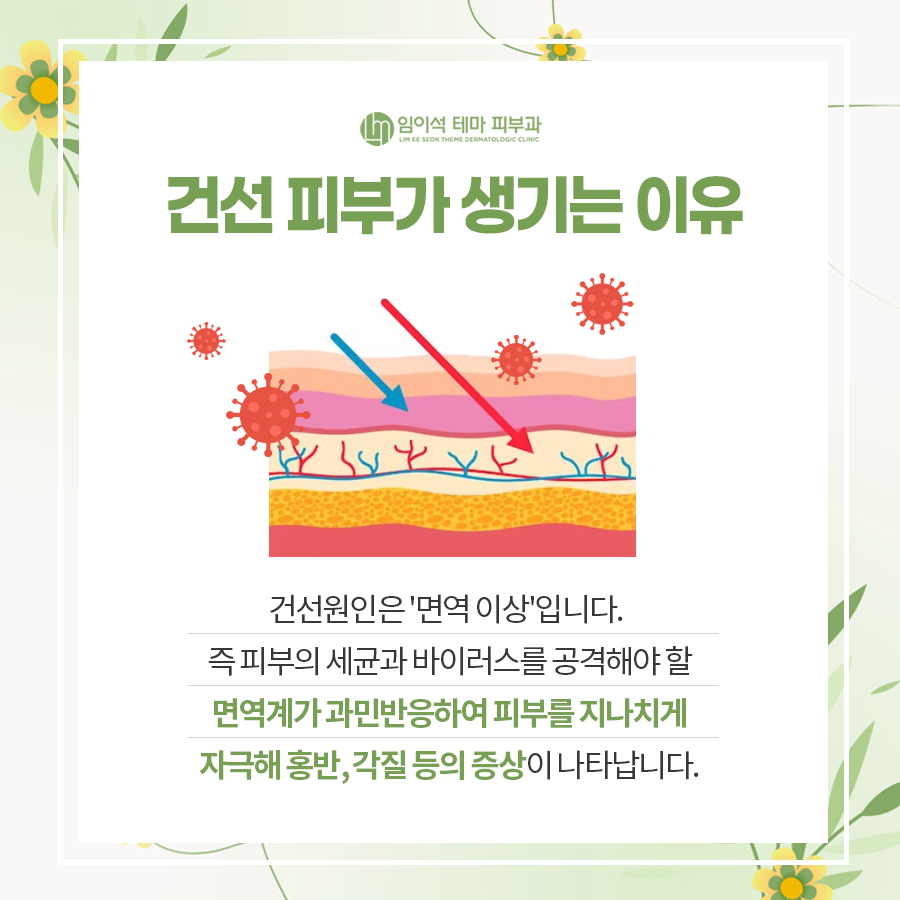
The cause of psoriasis is 'immune abnormality'.
This does not mean it is caused by weakened immunity,
but rather a disease in which there is an abnormality in immune function.
In other words, the immune system, which should attack skin bacteria and viruses,
overreacts and excessively stimulates the skin,
causing symptoms such as redness and scale.
Psoriasis often develops due to factors such as excessive mental stress,
skin trauma, overwork, obesity, and drinking.
In particular, as the end of the year approaches,
gatherings and drinking events increase,
and drinking can worsen psoriasis and become a cause of skin itching,
so caution is needed.
If skin psoriasis develops, you should be careful not to deliberately remove the scales.
This is because psoriatic skin tissue does not regenerate normally and is easily damaged,
so forcibly removing the scales may increase the risk of complications.
Can scalp psoriasis also develop?
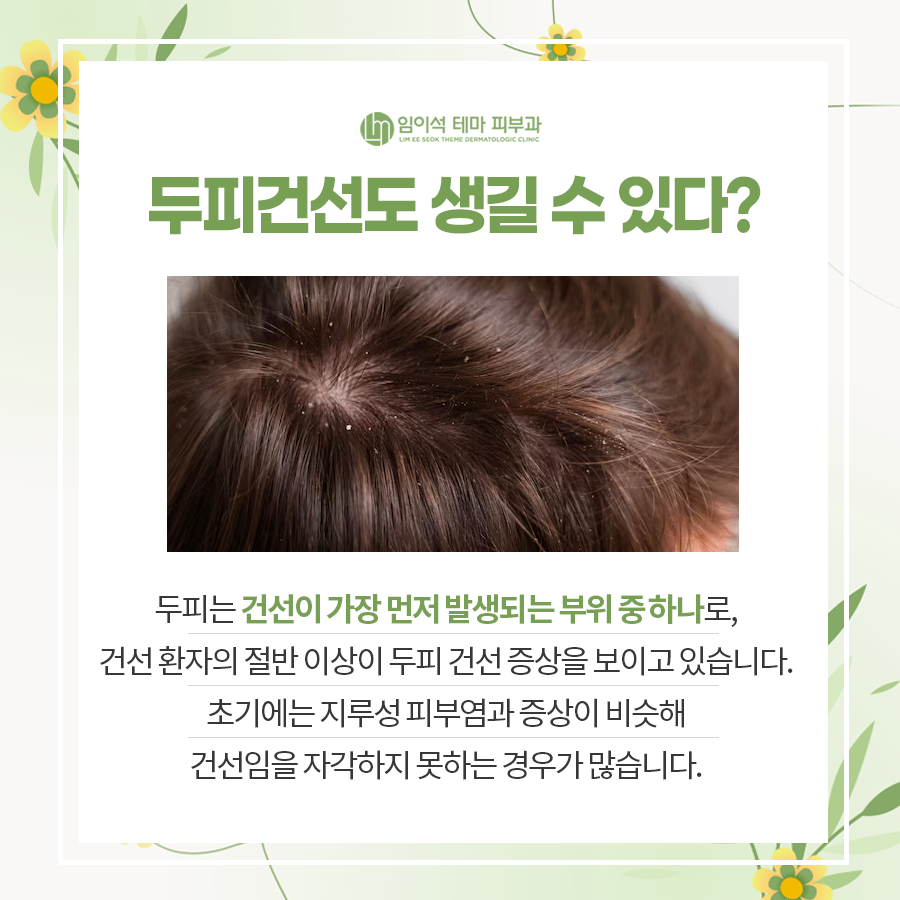
If psoriasis, a chronic inflammatory skin disease with erythematous lesions covered with scale and rashes that repeatedly flare up and improve,
develops on the scalp, it may go unnoticed and lead to hair loss.
The scalp is one of the first areas where psoriasis appears, and more than half of psoriasis patients show scalp psoriasis symptoms.
In the early stages, the symptoms are similar to seborrheic dermatitis, so if it occurs only on the scalp, many people do not realize it is psoriasis.
When scalp psoriasis is severe, it can look like dandruff, which can make it inconvenient to avoid dark-colored clothing.
In particular, if the symptoms of a dry scalp worsen, they can also lead to chronic hair loss, so caution is needed.
Hair falls out during the process of scratching the scalp due to itching or removing scales.
To avoid this and for scalp psoriasis treatment,
it is best to keep nails short, avoid touching the scalp as much as possible,
and maintain scalp cleanliness with gentle brushing.
It is also important to use shampoos that exclude irritating ingredients so as not to irritate the scalp as much as possible.
Laser treatment for skin psoriasis
-
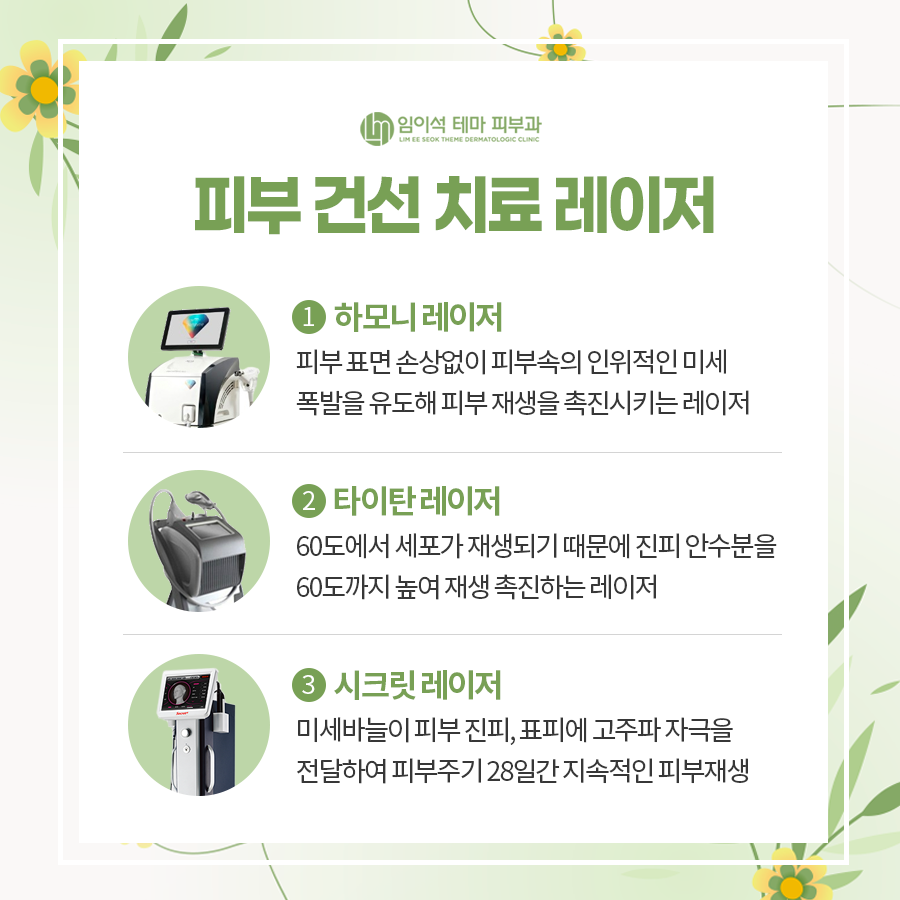
Harmony: a laser that promotes skin regeneration by inducing artificial micro-explosions inside the skin without damaging the skin surface
-
Titan: because human collagen cells regenerate at 60 degrees, a laser that raises the water inside the dermis to 60 degrees to promote regeneration
-
Secret: fine needles deliver radiofrequency stimulation to the dermis and epidermis, providing continuous skin regeneration over a 28-day skin cycle
Psoriasis treatment uses various skin lasers.
Representative examples include Harmony, Titan laser,
and Secret laser.
Harmony is a laser that induces collagen regeneration without damaging the skin surface,
thereby promoting fundamental skin regeneration.
It is effective for psoriasis as well as wrinkles, fine lines, and lifting,
and because it causes little pain, the procedure can be performed without anesthetic cream.
Titan laser uses the feature that human collagen cells regenerate at 60~70 degrees,
raising the water inside the dermis to 60 degrees to promote regeneration.
With energy reaching up to 3 mm,
it delivers energy to the dermal layer and provides excellent skin-improving effects.
Secret laser is a laser that delivers radiofrequency energy by directly inserting micro-scale fine needles into the skin.
By activating collagen and elastin regenerative cells,
it provides continuous skin regeneration effects over the 28-day skin cycle,
improving pores, acne, scars, and elasticity.
Medical skincare
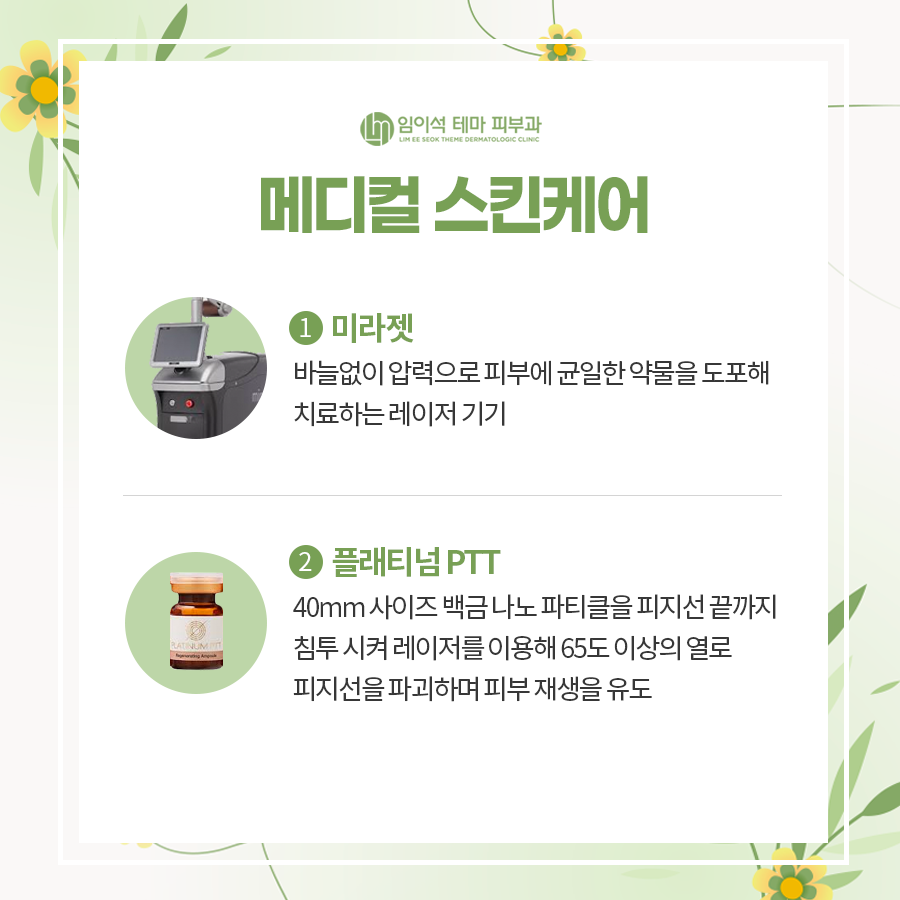
Using medical skincare together with laser treatment increases the treatment effect,
so we recommend combining them.
Representative medical skincare methods for psoriasis treatment include Mirajet and Platinum PTT.
Mirajet is a needle-free laser device that applies medication evenly to the skin using pressure for treatment.
After selecting a medication suited to the patient’s skin condition,
it applies it evenly and provides a booster effect for skin care.
Platinum PTT uses 140 mm platinum nanoparticles to penetrate to the end of the sebaceous glands,
and then uses laser heat above 65 degrees to destroy the sebaceous glands and induce skin regeneration.
In addition, improving lifestyle habits is important for psoriasis treatment.
It is good to use a humidifier or maintain appropriate indoor humidity with a wet towel.
In particular, when showering, washing with water that is too hot
or using too much body cleanser can remove more than necessary the skin’s natural moisturizing factors,
lipids in the stratum corneum, sebum, and more, which can make the skin even drier,
so caution is needed.
If you use moisturizer frequently and do not forcibly remove the scales,
leaving them to shed naturally, it may help make the skin healthier.
Imi Seok Thema Dermatology Clinic has long provided systematic treatment for skin problems and premium beauty care,
and based on extensive clinical experience, offers customized treatments for patients.
It also continuously adds or replaces premium laser equipment
in an effort to minimize side effects and increase effectiveness.
If you are considering treatment for psoriatic dermatitis, skin itching, or skin psoriasis,
visit us and solve your concerns through a consultation with a trustworthy doctor!
Imi Seok Thema Dermatology Clinic will always be with our patients.