
Chief Director Lee Jang-wook
A healthy and beautiful smile,
let’s protect it for a long time together.
This is Etoile Seoul Dental Clinic.
The saying that a smile is the first impression is something I truly believe.
Today, I’d like to talk about something that people who have had laminate veneers, or those considering them, should take a close look at at least once. It is the story of laminate veneer lifespan.
Because laminate veneers are a treatment that improves appearance by covering the front surface of the teeth with a thin porcelain material, a clear understanding of their lifespan and care methods is necessary to keep a beautiful smile for a long time.
If you read this article to the end, you will be able to gain practical information you can use right away in everyday life.
We take responsibility for your dental health.
"Exactly how long can it last?"

The lifespan of laminate veneers can vary greatly depending on a person’s oral habits, the type of material, the bonding condition, and how they are cared for afterward.
Laminate veneers are an aesthetic treatment in which the front surface of the tooth is covered with a thin porcelain piece about 0.3 to 0.7 mm thick. It may be easier to understand if you think of it as attaching a thin porcelain layer to the tooth surface, similar to artificial nails placed on a fingernail.
In general, when properly cared for, they may last an average of about 10 to 20 years. However, please remember that this is not simply a matter of time, but rather a possibility that varies depending on how you live and care for them. Major factors affecting lifespan include teeth grinding (nighttime bruxism), repeated consumption of hard or chewy foods, incorrect brushing methods, external impacts, and secondary caries (cavities) at the tooth bonding surface.

 What cases are they considered for?
Laminate veneers are mainly chosen when you want a positive change in the shape or color of your teeth. They may be used in cases such as naturally uneven tooth color, gaps between teeth, or teeth that are small or asymmetrical. One of their major advantages is that they can provide an aesthetic improvement while removing only a minimal amount of natural tooth structure.
Unlike crown treatment, which requires relatively extensive tooth reduction, laminate veneers are performed by lightly shaping only the front surface, allowing a significant amount of the tooth structure to be preserved. Thanks to the natural gloss of porcelain materials, results that harmonize with the surrounding teeth can be expected.
However, since suitability for treatment can vary depending on an individual’s oral condition, thorough diagnosis and consultation should be performed before treatment.

In the end, what determines lifespan is habit.
One of the factors affecting laminate veneer lifespan is your usual eating habits and whether you grind your teeth. Teeth grinding is a phenomenon in which strong pressure is repeatedly applied to the teeth during sleep without the person even noticing, and it is called parafunction.
Because it can damage all prosthetic restorations, including laminate veneers, wearing a night guard (nighttime mouthpiece) together may be helpful if teeth grinding is confirmed. If you enjoy hard foods or have a teeth-grinding habit, cumulative pressure may be applied to the laminate bonding area, creating tiny gaps.
Using your teeth to open bottle caps, biting your nails, or chewing ice are also habits best avoided.

Let’s look at specific care methods in daily life
For proper care, basic oral hygiene is the starting point.
First, it is recommended to brush gently along the line where the teeth and gums meet using a soft-bristled toothbrush.
If you rub too hard, microscopic scratches may form on the veneer surface, which can lead to staining or reduced gloss.
Second, we recommend making flossing a habit.
There are areas where a toothbrush cannot easily reach, such as the border between the laminate veneer and the natural tooth, and the spaces between teeth. Managing these areas with floss can help prevent secondary caries.
Third, after consuming foods or beverages with strong pigmentation, it is best to rinse your mouth with water if possible.
Coffee, red wine, curry, and similar items can cause staining on porcelain surfaces.

A healthy smile created through consistent checkups
Regular dental checkups are also important for protecting laminate veneer lifespan.
If you have a checkup about once every 6 months, you can periodically confirm the condition of the bonding area and the health of the surrounding gums. Even small changes can be identified early, which may help reduce unnecessary retreatment.
Oral hygiene management through scaling can also have a positive effect on keeping laminate veneers healthy. Please remember that care after treatment is just as important as the treatment itself.

 A beautiful smile is not made overnight
Knowing about laminate veneer lifespan in advance and reviewing small habits in daily life is, in the end, a practical way to keep your smile bright for a long time.
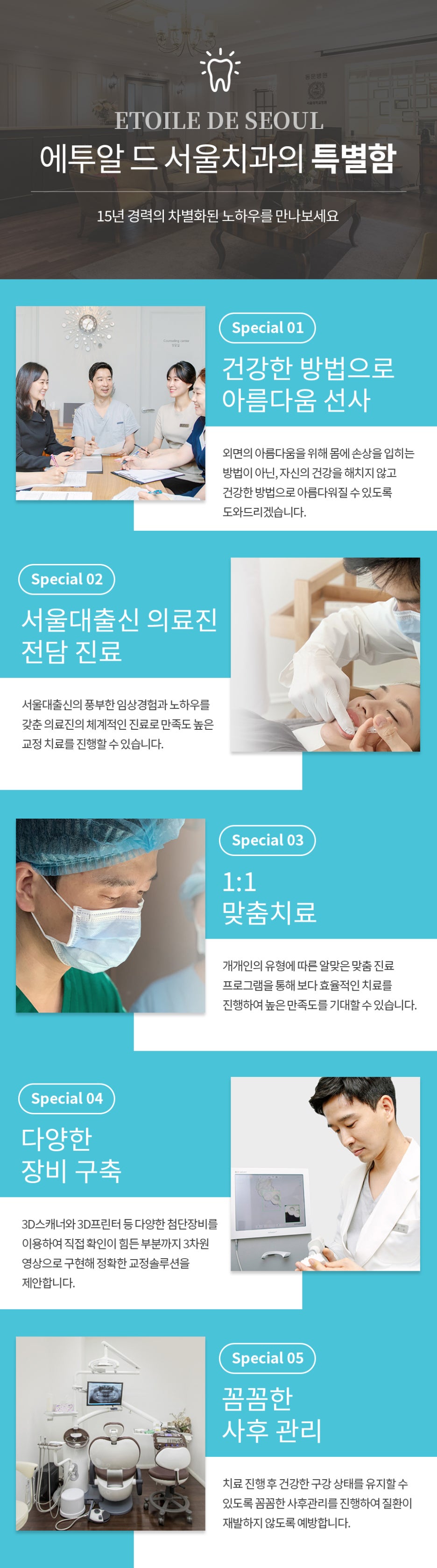
Dr. Lee Jang-wook of Etoile Seoul Dental Clinic graduated from the Seoul National University College of Dentistry and has built more than 20 years of clinical experience. His treatment philosophy goes beyond simply providing medical services; it is to work alongside each visitor so they can properly understand their own oral health and continue managing it consistently.
I hope today’s article was of some help to those who are thinking about laminate veneer care.

 Previous image
Next image
Previous image
Next image
▼ Chitterior YouTube ▼












 Previous image
Next image
Previous image
Next image









Previous image
Next image