
I will give you a bright and beautiful smile.
We often meet people who have been concerned about the color or shape of their teeth for a long time and finally gather the courage to come in for a consultation. Among the questions we have been receiving a lot lately, one stands out.
“Can you really get laminate veneers without filing down the teeth?”
No-prep laminate veneers, meaning veneers placed without removing tooth structure, are possible, but they are not something that can be applied the same way to everyone. Today, I’ll explain this calmly with dental evidence.
✨ Watch the Cheterior YouTube video ✨
(Click)
Interested in veneers?
❗Click quickly❗
Reasons teeth change in color and shape,
let’s look at the causes first.
The concerns of people considering veneers usually fall into two broad categories.
One is changes in tooth color, and the other is dissatisfaction with shape or size.
Tooth discoloration is largely divided into extrinsic and intrinsic types.
Long-term consumption of pigmented foods and drinks such as coffee, tea, and red wine, or smoking, can cause extrinsic discoloration by depositing pigments on the enamel surface.
On the other hand, taking tetracycline antibiotics, excessive fluoride intake, or congenital enamel hypoplasia can create intrinsic discoloration, where the color changes from within the tooth.

Because these two types have different causes and require different approaches, it is important to first identify which type of discoloration is present.
For shape-related concerns, commonly observed cases in the clinic include naturally small or short teeth, gaps between the front teeth (midline diastema), or shape changes caused by wear or fracture.
Even when there is no major functional problem, if you feel discomfort for aesthetic reasons, veneers can be one option for refining appearance while preserving the natural teeth as much as possible.
 How the restoration adheres to the tooth surface
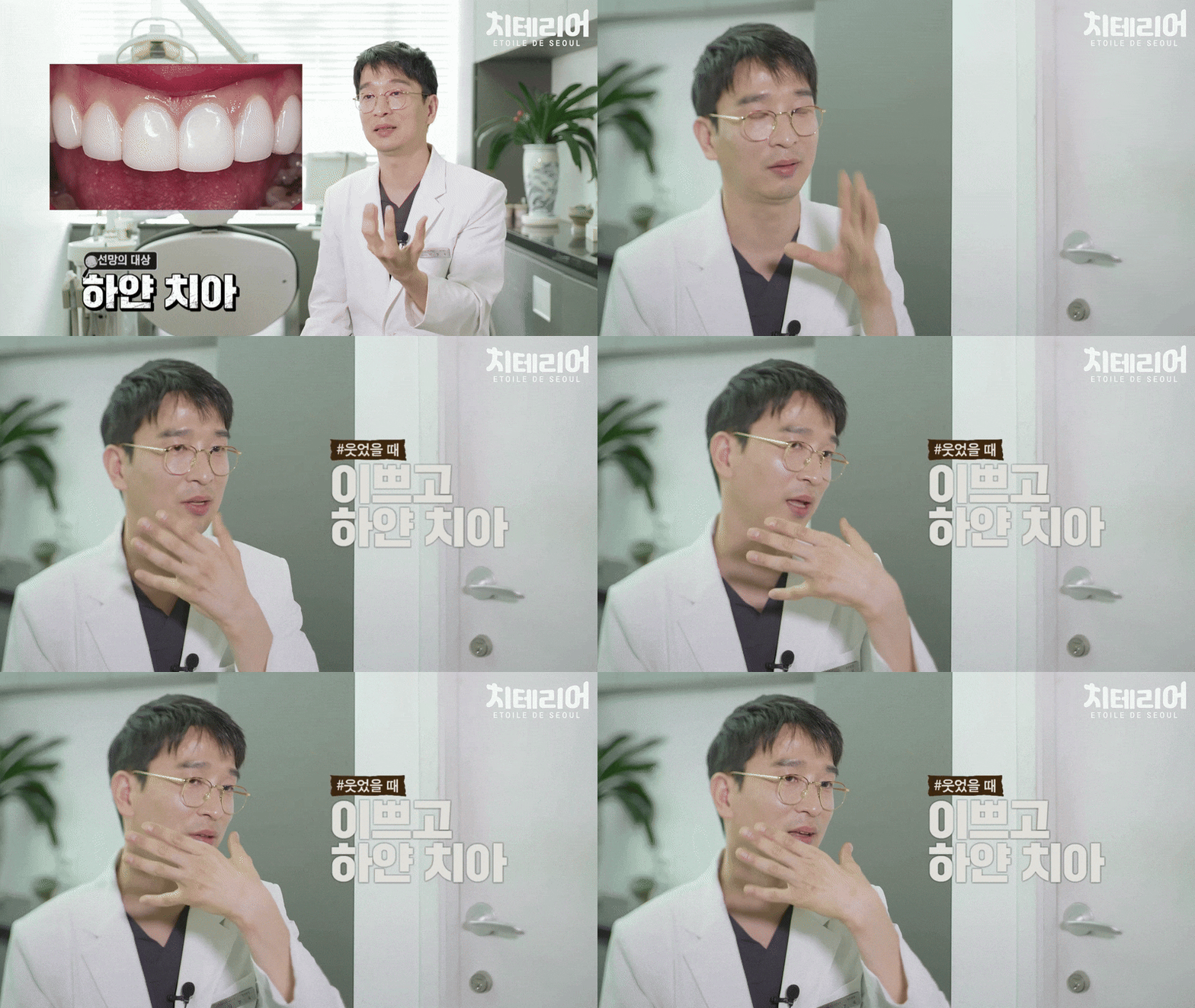
Veneers are thin porcelain shells bonded to the front surface of the teeth.
How the restoration adheres to the tooth surface
Veneers are thin porcelain shells bonded to the front surface of the teeth.
No-prep laminate veneers, as the name suggests, are a method of attaching the restoration without removing tooth structure, or only by minimally smoothing the surface.
In conventional veneers, the front enamel layer is reduced by about 0.3 to 0.7 mm to match the thickness of the restoration before bonding. In the no-prep method, this step is omitted or greatly reduced.
This is possible thanks to advances in porcelain material technology.
Because they can now be made much thinner than before, conditions have been established that allow sufficient adhesion to the tooth surface even without reduction.
However, because enough enamel must remain on the tooth surface to maintain bonding strength, suitability depends on the condition of the teeth.
 Not applicable to everyone; suitability must be checked first
Cases in which no-prep laminate veneers are appropriate are relatively limited.
These include situations where the original tooth size is smaller than average, there are spaces between teeth, or the overall tooth position is slightly inward so that adding thickness does not interfere with the bite.
Not applicable to everyone; suitability must be checked first
Cases in which no-prep laminate veneers are appropriate are relatively limited.
These include situations where the original tooth size is smaller than average, there are spaces between teeth, or the overall tooth position is slightly inward so that adding thickness does not interfere with the bite.
Conversely, if the teeth are already large or protruded, or if the bite is deep or the posterior teeth are under excessive load, adding restorations without reduction may instead create bite imbalance.
In such cases, some degree of reduction is unavoidable, and that may actually be the better choice for the teeth.
One point I want to emphasize is this.
That reduction itself is not bad.
In the clinic, I work with the principle of “preserve the teeth, but perform the necessary treatment accurately.”
As important as preserving the teeth is, it is also important not to avoid reduction excessively and instead make a judgment that considers both bite balance and the long-term health of the teeth.
 Daily care that determines the lifespan of the restoration
All laminate restorations, including no-prep laminate veneers, can vary greatly in lifespan depending on how they are cared for.
Daily care that determines the lifespan of the restoration
All laminate restorations, including no-prep laminate veneers, can vary greatly in lifespan depending on how they are cared for.
Because porcelain can fracture from strong impact, it is best to avoid the habit of biting directly into hard or chewy foods with the front teeth.
If you have teeth grinding or clenching (bruxism), continuous stress may be placed on the restoration, so please let us know beforehand so that we can plan an appropriate approach together.
Brushing should focus on carefully cleaning the border area between the tooth and the restoration.
This is because bacterial plaque buildup at the margin can lead to secondary cavities or gum inflammation.
We recommend using dental floss and interdental brushes together, and having regular checkups every six months to consistently monitor the bonding condition and gum health.
 Protecting natural teeth is the starting point of treatment
When deciding on treatment, I first think about how much natural tooth structure can be preserved.
That is because once a tooth is reduced, it cannot be restored.
For some people, no-prep laminate veneers are a good choice, while for others, a more stable result may be expected with some reduction.
This decision can only be made after comprehensively reviewing the bite condition, tooth position, enamel thickness, and aesthetic goals.
Rather than trying to provide every answer in a single blog post, it is important to confirm the direction that suits each person’s dental condition through an oral examination.

 Previous image
Next image
Previous image
Next image













 Previous image
Next image
Previous image
Next image








 Previous image
Next image
Previous image
Next image