

Have you ever looked in the mirror and thought that your face seems more sagging than it did a few years ago?
This is a change that naturally comes with age,
but the heavy, sagging feeling in the face when you wake up in the morning affects daily life more than you might expect.
A drooping line that makeup cannot fully cover, and an expression that looks tired, are not just appearance-related concerns; they can also affect confidence.
Today, we’d like to talk about the causes of a face that looks heavy and sagging overall, and ways to improve it.

Why does the face look sagging and heavy?
Facial sagging is not simply a problem of the skin’s surface, but occurs due to changes in the supporting structures beneath it. As we age, collagen and elastin in the skin decrease, subcutaneous fat is redistributed, and the facial muscles and fascia (SMAS) loosen.
These changes, under the influence of gravity, cause the entire face to droop downward, and they are especially noticeable below the cheekbones and along the jawline. In addition, loss of volume can make the face look flatter and blur the contours, creating an overall tired impression.
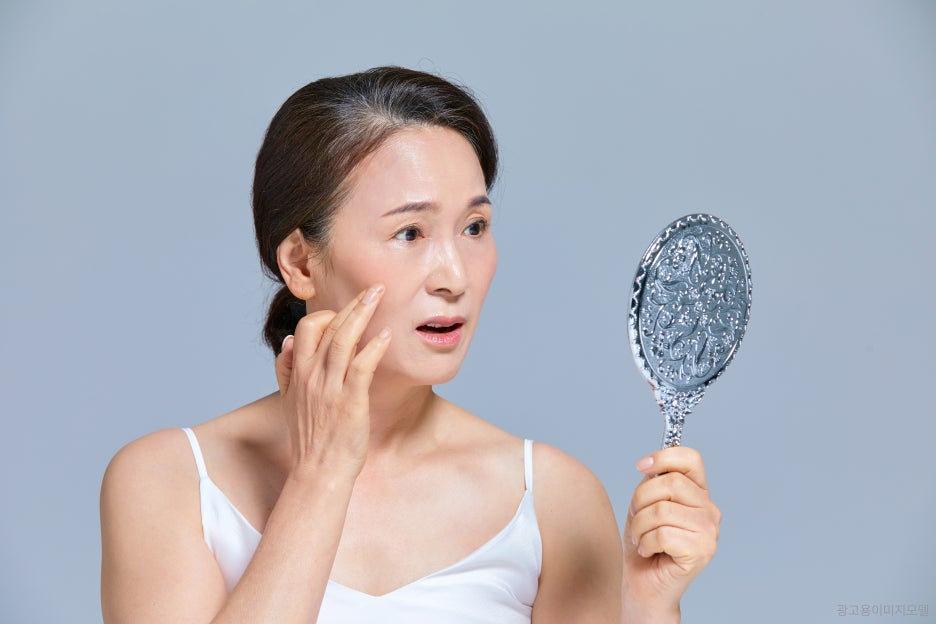
Facial sagging,
what effects does it have?
- Impact on impression and psychology
Facial sagging has a major effect on overall appearance. A firm, lively face is seen as a symbol of vitality and youth, while a sagging face often gives off a tired or depressed impression.
This goes beyond a simple aesthetic issue and can also affect communication with others and self-perception. According to research, facial expression and contour are among the important factors others use to judge us; a sagging face can make you look older than you actually are and give the impression of lacking vitality.
Facial sagging can also affect everyday activities. Many people feel that a heavy, sagging face requires more time and effort when applying makeup, and it is also common to avoid certain angles when taking photos.
In addition, some people feel that sagging around the eyes or cheeks limits their vision or causes discomfort. Furthermore, such changes can affect one’s sense of identity, creating a gap between the reflection in the mirror and one’s internal self-image.

What kinds of care can be done in daily life?
There are several ways in daily life that may help ease facial sagging. Proper moisturizing and sun protection are basic ways to delay skin aging, and face yoga or facial massage may help promote blood circulation and improve muscle tone.
In addition, drinking enough water, maintaining a balanced diet, and exercising moderately have a positive effect on overall skin health. Sleep posture is also important; the habit of sleeping on your side can place constant pressure on one side of the face and worsen asymmetry or wrinkles, so it is better to sleep on your back if possible.
 Lifting procedure, Titanium Lifting
How can facial sagging
be improved?
- Strengthening support with Titanium Lifting
If facial sagging that is difficult to improve with daily care is a concern, you may consider Titanium Lifting. This procedure works by using specially designed threads to lift and support sagging facial tissue.
Similar to general thread lifting, Titanium Lifting uses threads made of PCL (Polycaprolactone) with a titanium coating added to increase strength and durability. These threads are inserted into the layer beneath the skin to physically lift sagging tissue while also promoting collagen production, helping improve skin firmness over the long term.
Titanium Lifting is especially effective for the midface area (below the cheekbones), jawline, and neck, where sagging caused by gravity is more pronounced. The procedure is performed under local anesthesia and involves inserting threads through fine needles. The lifting effect can be seen immediately after the procedure, and as time passes, collagen regeneration leads to a more natural result.
- A customized approach for natural results
The biggest feature of Titanium Lifting is that it allows a customized approach based on each person’s facial structure and degree of sagging. Depending on which areas of the face are more sagging and in which direction lifting is needed, the number of threads, insertion points, and direction can be adjusted to achieve natural-looking results. In addition, if volume loss is also present and cannot be sufficiently improved with threads alone, a combined approach with other procedures such as fillers is possible.
After the procedure, temporary swelling, bruising, or pain may occur, but most people recover within 1–2 weeks. The lifting effect varies by person but typically lasts 1–2 years on average, and the collagen-stimulating effect may also help improve skin texture. Of course, even after the procedure, using sun protection and proper skin care can help maintain the effect for a longer period.
Facial sagging is a natural part of the aging process, but if it causes discomfort or lowers your confidence, it may be worth considering active care. Titanium Lifting is one method that can provide a natural lifting effect without surgery, and may help improve facial sagging caused by gravity.
Of course, results from all procedures may vary depending on the individual’s condition and expectations, so it is important to find the method that is right for you through a thorough consultation.



Seocho-dong Titanium Lifting: Restoring Natural Firmness from a Heavy, Sagging Feeling in the Face
Seocho-dong Titanium Lifting: Restoring Natural Firmness from a Heavy, Sagging Feeling in the Face