

"Do you find yourself avoiding side-profile photos when taking pictures?"
It may not have bothered you much from the front, but have you ever looked at a side-profile photo and thought, "Huh? Was my jawline always like that?" and been surprised?
The area under the chin can look blurred and sagging, making the overall facial contour appear less defined.
Because we usually check our faces mostly from the front in the mirror, it is easy to overlook changes in the side profile.
But when you see it in a photo, you may be startled to realize your jawline is not as distinct as you expected.
These changes do not happen overnight; they progress little by little over several years,
so there are many cases where your side profile has changed without you even noticing.
Did you know that more and more people are managing these concerns with non-surgical methods such as Gangnam Station Ulthera Prime?

Why does the bulldog jowl phenomenon occur?
There are several reasons why the jawline can look collapsed from the side. The loosening of skin under the chin, which makes the boundary between the neck and jaw less clear, is commonly called bulldog jowls, and this change does not have just one cause.
As we age, reduced skin elasticity has an effect, but weakening of the fascia layer that supports the face also causes it to sag downward, and the redistribution of fat that creates more volume under the chin plays a major role as well. Just as a building’s entire structure can collapse when its pillars weaken, if the supporting structure beneath the skin loosens, the visible contours on the outside also become blurred.
When we are young, the fascia firmly supports the face and maintains a clear jawline, but over time this layer stretches and sags downward, naturally changing the side profile. In particular, if you spend a lot of time looking at your smartphone, the habit of tilting your head down can place more pressure around the chin and make the change happen faster.

When the side profile changes,
your impression changes too
- Changes in overall facial proportions
It may not be obvious from the front, but from the side, a blurred jawline can make the face look longer or duller. In particular, when the boundary between the neck and jaw becomes unclear, it creates a stronger impression of looking older. This is not simply the same as gaining weight. Because it is a change caused by weakened structural support in the skin itself, it is not something that can easily be improved by weight management alone.
Many people begin to lose confidence as they keep worrying about camera angles every time they take a photo and start avoiding situations where their side profile is shown. This concern can grow even more these days, when so many people post photos on social media. You may find yourself looking for only front-facing photos when choosing a profile picture, and if you notice your side profile in a naturally taken photo, you may have felt embarrassed.
At first, you can try self-care
If it is an early stage, improving daily habits may help to some extent. Reducing the habit of keeping your head down and doing stretches that frequently move the muscles around the chin can be beneficial. Also, if swelling is a major issue, reducing salty foods and drinking enough water can help keep the jawline looking more defined. However, if the fascia has already stretched, there may be limits to what this kind of care can do.
So what kind of care can you consider?
- A method that restores elasticity starting from deep within the skin
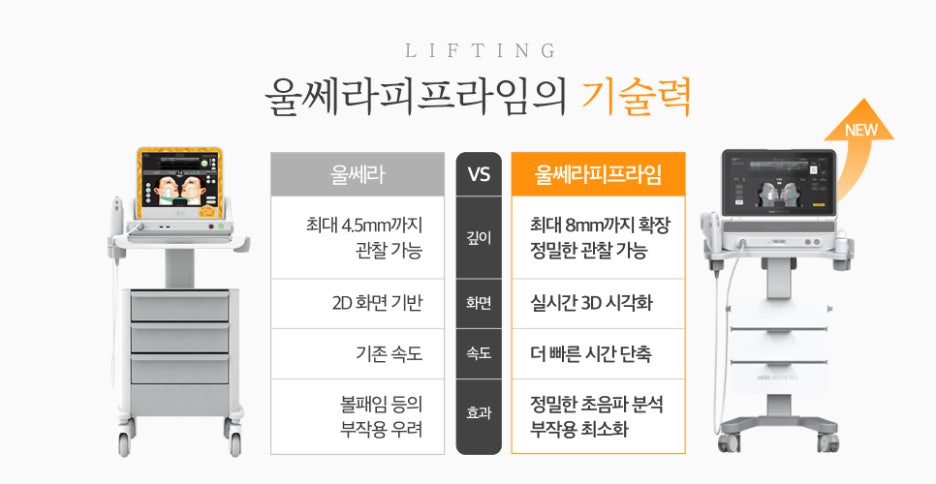
If the fundamental cause of a collapsing jawline is loosening of the fascia layer, then rather than only treating the surface, an approach that restores support from within is needed. Ulthera Prime works by using high-intensity focused ultrasound to deliver energy to the fascia layer without damaging the skin surface. By using 1.5 mm, 3.0 mm, and 4.5 mm cartridges, it can manage the shallow dermis through the deep fascia layer step by step.
The ultrasound energy creates thermal coagulation points inside the skin and promotes collagen regeneration. Through this process, stretched tissue contracts, and you may expect the jawline to look more defined.
It can be seen as a method that strengthens the supporting structure inside the skin, like tightening a loose rubber band again. The Gangnam Station Ulthera Prime procedure is performed while checking the skin layers with real-time ultrasound imaging, so it also has the advantage of allowing care at the appropriate depth according to each person’s skin thickness and condition.
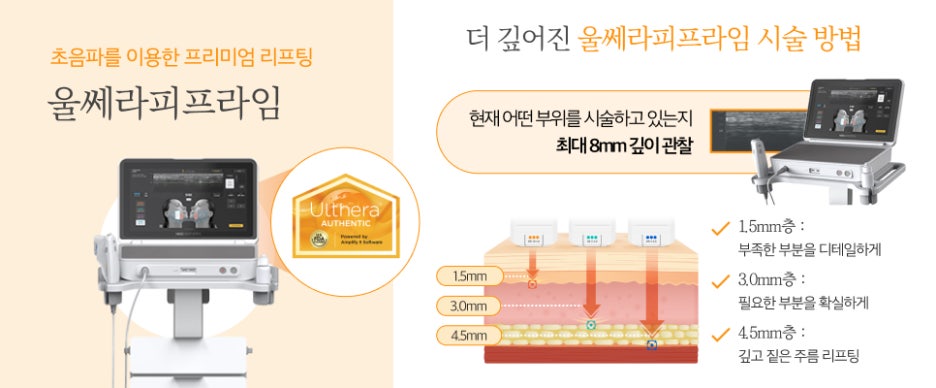 Ulthera Prime, a premium lifting treatment using ultrasound
- If you want a natural change
The Gangnam Station Ulthera Prime procedure is suitable for those who want a natural improvement rather than a sudden change. It does not produce a dramatic effect immediately after the procedure, but as time passes, collagen regenerates and elasticity recovers, allowing you to experience a gradual refinement of the jawline.
Typically, the best result can be seen around three months later, and it tends to last about six months to a year after that. However, results can vary depending on individual skin condition, age, and lifestyle habits, so it is important to set realistic expectations through sufficient consultation.
Because it is a non-invasive method, there is no separate recovery period, and you can return to daily life immediately after the procedure. However, for about a week afterward, it is best to avoid heat-intensive environments such as saunas and drinking alcohol, and to postpone any irritating treatments.
Concerns about the side profile are shared by more people than you might think. Since this is connected not only to appearance but also to confidence, remember that it is important to understand your condition accurately and find the right direction for care.


Gangnam Station Ulthera Prime Side Profile Jawline Refinement, 'This' Makes It Natural at Toxnfill Gangnam Main Branch
Gangnam Station Ulthera Prime Side Profile Jawline Refinement, 'This' Makes It Natural at Toxnfill Gangnam Main Branch









 Previous image
Next image
Previous image
Next image