
Do you know that the concerns that appear on the face each have different depths?
Have you ever had this thought while looking in the mirror?
"Why do the fine lines around my eyes look so shallow, while my cheeks feel saggy much deeper down?"
In fact, this difference is not accidental. The skin is made up of multiple layers,
and the changes and concerns experienced in each layer are different.
The fine lines in thin areas such as around the eyes mainly appear in shallow layers,
while the overall sagging of the cheeks or jawline is related to much deeper layers.
So how should you manage these concerns at different depths?
This is where a technology that delivers energy precisely to only the necessary depth becomes important.

Concerns differ by skin layer,
Should the energy be different too?
Our skin is composed of several layers, starting from the surface, down to the dermis and then the fascia layer beneath it. It is like a layered cake. Each layer plays a different role, and the changes it experiences with age are also slightly different. In the shallow layers closer to the surface, issues such as fine lines and skin texture mainly appear, while in deeper layers, reduced elasticity and changes in facial contours begin to occur.
So even on the same face, the care needed can differ by area and by depth. There is no need to send energy all the way to deeper layers to improve the thin lines around the eyes, and conversely, if you want to manage deeper sagging in the cheeks, simply touching the surface will not be enough.

Precise depth settings,
Why are they so important?
- What happens if energy reaches unnecessary areas
One of the most important parts of delivering energy in skin care procedures is 'accurate targeting.' If energy is delivered to depths that are not needed, the effect can become dispersed, and in some cases, unwanted changes may appear. It is a bit like needing to hit the center of a target, but the arrows scatter everywhere. If the energy does not concentrate where it is needed, it may be difficult to see the improvement you expected.
- What changes when energy is focused only on the necessary depth
On the other hand, if energy is delivered only to the exact depth needed, much more efficient results can be expected. For concerns in shallow layers, you approach them at a shallow depth; for changes in deeper layers, you use the corresponding depth. This helps minimize unnecessary stimulation while still producing enough effect in the intended area. In addition, the recovery process after the procedure may proceed more naturally.

How does Ulthera Prime
adjust the depth?
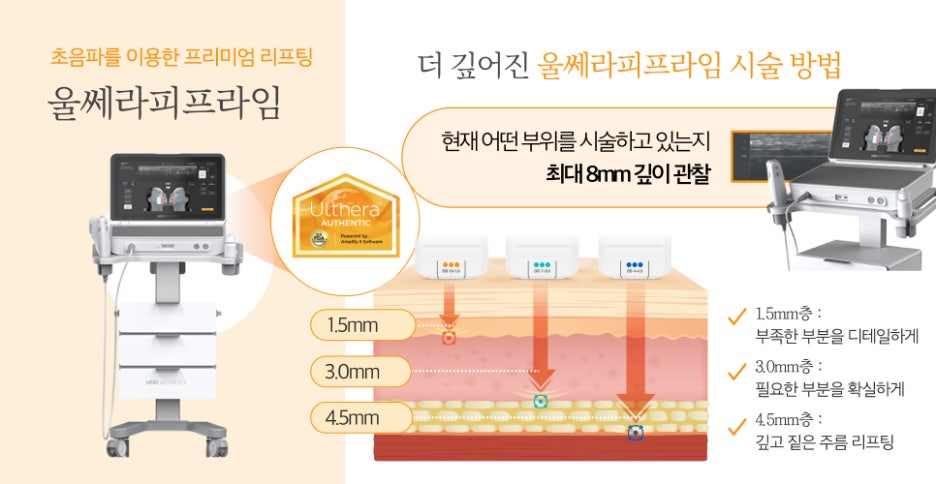
Ulthera Prime is a procedure that uses HIFU (High-Intensity Focused Ultrasound) technology, and the important point here is that it can selectively target various depths. By using cartridges of different depths—2.0 mm, 3.0 mm, and 4.5 mm—it is possible to set the depth according to each area and concern.
2.0 mm reaches the relatively shallow dermis, 3.0 mm reaches the mid-dermis, and 4.5 mm reaches deeper into the fascia layer, inducing the changes needed in each layer.
What is especially interesting is that the procedure can be performed while checking the skin interior in real time. With observation possible up to a depth of 8 mm, it has become possible to understand the skin structure in far more detail than before.
This helps deliver energy to the exact location while checking the internal structure of the skin, like finding your way while looking at a map. Thanks to the improved ultrasound imaging system, noise has been reduced and the skin layers can be seen more clearly, allowing for a more even and consistent result.
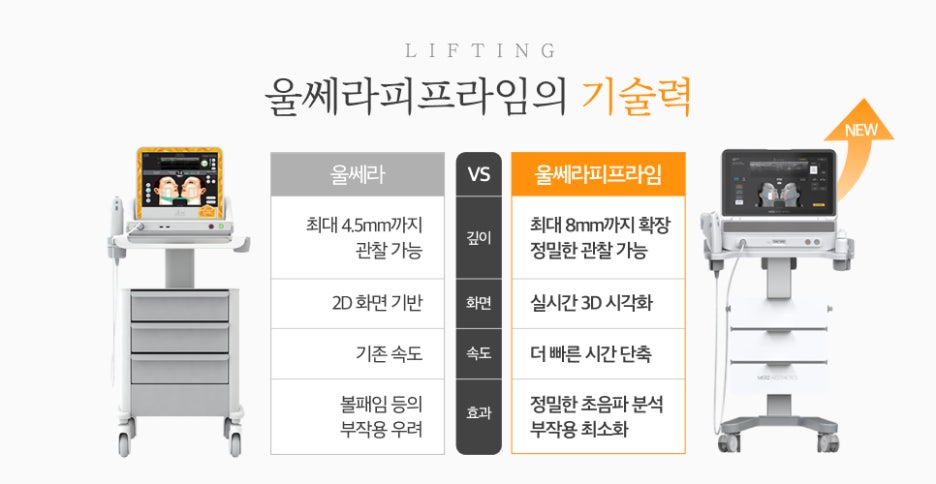
Then what concerns
is it suitable for?
- If you are concerned about changes in shallow layers
Fine lines around the eyes or forehead, or concerns such as skin texture feeling rough overall, are mainly related to the shallow layers of the skin. In such cases, an approach at a relatively shallow depth such as 2.0 mm or 3.0 mm may help.
As the focused ultrasound energy is delivered to the shallow dermis, it helps support collagen regeneration in the area, and over time, the skin surface may appear smoother. Because energy is delivered precisely only to the necessary depth, even thin and delicate areas can be managed relatively safely.
- If you are concerned about changes in the middle to deeper layers
On the other hand, concerns such as overall loss of elasticity in the cheeks or jawline, or a blurred facial contour, are related to deeper layers. In such cases, using the 4.5 mm depth and approaching the fascia layer may be effective.
When energy is delivered to deeper layers, thermal coagulation points are created there, and in this process, the loosened tissue may become tighter, helping to refine the overall contour. Of course, the necessary depth and approach may vary depending on each person's skin condition and the degree of concern, so it is important to establish a plan that suits you through sufficient consultation.
What you can expect
from precise targeting
In skin care, 'precision' is not merely a technical issue; it is directly linked to the quality of the result. Delivering energy only to the necessary depth means that you can avoid touching unnecessary areas while still inducing enough change in the target layer.
A method like Ulthera Prime makes this kind of precise approach possible, and thanks to enhanced ultrasound imaging and various depth options, it allows for a more careful plan tailored to each person's concerns.
However, it is important to remember that any procedure may vary in suitability depending on an individual's skin condition, age, lifestyle habits, and the degree of change they expect. After the procedure, following precautions such as washing with lukewarm water and avoiding irritating activities can also affect the result. Above all, the first step is to accurately understand what depth the changes appearing on your face are related to, and what care method is appropriate for them.




Seocho-dong Ulthera Prime The Secret of Energy Delivery That Changes by Skin Layer
Seocho-dong Ulthera Prime The Secret of Energy Delivery That Changes by Skin Layer









 Previous image
Next image
Previous image
Next image