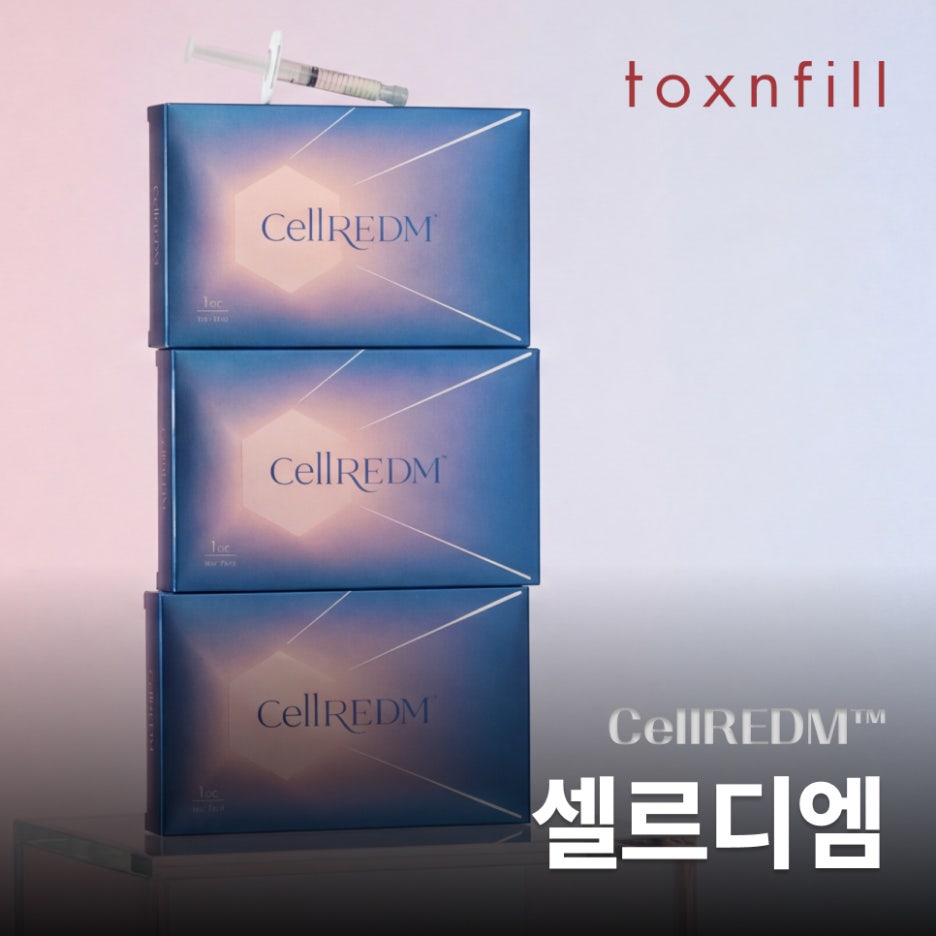
Many people wonder whether additional treatment is necessary after receiving CellreDM once.
It can be difficult to decide without clear criteria for why further treatment is needed even when you have noticed an effect, or how many sessions are enough.
CellreDM involves directly injecting allogeneic dermal ECM components into the dermal layer, so time is needed for the injected components to settle and affect the skin’s structure.
It is true that changes begin after a single treatment, but repeated sessions are needed for those changes to stabilize and build over time.
The appropriate interval and total number of sessions vary depending on the condition of your skin.
Understanding the schedule allows you to create a more specific treatment plan.

ECM-Based Skin Booster, CellreDM
Why One Session Is Not Structurally Sufficient
The weakening of the dermal ECM structure does not happen all at once. Since collagen, elastin, and GAGs gradually decrease over a long period of time, causing the skin’s framework to break down, restoring this structure also cannot be completed with a single injection.
When CellreDM’s allogeneic dermal ECM components are injected into the dermal layer, the effect does not appear immediately. Instead, the components begin to affect the skin’s structure as they settle over several weeks. This is also why noticeable changes begin 2–4 weeks after the first treatment: the process requires time.
The changes created by one session are still relatively shallow. Just as the skin’s structure builds layer by layer, the ECM components continue to settle more evenly and densely in the dermal layer with each successive session. When the next stimulus is added before the previously injected components have completely broken down, the ECM environment can be maintained more stably. This cumulative structure is why elasticity and density may become more noticeable as sessions accumulate.
Skin aging continues even between treatments. A regular schedule is needed to maintain a balance between the rate at which ECM components break down and the rate at which they are supplemented through injections. If the interval becomes too long, the environment created by the previous treatment may deteriorate before a new stimulus is added, reducing efficiency. Following the recommended schedule is itself part of the overall effect.
How CellreDM Builds Up in the Dermal Layer and the Recommended Schedule
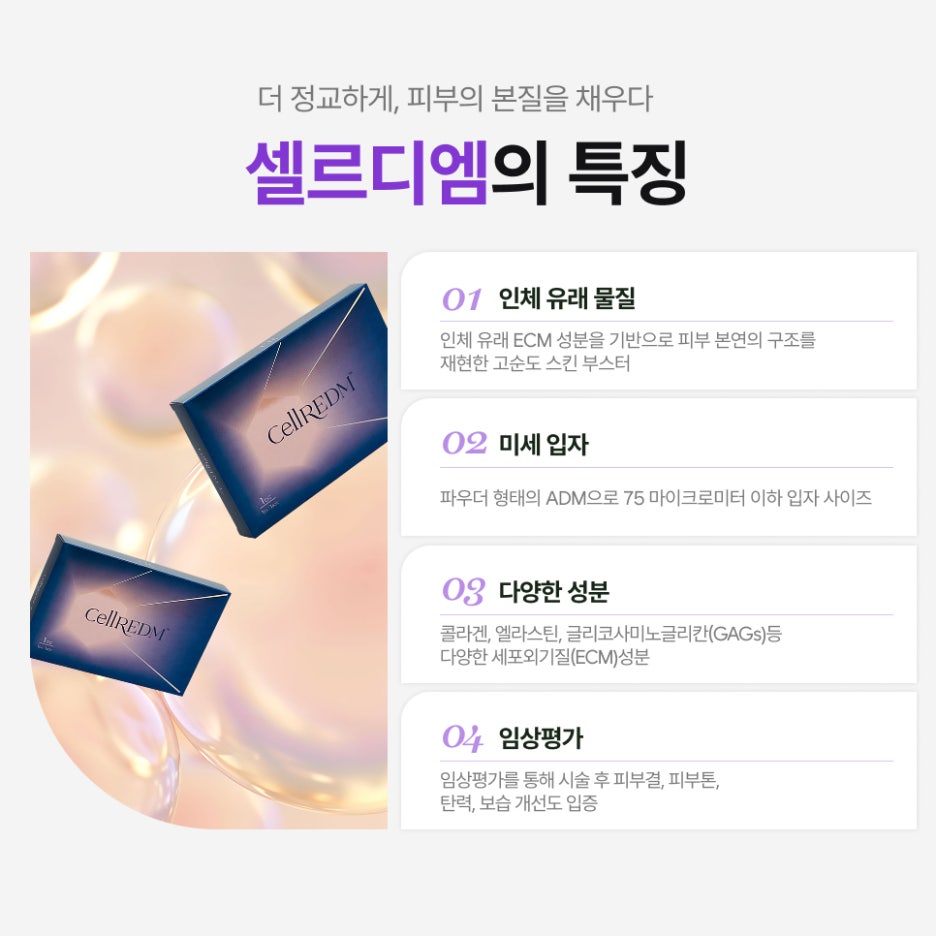
CellreDM contains three ECM components—collagen, elastin, and GAGs—which are processed into ultrafine particles no larger than 75 micrometers and evenly dispersed throughout the dermal layer. The more evenly the particles spread, the wider the area in which the ECM structure can be supported, and with repeated sessions, the changes accumulate as this area is filled more evenly.
Because it is based on human-derived allogeneic dermal components, immune or rejection reactions are relatively uncommon, so repeated treatments at set intervals tend to place relatively less strain on the body.
The CellreDM treatment schedule and session guidelines are as follows.
| Category | Details |
|---|
| Recommended interval | Every 4 weeks, with at least 3 consecutive sessions |
| Duration of effect | Approximately 6 months to 1 year after completing 3 sessions |
| Individual variation | The duration of the effect varies depending on skin condition |
The reason treatment is recommended for at least 3 consecutive sessions at 4-week intervals is to add the next stimulus while the components injected during the previous session are still active. When this interval is followed, the ECM environments overlap, allowing the dermal structure to be filled more stably.
After completing 3 sessions, the effect is generally known to last approximately 6 months to 1 year. After that, the decision on whether to receive maintenance treatment is made according to the condition of the skin.

Changes in Skin Condition as Sessions Accumulate
After one treatment, many people first notice a slight change in skin density or a temporary change in hydration. After 2–3 sessions, the dermal ECM structure gradually becomes replenished, and the accumulated changes may include improved elasticity and a more refined skin texture as the appearance of pores becomes tighter.
By the time 3 sessions are complete, people tend to notice most clearly that their overall skin density and radiance have changed. Many also experience everyday changes at this point, such as less dryness and better makeup adherence.
If care is continued during the 6-month to 1-year maintenance period, the effect may continue more consistently. Light cleansing and makeup are possible from the day after treatment, while it is advisable to avoid saunas and strenuous exercise for several days after the procedure. Consistently using sunscreen and moisturizer can help maintain a stable environment for recovery in the dermal layer.

CellreDM’s effects are not completed in a single session; they develop through repeated treatments. Even if you are satisfied with the change after the first session, a regular approach at 4-week intervals is needed for the change to last longer and progress further. Since the number of treatments and maintenance interval vary depending on your skin condition, consult with a professional to create a plan suited to you. The changes may come more slowly than expected, but they become clear over time.


Toxnfill Gangnam Main Branch
If You Are Curious About Gangnam Station CellreDM
| Address | 10th and 11th floors, Daedong Building, 415 Gangnam-daero, Seocho-gu, Seoul |
|---|
| Phone | 02-537-4842 |
We pursue healthy beauty based on the principles of authentic products, accurate quantities, and sincere care.

Gangnam Station CellreDM Treatment Schedule: Why Repeated Sessions Matter More Than a Single Session
Gangnam Station CellreDM Treatment Schedule: Why Repeated Sessions Matter More Than a Single Session










Previous image
Next image