

The nose, located at the center of the face, plays an important role in the overall proportions, harmony, and three-dimensional balance of the face. For example, if the nasal tip is turned upward, the face may look brighter and more lively, while a lower nasal tip may give a calmer or more refined impression. In rhinoplasty, the most important points to consider are the height of the nasal bridge and the height of the nasal tip. The bridge is usually adjusted with silicone, but the nasal tip, which is raised in line with it, can be supported and adjusted with various materials. Today, I will explain the materials used for the nasal tip.
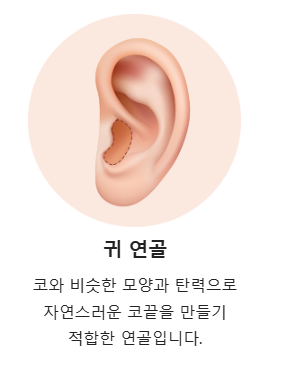
- Ear cartilage
This cartilage is suitable for creating a natural nasal tip because its shape and elasticity are similar to the nose. It is often used as an additional material when there is nasal asymmetry or when the existing nasal cartilage (septal cartilage) is insufficient or weak. Because it is elastic and flexible, it is easy to shape into various forms to create the desired appearance. To harvest it, a small incision is made in the skin behind the ear to collect the ear cartilage. When ear cartilage is harvested, small sutures are placed on both the ear and nose, and a compression band or protective support may be worn for a certain period to protect the ear.

- Septal cartilage
This is the cartilage inside the nose used to support the columella and control the angle of the nasal tip. It supports the central structure of the nose and plays an important role in maintaining its shape. It is harvested from inside the nose, so it can be obtained without making incisions in areas other than the nose. It is also firmer than ear cartilage, making it useful for supporting a firm, well-defined nasal tip, and it is one of the most convenient materials used in primary surgery. However, in Asians, it is generally
smaller than in Westerners, and since the septum forms the support of the nose, it must be harvested while leaving a certain width behind to maintain the normal support of the nose. For this reason, additional cartilage may need to be used together.
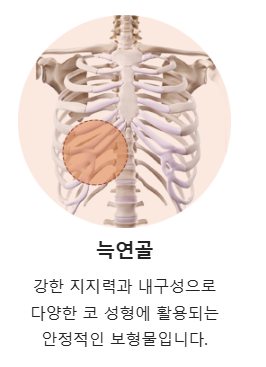
- Autologous rib cartilage
This is a stable cartilage used in various rhinoplasty procedures because of its strong support and durability. Compared with other cartilage types, it has a stronger structure, so its shape is less likely to change over time, allowing the nose shape to be maintained for longer. In particular, when septal cartilage or ear cartilage is not enough, autologous rib cartilage is used as an alternative. It is harvested from the cartilage located at the end of the ribs in the chest area, but because the harvestable area is limited, it is used more often in revision surgery than in primary surgery. To obtain enough cartilage, it may be necessary to take cartilage from several ribs in the chest area. Also, after rib harvest, a chest incision is required, so scar management is essential.
- Donor rib cartilage
This is a material made by harvesting and processing another person's rib cartilage so that it does not cause a reaction in the body. Donated cartilage undergoes strict testing and is prepared to minimize immune rejection, making it an important alternative for patients who do not have autologous cartilage. Also, because another person's rib cartilage is used, there is no need to worry about scars and recovery is faster, and it has strong support and durability similar to autologous rib cartilage. However, there may be differences in strength or quality depending on the product, and the absorption rate may be higher than that of autologous rib cartilage.

The most important part of rhinoplasty is making an accurate diagnosis of the patient’s condition and then selecting the appropriate material and surgical method. Nasal tip surgery covers a wide range of cases, such as a large and bulbous nasal tip, a drooping nasal tip, or inflammation caused by inserting an implant into the nasal tip. Accordingly, the materials that can be used also vary. For this reason, before considering the material, it is important to gather enough information through consultation with an experienced specialist and to decide after comparing the pros and cons of the surgery.


