
Rhinoplasty is a surgery that improves the nose, which is located at the center of the face, and it plays an important role not only in aesthetics
but also in function. Among the materials used in rhinoplasty, one of the most useful and commonly used materials is autologous cartilage rhinoplasty, which can deliver a more natural and safer
result. So today, I will talk about rhinoplasty using autologous cartilage.
What Is Autologous Cartilage Rhinoplasty?
Autologous cartilage rhinoplasty is a surgical method that improves the shape of the nose using cartilage harvested from one’s own ear, nasal septum, or rib.
Depending on the shape of the nose, various autologous tissues such as ear cartilage, septal cartilage, rib cartilage, and autologous dermis can be selected.
Benefits of Autologous Cartilage Rhinoplasty

- Natural Results
Without artificial implants, the shape of the nose is made to look more natural and softer using only autologous tissue. It minimizes an artificial look and can be designed to blend most harmoniously with the patient’s face.

- Minimal Rejection Response
Because no artificial implant is used, there is less foreign-body sensation, fewer side effects, and a lower risk of inflammation. This is an important factor that increases stability during the recovery process after surgery.

- Long-Term Stability
Autologous cartilage undergoes little deformation over time and offers excellent fixation, allowing for long-lasting maintenance. It can help prevent deformation issues that may occur when silicone or another person’s cartilage is used.
"Autologous Tissue Implants"
Because each type of autologous tissue has different characteristics, advantages, and disadvantages, it is most important to select the optimal autologous tissue according to the patient’s symptoms and condition.
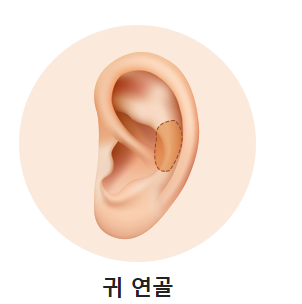
This cartilage has a shape and elasticity similar to the nose, making it suitable for creating a natural-looking nasal tip.

This is the cartilage inside the nose used to support the columella and adjust the angle of the nasal tip.
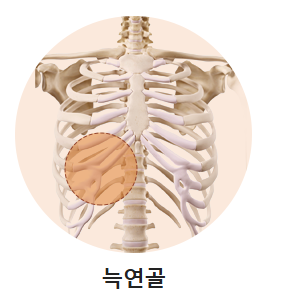
It is a stable implant used in various rhinoplasty procedures thanks to its strong support and durability.
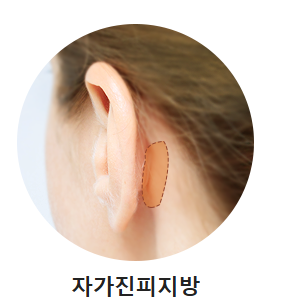
Buttock, ear, and posterior dermis tissue can be safely used as bridge materials even when the skin is thin.
Cases Where Autologous Cartilage Rhinoplasty Is Needed
◆ When there is strong concern about complications from rhinoplasty
◆ When there is an allergic reaction to silicone
◆ When an extremely natural look is desired
◆ When revision surgery is needed rather than a first surgery
◆ When only a slight correction of the nose is desired

Autologous Cartilage Rhinoplasty Procedure
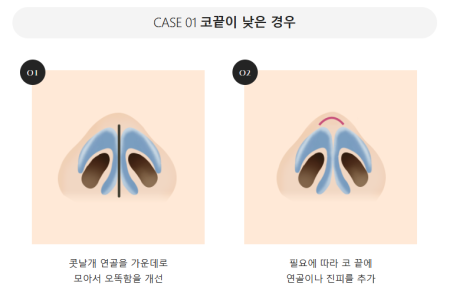
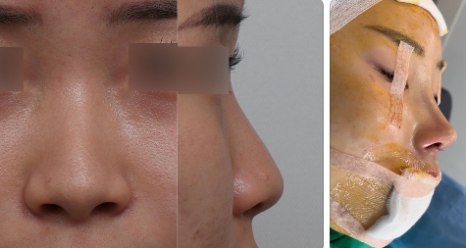 Bring the alar cartilages toward the center to improve projection, then add cartilage or dermis to the nasal tip if needed.
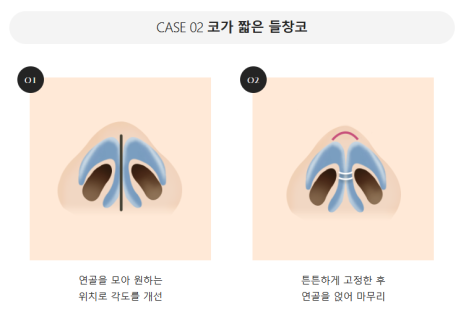
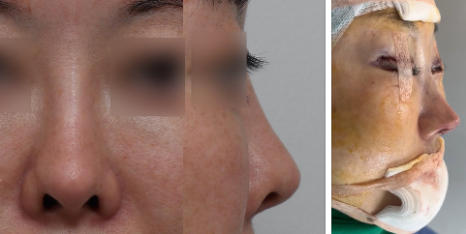
The cartilage is gathered, the angle is improved to the desired position, and it is firmly fixed before placing the cartilage to finish.
Advantages and Disadvantages of Artificial Implants and Autologous Tissue
Artificial implants can be broadly divided into silicone, Gore-Tex, and similar materials. Silicone is a material mostly used to increase bridge height, and it is recommended for people who want a safe and natural-looking nasal bridge; depending on the need, it can also be used to reinforce the nasal tip. Autologous tissue is most commonly used for the nasal tip and, if needed, can also be used to reinforce the bridge. Because it offers the highest level of stability, it causes almost no rejection response and can be maintained for a long time without concern about inflammation.

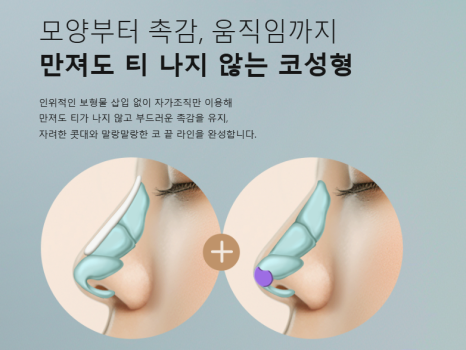

Autologous cartilage rhinoplasty is an excellent rhinoplasty method that can pursue natural beauty while also seeking stability. If you want to improve your appearance using your own cartilage without worrying about inflammatory side effects, autologous cartilage can be the best choice. If you are considering autologous cartilage rhinoplasty, we hope you will have a thorough consultation with a specialist and create a surgical plan suited to you so that you can achieve an improved nasal line.


