
The braces are off...
But if a black gap has appeared between your teeth?
👉 Is a black triangle a side effect?
On the day the braces come off,
I thought, “Now I have straight teeth too!” and
looked in the mirror,
but if you see
what looks like a black gap
between your teeth,
almost as if there were seaweed flakes stuck there,
If it doesn’t go away even after brushing,
if it stays the same even after scaling,
and if it keeps bothering you every time you smile,
you may have wondered about this at least once.
“Did my orthodontic treatment fail?”
“It’s a side effect, right...?”
To give you the conclusion first,
👉 in most cases, it is not because the orthodontic treatment was done incorrectly.
Hello, this is Smile D Dental Clinic.
Today, I’d like to talk about black triangles that appear after orthodontic treatment.
After spending so much time and money to finish orthodontic treatment,
if you see a black triangular gap near the gums of the front teeth,
a so-called black triangle,
it’s only natural to feel disappointed.
However, in most cases, this phenomenon is
✔ not an accident,
✔ not tooth decay,
✔ and not a problem caused by poor care.
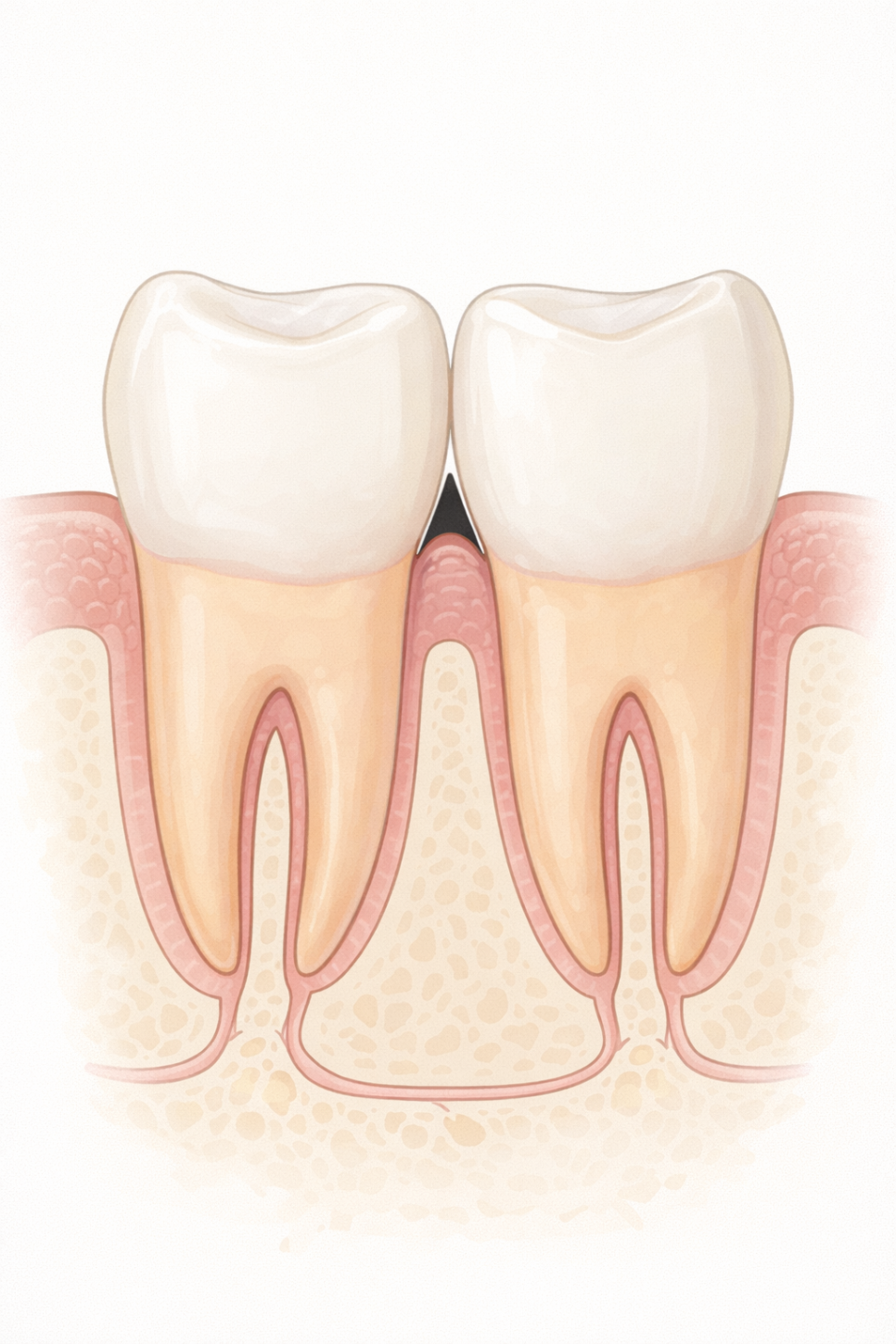
Why do black triangles form?
The boundary between “normal” and “abnormal”
Teeth are not as simple in shape as you might think.
They are wider at the top
and gradually become narrower toward the gums,
👉 forming an inverted triangle or vase-like shape.
Before orthodontic treatment,
the teeth may have been overlapping
or the gums may have been swollen,
so this space may not have been very noticeable.
But once orthodontic treatment straightens the teeth?
The tooth crowns fit closely together,
but the roots are naturally narrower, leaving space behind.
In particular, in adult orthodontic treatment,
✔ if the alveolar bone has already receded somewhat, or
✔ if the gums are not as elastic as they used to be,
the gums may not fill that space again,
and it remains as a “black triangle.”
So rather than saying
“the orthodontic treatment failed,”
it is closer to a structural gap that became visible
as the teeth found their correct positions.
But it can still be uncomfortable if left alone
If the black triangle is only slightly noticeable and bothers you visually,
treatment may not be necessary.
If any of the following apply,
it is a good idea to get an accurate diagnosis at a dental clinic.
✔ Check yourself
1️⃣ Whether the gums have receded overall and the roots seem exposed
2️⃣ Whether your tooth shape is especially close to an inverted triangle
3️⃣ Whether the gap is clearly visible at 1 mm or larger
👉 If even one of these applies,
you will need to choose from the solutions below.
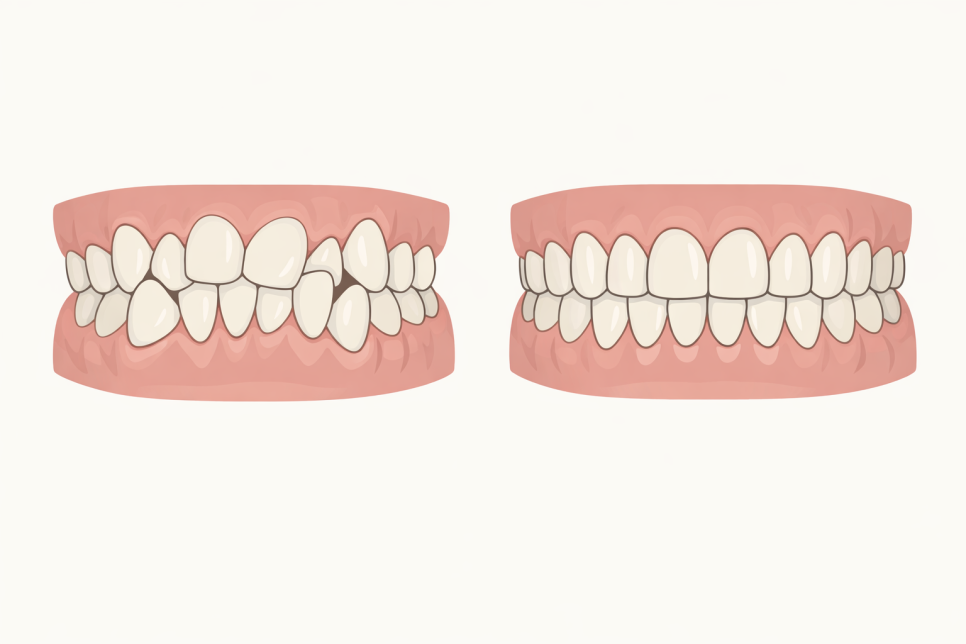
① Mild cases
A method that barely touches the teeth?
▪ Interproximal shaping (IPR) + retreatment
This is a method of slightly reshaping only a very small amount of the tooth sides,
then bringing the teeth together again with orthodontic treatment
to reduce the space itself.
- Minimal tooth damage
- Natural solution
- Can be considered if you are in orthodontic treatment or at the finishing stage
▪ Filling with resin
This method fills the empty space
with a material similar to tooth color.
- Relatively simple
- Lower cost burden
- Possible without tooth reduction
❗ But there is an important point here.

“Then can’t we just
use resin for everything?”
Many people ask this.
But to be honest from the dentist’s perspective,
👉 if the black triangle is beyond a certain size,
resin is not the first choice.
Because resin
✔ is a plastic-based material,
✔ can discolor,
✔ and is not as smooth as natural teeth.
The inside of the mouth
is exposed repeatedly to hot food, cold drinks, and acidic conditions,
so over time,
boundary discoloration,
microscopic gaps,
and easier plaque adhesion
👉 can actually lead to gum inflammation.
Trying to eliminate a black triangle
while harming gum health
is something that must be avoided.
② For moderate cases or worse
Why consider “laminate veneers”?
The laminate veneers being discussed here
are not the kind that requires filing down a lot of the teeth, as in the past.
Nowadays,
✔ only the necessary areas,
✔ with very thin ceramic,
✔ and in some cases with minimal reduction or no reduction at all,
are approached.
The core issue with a black triangle
is the “empty space between teeth,”
so the method used focuses on adjusting the shape mainly on the side surfaces
rather than the whole tooth.

Advantages of laminate veneers
✔ Ceramic material → almost no discoloration
✔ Smooth surface, so less plaque adhesion
✔ Excellent compatibility with the gums
✔ Can design the tooth shape itself
Rather than simply covering the gap,
it can improve the overall smile impression
by changing inverted-triangle-shaped teeth into a more stable proportion.
⚠ Important note ⚠
“Not something to do unconditionally”
Laminate veneers can be a good option,
but
✔ they are not the correct answer in every case.
Before treatment, the following must be checked:
1️⃣ Are the gums healthy?
→ If there is inflammation, treatment is needed first
2️⃣ Is orthodontic treatment completely finished?
→ If there is still minor tooth movement, the timing must be adjusted
3️⃣ Are there any problems with the bite force?
→ If the front teeth experience strong forces, other alternatives should be considered
Proceeding without checking these
is not a good choice for either the patient or the doctor.
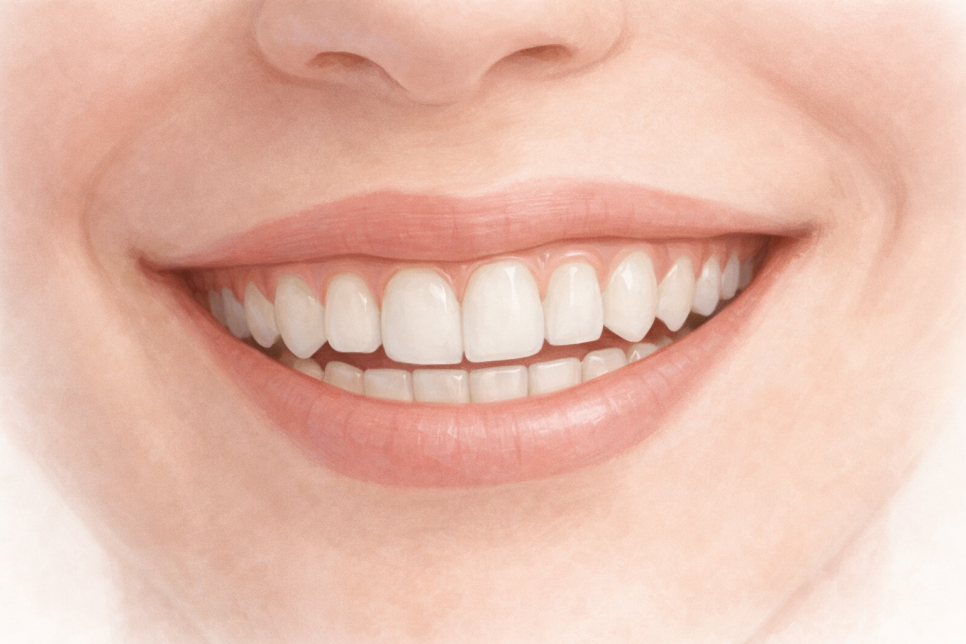
Today’s summary in one line
Black triangles are a common phenomenon after orthodontic treatment,
and depending on their size,
orthodontic correction, resin, or laminate veneers,
making the “right choice for the tooth condition” is important.
It is hard to judge by appearance alone,
because there is a very big difference between the mirror you look at at home
and the gum condition confirmed by X-ray at the dental clinic.
Rather than worrying alone,
I hope you make the least harmful choice for your teeth
through an accurate diagnosis.

※ This post is not intended to guarantee specific treatment results
or to recommend a procedure,
but is content provided for the purpose of offering general information
about black triangles after orthodontic treatment.