Chipped front tooth—can veneers fix it?

Hello.
I’m Oh Soo-hwan, chief dentist at Smile D Dental Clinic,
a specialist in orthodontics with 19 years of experience.
If your front tooth has chipped, what should you do first?
When it suddenly breaks off with a “snap” while eating,
or when a corner chips from impact during exercise,
many people ask this.
“Veneers are the right answer, aren’t they?”
But there is no single correct answer.
A chipped front tooth requires a treatment approach that changes completely depending on the depth of the damage and how much of the tooth is still intact.
Today, I’ll organize this around the decision criteria:
✔ What should be checked first when a front tooth chips?
✔ What are the exact indications for composite resin, veneers, and crowns?
✔ What problems can arise if the wrong option is chosen?
※ Treatment methods may vary depending on the individual’s condition,
and the final decision should be made through a specialist’s diagnosis.
1️⃣ Chipped front tooth: why you should not judge by appearance alone

The front teeth are in the most visible position.
That is why a chip can feel more serious psychologically.
If you have an interview, a photo shoot, or an important appointment,
your first thought may be, “I need to fix this quickly.”
But if treatment is decided based only on what is visible on the outside,
unexpected problems can arise.
The first factors to check in front tooth treatment are:
- The extent and depth of the chip
- Whether the nerve is exposed
- The amount of remaining tooth structure
- The condition of the bite (occlusal force)
- Whether there are microcracks
Even with the same chipped front tooth,
the approach differs depending on whether it is a small edge fracture or structural damage.
2️⃣ Treatment options for a chipped front tooth can be broadly divided into three types

① Composite resin treatment
✔ Indications
If the tip is only slightly chipped
A small edge fracture
When there is no nerve damage
Composite resin treatment restores the damaged area directly using tooth-colored composite resin.
✔ Features
Almost no tooth reduction is needed
In many cases, treatment can be done immediately after diagnosis on the same day
A relatively conservative approach
In other words, it is the most basic treatment focused on preserving tooth structure.
However, it has limitations when the damage is extensive or there is structural weakening.
② Veneers
Many people are most curious about this treatment.
✔ Indications
When the front surface damage is broad
When there is a change in color
When improvement in shape and alignment is also needed
Veneers are placed by lightly reshaping the front surface of the tooth
and bonding a thin ceramic shell to it.
✔ Conditions that must be checked
Is there enough tooth structure thickness?
Is the bite pressure not too strong?
Is the tooth alignment stable?
Veneers are not a “universal solution.”
Because some tooth reduction is required,
there must be enough original tooth structure remaining,
and if the bite is strong, there may be a risk of fracture.
In short, it is a treatment that must consider both aesthetic improvement and structural stability.
③ Crown
✔ Indications
When the fracture is deep
When the nerve is exposed
When there is insufficient remaining tooth structure
A crown is a method that covers and protects the entire tooth.
It is chosen when structural stability is the priority.
It is sometimes performed together with root canal treatment.
Although the amount of reduction is relatively large,
the purpose is to protect the tooth long term.
[ Smile D Navigation ]
[ More from Smile D ]
| 📞 Connect with Smile D |
|---|
| 0507-1449-2087 |
3️⃣ Problems that can arise if the wrong option is chosen
Treating a chipped front tooth
can be risky if approached mainly from a design standpoint.
① Excessive reduction
Many people request,
“Please make it as white as possible,”
but excessive reduction can increase
sensitivity,
nerve irritation,
and the possibility of future root canal treatment.
② Gum problems
If the restoration margin is not precise,
it can lead to
gum inflammation,
gum recession,
and exposed roots.
③ Color and proportion imbalance
If harmony with the surrounding teeth is not considered,
it can result in
a fabricated appearance,
left-right asymmetry,
and lower aesthetic satisfaction.
Front tooth treatment is not about “making the teeth white.”
It is a process of balancing function, structure, and harmony.
4️⃣ Then how should you choose?

Treatment selection should begin not with “which treatment looks best,”
but with “what is possible given the current condition of the tooth.”
The key factors to check are:
✔ Remaining tooth structure thickness
✔ Whether the nerve is exposed
✔ Bite pressure
✔ Gum condition
✔ Color harmony
Especially when considering veneers,
condition and design must be judged at the same time.
A natural color is one that matches your own original tooth tone.
A brighter color does not always produce the best result.
5️⃣ Key summary
Even with the same chipped front tooth, the solution is different.
Minor fracture → resin
Expanded surface damage → consider veneers
Structural damage / nerve exposure → crown may be needed
Veneers are only an intermediate option,
not the answer in every case.
The most important thing in front tooth treatment is
not a quick choice, but an accurate diagnosis.
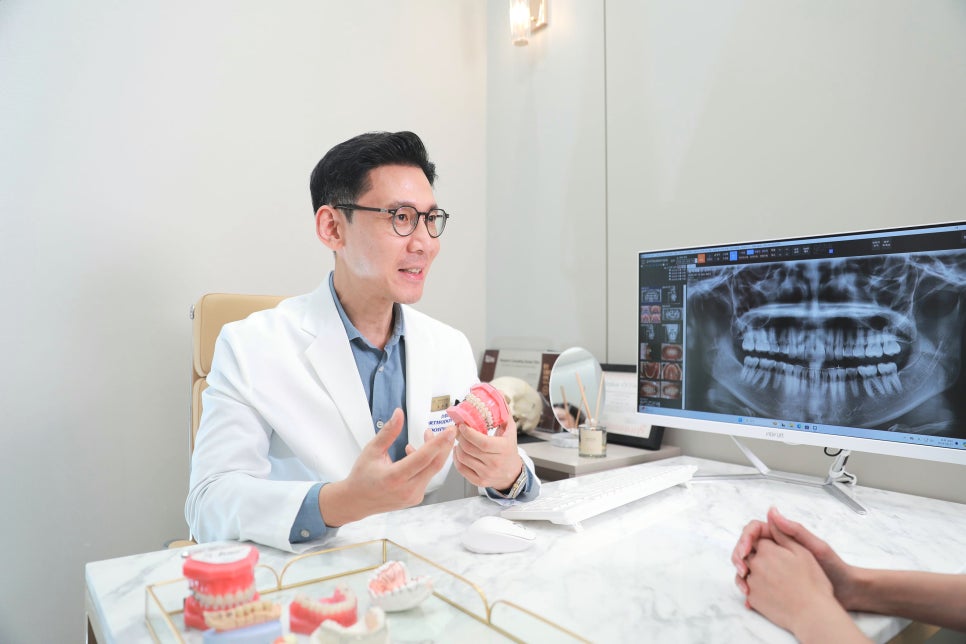
After X-rays, bite analysis, and condition assessment,
the decision should be made with long-term maintenance in mind.

If your front tooth has chipped,
don’t panic first,
and rather than deciding on treatment based only on appearance,
it is important to fully check the tooth structure.
Not every chipped tooth
requires the same solution.
It depends on the condition.
An accurate diagnosis comes first.
Thank you.
This was Oh Soo-hwan, chief dentist at Smile D Dental Clinic.