Hello.
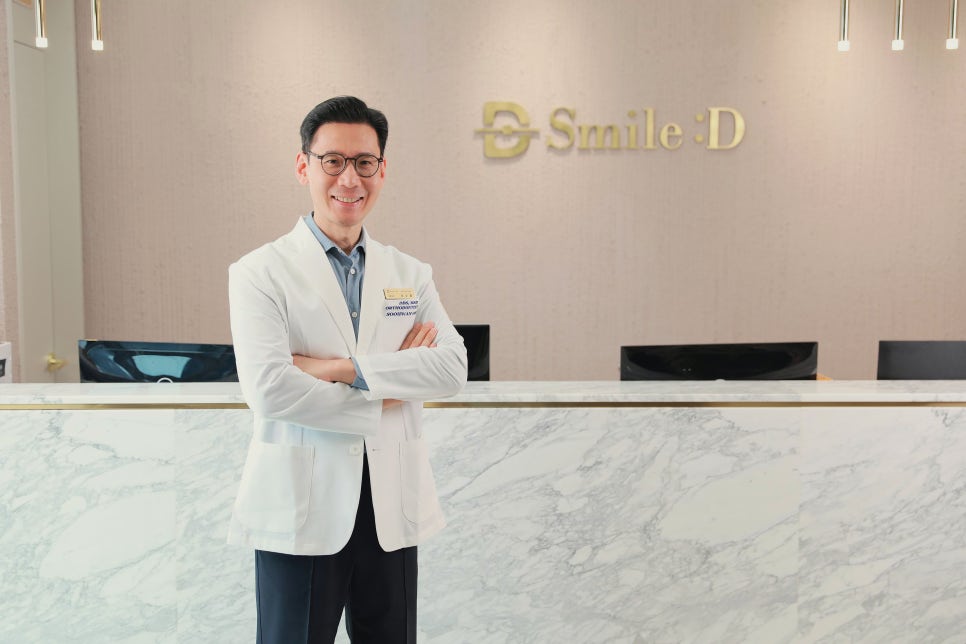
I’m Oh Su-hwan, the chief director of SmileD Dental Clinic,
located at Sinsa Station on Subway Line 3.
If you are considering orthodontic treatment,
you may have thought about this at least once.
 Will orthodontics change my face shape too?
Can it be refined into a V-line?
Will it make my face look sunken?
Will orthodontics change my face shape too?
Can it be refined into a V-line?
Will it make my face look sunken?
This is actually a question we hear very often in the clinic.
But the important thing is this.
Orthodontics can cause significant changes to face shape in some cases,
and very little change in others.
Today, among these, I’ll organize only the key criteria
that many people are most curious about.
※ This article is for general informational purposes only,
and treatment methods may vary depending on each individual’s oral condition.
Why Face Shape Can Change with Orthodontics (Core Principle)
There is something many people misunderstand.
Orthodontics is not a treatment that changes the jawbone.
In other words, it is not a treatment that shaves the jaw or reduces the facial bones.
So why do some people hear,
“It looks like I had plastic surgery”?
✔ The key is changes in the soft tissues (lips and cheeks)
Teeth and the alveolar bone = the structure that supports the face
Lips and cheeks = the appearance that covers it
To put it simply,
if the teeth are positioned forward,
the lips also appear to be pushed forward.
If the teeth are moved backward through orthodontic treatment,
the lips naturally move inward as well.
During this process,
changes can appear as if the facial line has been refined.
 Cases Where Face Shape Changes Significantly
- Protruding mouth
✔ The lips do not close naturally
✔ Wrinkles form as you strain your chin
✔ The mouth looks protruded in side profile
In these cases, people often feel a strong change after treatment.
As the lips move inward naturally
and tension in the chin muscles decreases,
the overall facial line can feel more refined.
- Tendency toward a recessed chin + protruding mouth
✔ A chin that feels small or set back
✔ A structure where the mouth appears relatively more protruded
After orthodontic treatment,
when the jawline becomes more visible,
the side-profile change can feel even more distinct.
Cases Where Face Shape Changes Very Little
- Simple crowding or mild alignment issues
✔ A state where the mouth is not protruded
✔ Only the teeth alignment is irregular
Because this is mainly a treatment focused on alignment,
there is almost no change in face shape.
However, the impression may become cleaner and more polished.
- Skeletal issues (underbite, asymmetry, etc.)
✔ A problem with the jawbone itself
It is difficult to significantly change face shape with orthodontics alone.
In these cases,
because it is a structural issue rather than a tooth problem,
other approaches may be considered together.
[Introducing SmileD Dental Clinic]
[Directions to SmileD Dental Clinic]

Will orthodontics make the cheeks look hollow? What about smile lines?
This is one of the things many people worry about the most.
Does orthodontics cause loss of cheek volume?
Does the face become gaunt?
Do smile lines get deeper?
You may have seen these claims a lot.
To give the conclusion first,
most of these are either “temporary changes” or “changes depending on the condition.”
- Hollow cheeks
This is mostly a temporary phenomenon.
At the beginning of orthodontic treatment,
due to tooth pain and reduced chewing function,
food intake and the use of the chewing muscles decrease,
which can make the muscles smaller and the cheeks look hollow.
But
as chewing function recovers during treatment,
the muscles often return as well.
However,
✔ if you originally have little cheek fat
✔ if the cheekbones are prominent
in these cases,
the change may feel more noticeable.
- Smile lines
This depends on the situation.
✔ Protruding mouth → often improves after orthodontic treatment
→ As the mouth moves inward, the surrounding tissues naturally smooth out
On the other hand
✔ If the mouth is excessively moved inward
→ The lips may become thinner
→ It may make you look older instead
So what matters is
not how much you move it in,
but how far you move it in.
In other words,
✔ facial proportions
✔ lip thickness
✔ philtrum length
These factors should be considered together
when deciding the point where you should stop.
Common Misconceptions to Clear Up
Does orthodontics always create a V-line?
Does orthodontics make the face smaller?
Does orthodontics reduce the jaw?
These ideas are not accurate.
Orthodontics is a treatment that changes the position of the teeth,
and facial changes are the result that appears depending on the conditions.
Conclusion
To summarize it like this.
✔ If the mouth is protruded → changes are possible
✔ If it is only a tooth alignment issue → almost no change
✔ If it is a skeletal issue → there are limits with orthodontics alone
✔ Hollow cheeks → mostly temporary
✔ Smile lines → may improve or worsen depending on the case
In other words, orthodontics is not a treatment that “changes the face,”
but rather a treatment that can lead to changes depending on the conditions.
Today, I organized only the topics many people are most curious about:
“changes in face shape” and “hollow cheeks, smile lines.”
Orthodontics is not simply a treatment for becoming prettier;
it is a treatment that considers function + structure + balance together.
So
understanding the changes you can expect
and the parts that are difficult
can lead to more satisfying results.
If this article focused on explaining the “criteria for face-shape change,”
then in the next article,
→ extraction orthodontics vs. non-extraction orthodontics
→ the criteria that determine how much the mouth will move inward
→ points you must check during an actual consultation
I’ll organize more realistic decision-making criteria
based on those topics.
If you are considering orthodontic treatment,
I recommend continuing with the next post as well.
Thank you for reading this long article today.