When you visit the dentist, you may become so nervous
that you cannot properly ask even the questions you had thought about beforehand.
“Can’t I just have everything extracted and get implants?”
“So, roughly how much will it cost?”
“Can’t I wait a little longer?”
Although these comments may be made casually,
starting a consultation with questions like these
can cause the conversation to focus on a single topic,
such as implants or cost,
rather than on how much of your current condition can be preserved
or what treatment is actually needed.

Of course, regardless of the words a patient uses,
dental professionals should sufficiently explain the necessary treatment methods
and possible alternatives based on the examination results.

However, if patients also know how to ask the right questions,
they can better understand the basis of the diagnosis and the need for treatment
and make decisions that suit them.
Today, for those looking for information about recommended dentists in Gangnam,
we will organize five phrases to avoid at the dentist
that are helpful to know before a consultation,
along with questions you can ask instead.
Can’t I just have everything extracted and get implants?
If several teeth are loose or pain keeps recurring,
patients may feel that it would be better to extract all the problematic areas
and get implants rather than treating each one individually.
However, implants are a treatment that replaces missing teeth;
they are not automatically the first choice for replacing natural teeth
that can be preserved.
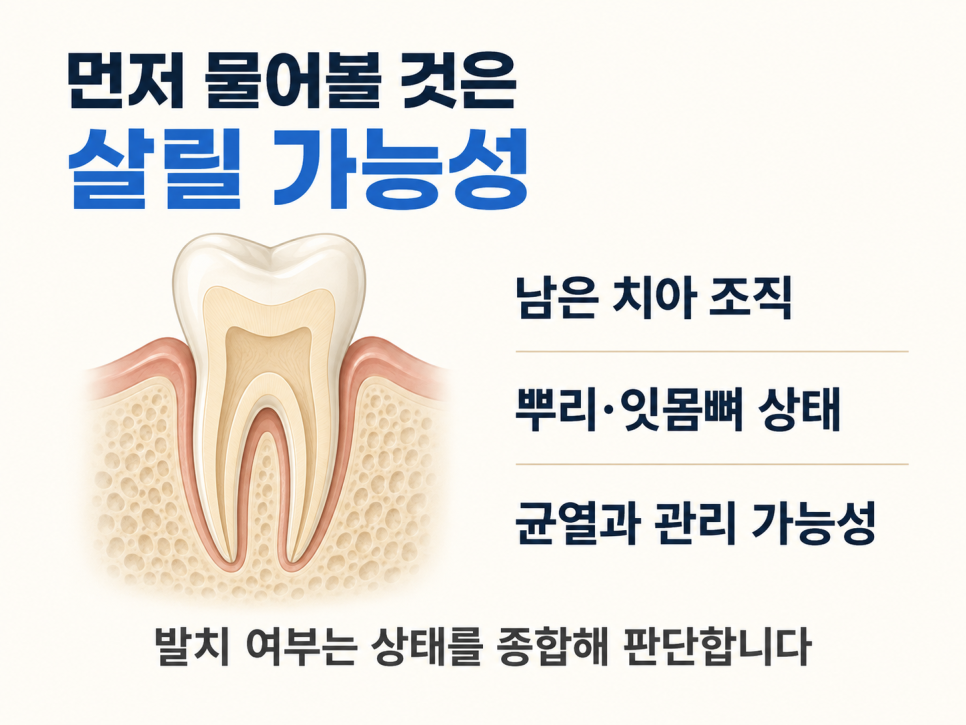
Whether a tooth can be preserved should be determined
after comprehensively considering factors such as the following:
The amount of remaining tissue
The depth to which the decay has progressed
The condition of the root
The amount of supporting jawbone
The extent of periodontal disease
Whether there is mobility or cracking
The way the upper and lower teeth meet
The possibility of future maintenance
The American Dental Association also recommends a conservative approach to treating cavities,
which treats the infected areas while preserving healthy tissue
as much as possible.
However, this does not mean that every tooth can always be preserved.
If there is a root fracture or severe periodontal disease
and the likelihood of recovery is low, extraction may be necessary.
Ask questions like these!
“Is there a possibility of preserving the tooth?”
“What are the advantages and disadvantages of preserving the tooth compared with extraction followed by an implant?”
“If the tooth is preserved, what lifespan can be expected, and how should it be maintained?”
By asking these questions, you can compare not only whether an implant is possible
but also whether preserving the natural tooth is possible.

How much does it cost? Just roughly how much?
Cost is, of course, an important factor
when deciding on dental treatment.
However, if you ask about the price first
before undergoing an examination and receiving a diagnosis,
important details may be left out, including:
The exact scope of treatment
The materials used and the type of prosthesis
The possibility of additional treatment
The number of appointments and expected treatment period
The scope of aftercare
Maintenance and repair costs
Whether national health insurance applies

For example, even when the treatment is called “crown treatment,”
the overall treatment process and cost may differ depending on
the depth of the decay, whether root canal treatment is necessary,
the amount of tooth structure remaining, and the prosthetic material.
Implant treatment likewise varies in scope depending on
whether bone grafting is needed,
the placement site, the condition of the gums, and the prosthetic method.
Therefore, rather than asking only, “How much does it cost?”
it is better to check the diagnosis results
and what is included in the cost at the same time.
Ask questions like these!
“What treatment items are necessary based on my current diagnosis?”
“Please separate the cost of each item from costs that may be added later.”
“Please explain the advantages, disadvantages, and cost differences among the available treatment options.”
With dental costs, what is included
is more important than the total amount.
| Item to check | Simple price question | Recommended question |
|---|
| Treatment scope | Check only the total amount | Check which treatments are included |
| Materials | Check the lowest price | Check the advantages and disadvantages of each material and why it is recommended |
| Additional costs | Check only the price quoted during the consultation | Check which items may be added later |
| Treatment period | Not checked | Check the number of visits and expected period |
| Aftercare | Assume it is included in the price | Check the inspection/repair coverage in detail |
| Alternatives | Check only one treatment | Compare all possible treatment methods |
< Smile:D Location >
< Smile:D More Information >
| 📞 Contact Smile:D |
|---|
| 02-512-2085 |
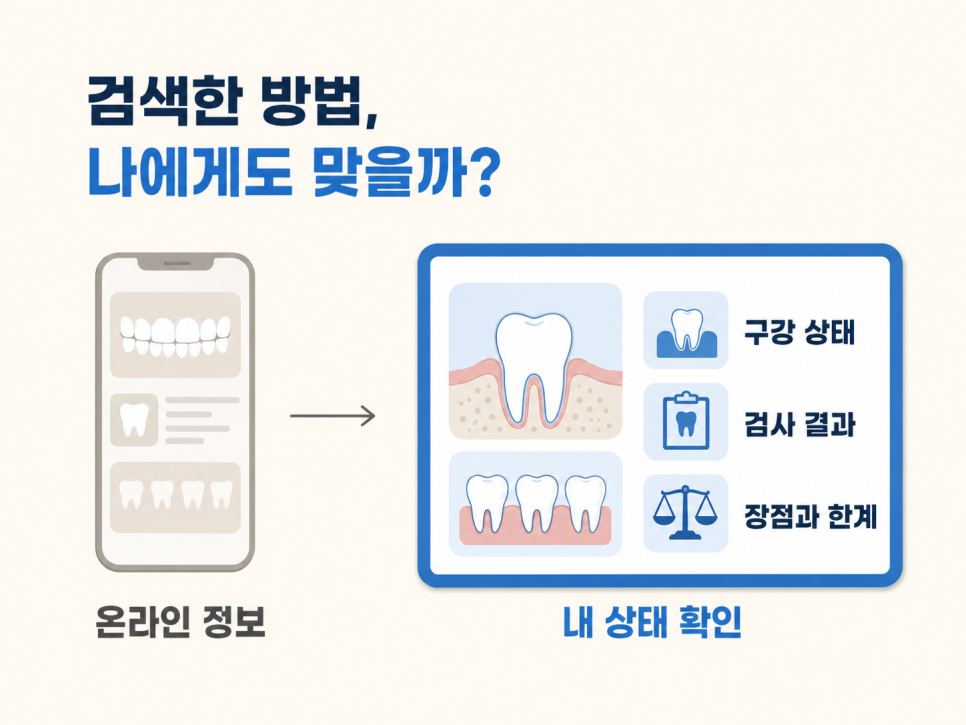
“According to what I saw online, you can just get this treatment. Please do the same for me.”
Before treatment, searching for information online
can help organize your questions.
However, online information consists of general explanations,
so it can be difficult to apply it directly to an individual’s condition.
Even protruding teeth that appear similar
may require different treatment options—such as orthodontics, prosthetic treatment, or surgery—
depending on the angle, the shape of the jawbone, the condition of the gums,
and the way the upper and lower teeth meet.
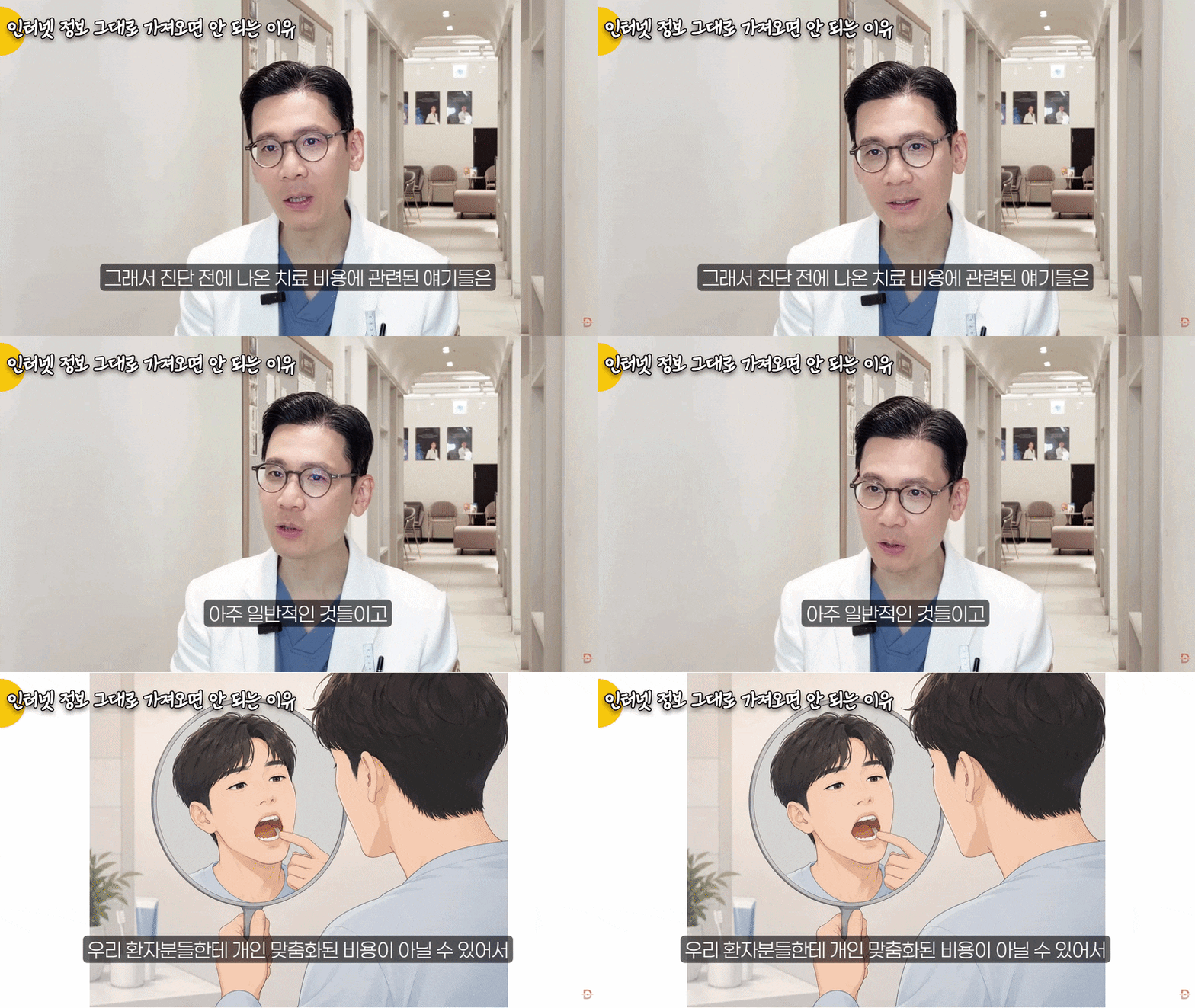
The same applies to implants.
Just because someone else received treatment without bone grafting
does not mean you can receive the same treatment.
This is because the height and width of the jawbone visible on a CT scan,
the location of the nerve canal, and any systemic diseases
must be taken into consideration.
Rather than presenting a method found online as a definitive answer,
it is better to check whether it can also be applied to you.
Ask questions like these!
“Can the method I found also be applied to my condition?”
“If it is difficult to apply, which examination results make it unsuitable?”
“What are its advantages and limitations compared with other methods?”
I’ll wait a little longer. I’ll monitor it for now.
If you are afraid of dental treatment or concerned about the cost,
you may want to postpone it until the pain becomes difficult to tolerate.
However, it is difficult to judge the progression of dental disease
based only on the degree of pain.

Even when a cavity deepens or gum disease progresses,
there may be few noticeable symptoms for some time.
A reduction in pain does not necessarily mean that the cause has been resolved.
A problem that could have been managed with relatively simple treatment in its early stages
may require more extensive treatment after it progresses,
including root canal treatment, a crown, or even extraction.
Conversely, not every condition needs to be treated immediately.
Some early lesions can be monitored through regular observation and preventive care.
The important thing is not to decide on your own that you can “just put up with it,”
but to ask your dental professional whether it is safe to postpone treatment.
Ask questions like these!
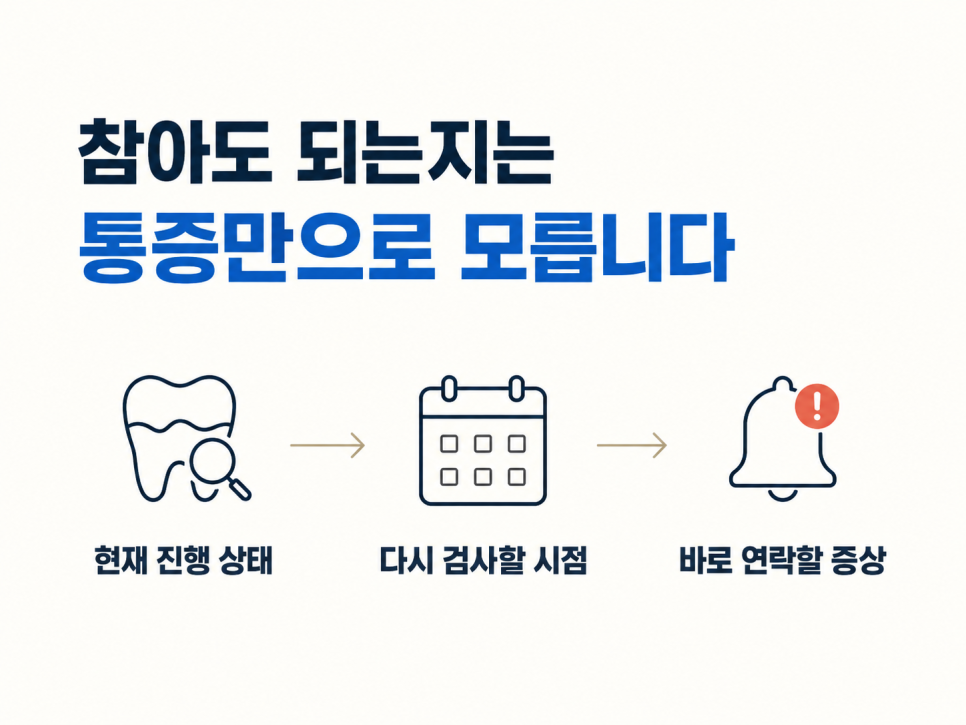
“Is it safe to monitor my condition without treating it right now?”
“What problems could occur if treatment is postponed?”
“If we monitor it, when should I be examined again?”
“What symptoms would require me to visit the dentist immediately before then?”
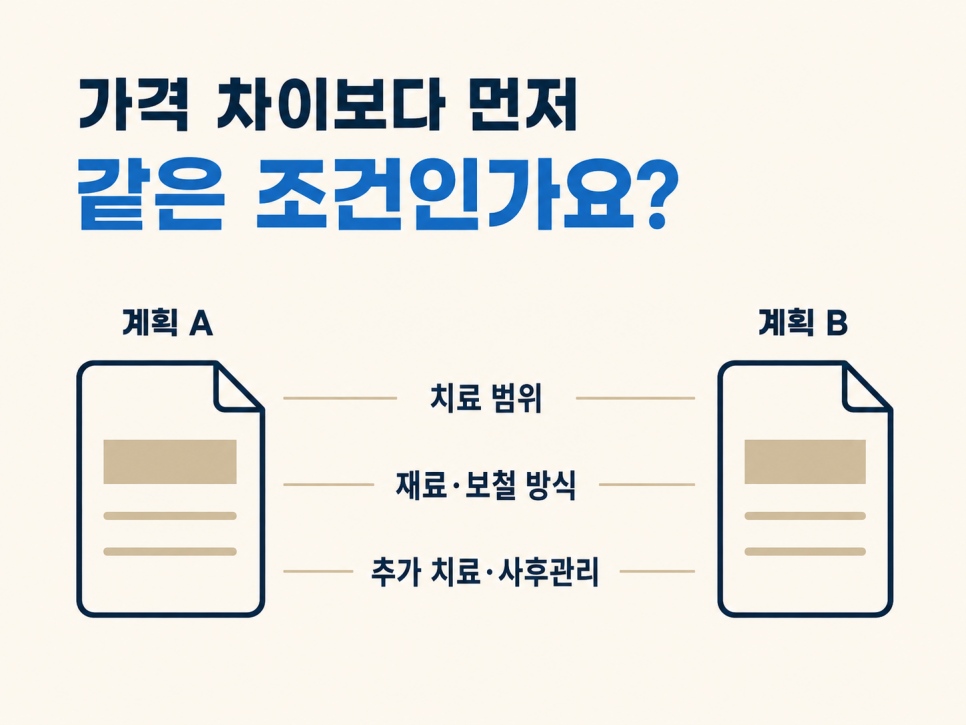
Another dentist said something different. Why is the price different?
Even for treatment of the same area,
different dentists may present different diagnoses and treatment plans.
This does not simply mean that one side is right and the other is wrong.
The standards used to interpret the possibility of preservation,
the expected treatment outcome,
the materials used, and the scope of treatment
may differ.
For example, one dentist may first suggest treatment to preserve the tooth,
while another may recommend extraction followed by an implant
based on the long-term outlook.
Comparing prices alone may cause you to overlook important differences.
Is the diagnosis the same?
Is the number of teeth being treated the same?
Are root canal treatment or bone grafting included?
Are the materials and prosthetic methods the same?
Are temporary teeth and aftercare included?
Are the treatment goals and expected results the same?
Ask questions like these!
“What differences in diagnosis explain why the plan differs from the one at another clinic?”
“Please separate the treatments that are essential under the current plan from those that are optional.”
“What advantages and disadvantages can be expected when choosing one of the two methods?”
It is necessary to hear an explanation of the difference in treatment costs,
but it is more important to first confirm
that you are comparing the same treatment scope and conditions.

Frequently Asked Questions Q&A
Q1. Do I have to decide on treatment immediately on the day of the appointment?
Unless prompt treatment is needed because of pain, infection, trauma, or another urgent issue,
you can review the treatment plan after hearing the diagnosis and explanation.
However, the period for which it is safe to wait
depends on the patient’s condition,
so you should confirm a specific timeframe with the dental professional.
Q2. Is it okay to ask about the cost of dental treatment first?
Yes, that is fine.
Cost is important information when deciding on treatment.
However, it may be difficult to confirm the total treatment cost
before an accurate examination,
so it is best to check the diagnosis results, treatment scope,
alternatives, and possible additional costs together.
Q3. Is it always best to preserve natural teeth?
If preservation is possible and the long-term outlook is reasonable,
preserving the natural tooth can be considered first.
However, if a tooth with a root fracture or severe periodontal disease
has a very low likelihood of recovery and is forcibly maintained,
problems may develop in the surrounding tissues.
Therefore, you should confirm not only “whether it can be preserved,”
but also “what kind of outlook can reasonably be expected.”

Q4. Is it okay to get a second opinion from another dentist?
If the treatment is extensive or irreversible,
you may seek an additional opinion from another dental professional.
If possible, bring your existing examination records and diagnostic information
and compare specifically where the differences between the treatment plans arise.
Q5. Is it okay to show information I found online?
Yes, that is fine.
However, rather than treating online information as the correct answer,
asking, “I wonder whether this information also applies to my condition,”
can help you receive a more accurate explanation.
What to Check Before Price When Choosing a Recommended Gangnam Dentist
When choosing a dentist, it is important to check the following criteria together
rather than looking only at reviews or cost.
-
Whether the examination results are explained in a way the patient can understand
-
Whether the current condition and the need for treatment are explained separately
-
Whether the available treatment methods and the limitations of each are explained
-
Whether the possibility of preserving natural teeth is thoroughly considered
-
Whether the estimated cost and possible additional items are explained
-
Whether time is provided for questions or seeking an additional opinion
-
Whether a post-treatment care plan is explained
A good consultation is not a process in which the patient demands a particular treatment
or simply follows the dental professional’s explanation without question.
It is a process of creating a plan that the patient can understand and accept
by considering the examination results, the professional judgment of the dental provider,
and the patient’s circumstances and preferences together.
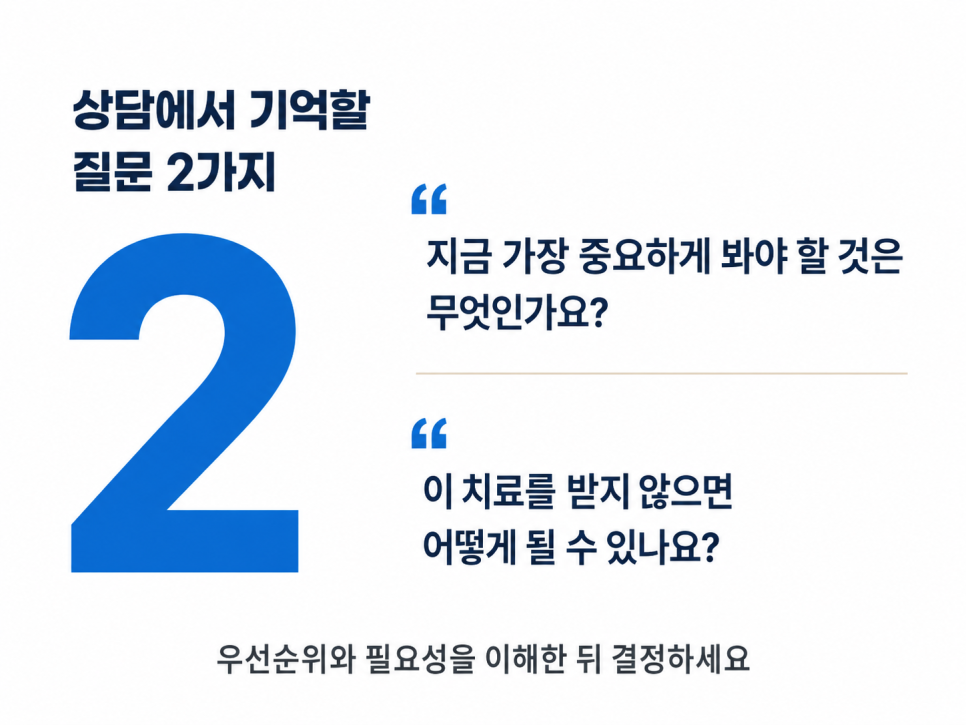
If you are researching dentists through searches for recommended dentists in Gangnam,
before asking, “Which treatment is the cheapest?”
remember these two sentences:
What is the most important thing to consider given my current condition?
What will happen if I do not receive this treatment?
Even these two questions alone
can help you understand the priority and necessity of treatment.
I hope the information provided today
will be helpful to those looking for information about recommended dentists in Gangnam.
Thank you for reading.

※ This post is informational content prepared in compliance with Article 56, Article 57, and other relevant provisions of the Medical Service Act.
It was prepared to provide general medical information exempt from medical advertising review,
and does not guarantee the effects of any specific procedure or replace a medical diagnosis.
The images and materials used in this post are examples intended to aid understanding;
actual diagnoses are determined through consultation and examination by a medical professional.
Methods, prognosis, and effects may vary depending on each individual’s health condition
and the characteristics of their disease,
and side effects may occur.