Hello.
I’m Yeo Sang-ho, director of Songjeong Station Dental Clinic.
When two people meet for the first time,
we get many impressions from facial expressions.
In particular, the front teeth that are visible when smiling
have a big influence on that impression.
If there is a space between the front teeth,
that subtle gap can stand out more than expected,
and it can often become something you notice when speaking or in photos.
So, why does this kind of ‘interdental spacing (a gap between teeth)’ occur,
and how can it be improved?
Today, I’ll explain that.
- Why does it happen?
Interdental spacing refers
to a space that forms between the front teeth.
In addition to genetic factors,
such gaps can occur due to a variety of causes,
including the following:
✔ When the natural teeth are smaller than the dental arch (the curved shape of the jaw that forms the teeth row)
✔ Early loss of primary teeth or prolonged retention of primary teeth
✔ Habit of pushing the front teeth with the tongue
✔ Persistent mouth breathing
✔ When the muscular tissue of the mucosa between the gums (gingiva) and the lips is well developed
Among these, in adults,
one common cause is that the natural teeth are relatively smaller than the dental arch,
which creates gaps.
Although it may seem like a small issue at first glance,
it can affect both aesthetics and function,
so it cannot be ignored.
I’ll explain how this can be improved
at Songjeong Station Dental Clinic.
- How is it treated?
Methods for resolving interdental spacing
are typically divided into three main types.
- Orthodontic treatment
This gradually closes the space by moving the teeth,
and while it can structurally address the cause,
it takes a relatively long time.
- Resin buildup
This fills the gap between the teeth with resin.
It is fast and simple,
but it can be affected by long-term stability, color, and wear.
- Prosthetic restoration (including laminate)
This is designed by considering the shape of the space and the size and shape of the natural teeth themselves.
Laminate is one type of prosthetic restoration,
and it can take both aesthetics and function into account.
- How should we approach the distribution of the spaces?
It is not common for interdental spacing to appear symmetrically on both sides.
In many cases, there is asymmetry,
such as one side being closed while a gap appears only on the other side.
If this is approached simply by filling the empty space,
it can create an imbalance in the size of the front teeth
or make them look unnaturally large,
like “rabbit teeth.”
In such cases, the overall proportions and symmetry of the front teeth
need to be newly established.
Using laminate,
we can effectively improve this asymmetry by adjusting the width, length, and angle of the teeth.
Then, if this treatment is performed,
must the teeth always be shaved?
I’ll explain this at Songjeong Station Dental Clinic.
- Do the teeth really have to be shaved?
Laminate is a method in which
a certain portion of the front surface of the tooth is removed,
and then a thin ceramic prosthesis is bonded on.
Here, the meaning of removal is
an essential step to secure space for the thickness of the prosthesis.
There are also no-prep laminate or resin buildup methods,
which bond without reshaping the teeth,
but with these methods, the protrusion of the existing natural teeth
may become more pronounced,
and there are limitations in adjusting shape and color,
so when symmetry and natural appearance are important,
they are a more limited option.
In particular, when the interdental spacing is large
or the natural tooth shape is asymmetrical,
some degree of removal is actually necessary
to achieve overall harmony.
From here, I’ll introduce the treatment process
at Songjeong Station Dental Clinic.
- What is the treatment process, as seen in the example photos?
Laminate treatment for improving interdental spacing
is carried out in the following steps.
- Diagnosis and design
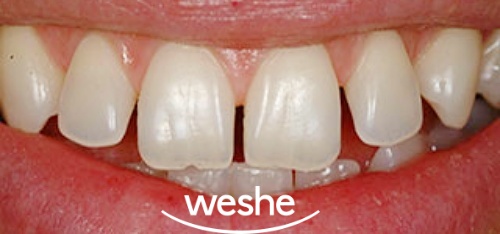
First, at Songjeong Station Dental Clinic,
we establish a design based on intraoral photos, scan data, and other information,
considering the arrangement and color of the teeth,
as well as the range visible when smiling.
- Trial restoration
(Wax-up or Mock-up)
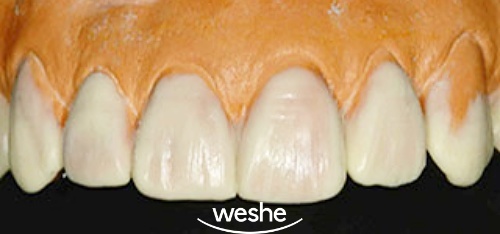
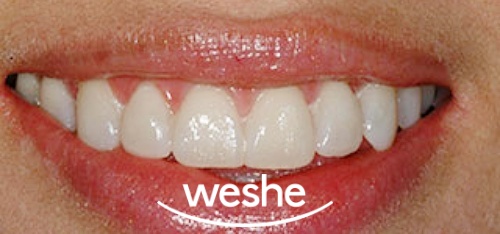
We review the preliminary design through a model,
and check the proportions and smile line.
- Natural tooth reduction and impression taking
To secure the proper thickness,
the front surface of the natural teeth is minimally reduced,
and information for fabricating the prosthesis is obtained
through an intraoral scanner and silicone impression.
- Final bonding and finishing
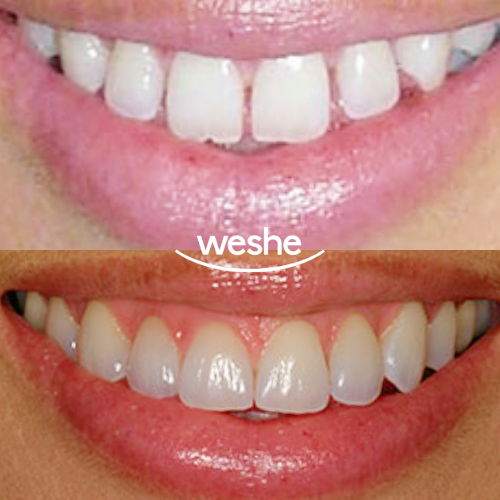
The fabricated laminate is bonded,
and the final symmetry and occlusion are checked in the mouth.
The space between the front teeth,
that small gap,
can be a major concern for some people.
I hope this was helpful for those who needed this kind of medical information.
This was Yeo Sang-ho, director of Songjeong Station Dental Clinic.
Thank you for reading this long post.

Treatment period: 2025.02.12~2025.03.05