To beautify everyone’s smile,
we + she + he = weshe
Even though I know scaling is needed every year,
many people still put it off
because they worry it will hurt or feel uncomfortable.
In fact, scaling is not just for removing tartar;
it is also a basic form of care that lets you check
both the condition of your teeth and gums.
Just receiving it at the right time can often help
catch cavities or gum disease early and
prevent the problem from getting worse.
So this time, we’d like to talk about
Airflow scaling, which is known as a gentler
care method,
focusing on questions patients often ask.
Before we get into the main discussion,
let’s briefly go over
what kind of care Airflow scaling is.
📍 What is Airflow scaling?
Airflow scaling is a method that removes staining and biofilm
from the tooth surface by spraying fine powder,
water, and air.
Compared with conventional ultrasonic scaling,
it causes less direct stimulation to the teeth and gums,
and it is relatively effective at removing
stains caused by coffee, tea, wine, and more.
When people usually visit for
Airflow scaling,
what leads them to decide on it?
A.
Many people visit because they drink coffee or tea often
and are concerned about tooth staining,
but the condition is not yet severe,
so they come in while considering it as part of maintenance.
Also, while they know the importance of scaling,
they may have delayed care because of past experiences of pain,
and then decide to go ahead after learning about
Airflow scaling, which is gentler.

Even after deciding to do it,
what do you worry about most before the procedure?
A.
Even if they come in after hearing that it is less stimulating,
people worry most about pain.
Because of memories of machine noise or the feeling of scraping on the teeth,
many people feel that scaling itself
is burdensome.
Especially for those who have had uncomfortable experiences before,
their tension before the procedure tends to be high,
so we explain in advance enough about
how Airflow scaling is performed and
how much stimulation there is.
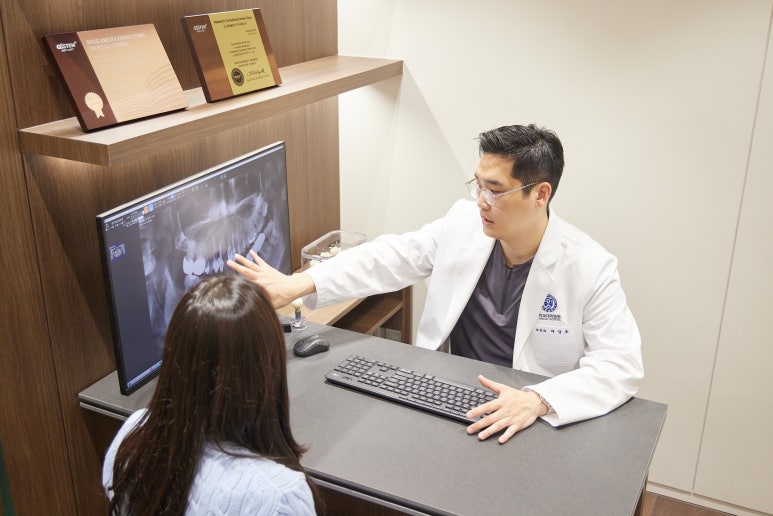
For people who have actually received
Airflow scaling,
what did they say it felt like?
A.
Most people say it was
much more comfortable than they expected.
Some describe it as feeling more like cleaning
than scraping the teeth,
and others say they relaxed during the procedure.
When I received it for the first time,
I could clearly feel a difference
compared with conventional scaling,
and it felt less stimulating while still making
the surface of the teeth feel clean.
Then, compared with conventional scaling,
what feels different the most?
A.
With conventional scaling,
there can be a feeling of vibration or pressure
when removing tartar.
On the other hand, Airflow scaling feels more like cleaning
than scraping the teeth,
so many people say it causes less gum irritation
and feels more comfortable overall.
Who would you recommend
Airflow scaling to?
A.
I would recommend it to people who have put off
regular care because of pain or discomfort from scaling.
It can also be an option for people who are bothered by tooth staining
but feel burdened by strong stimulation,
and for those with sensitive gums
who found conventional scaling uncomfortable.
However, depending on a person’s oral condition,
there are cases where conventional scaling is needed,
so after an accurate diagnosis,
it is important to choose the care method
that is right for you.

If there is one last thing you would like to say?
A. Many people delay visiting the dentist
not so much because of scaling itself,
but because they worry about pain or discomfort.
Airflow scaling is one care method
intended to reduce that burden,
and I think it is an option that can make
regular oral care a little more comfortable.
If you have been putting it off because you were worried it would hurt,
it may be good to start oral care
with a less burdensome method.

Wrapping up the interview
A dental clinic is a place where, rather than the treatment itself,
the first thought that often comes to mind is,
“Will it hurt?”
Because of this concern,
many people delay visiting the dentist
even when they know regular care is needed.
Yonsei Wish Dental Clinic hopes that these burdens
will not become a reason to postpone treatment,
and views patients’ oral health
not as a one-time treatment,
but from the perspective of ongoing care.
Going forward, we will continue to work with you
so that you can maintain oral care comfortably
through thorough treatment tailored to each person’s oral condition.
Thank you.
This was Director Seongho Yeo, CEO of Yonsei Wish Dental Clinic.