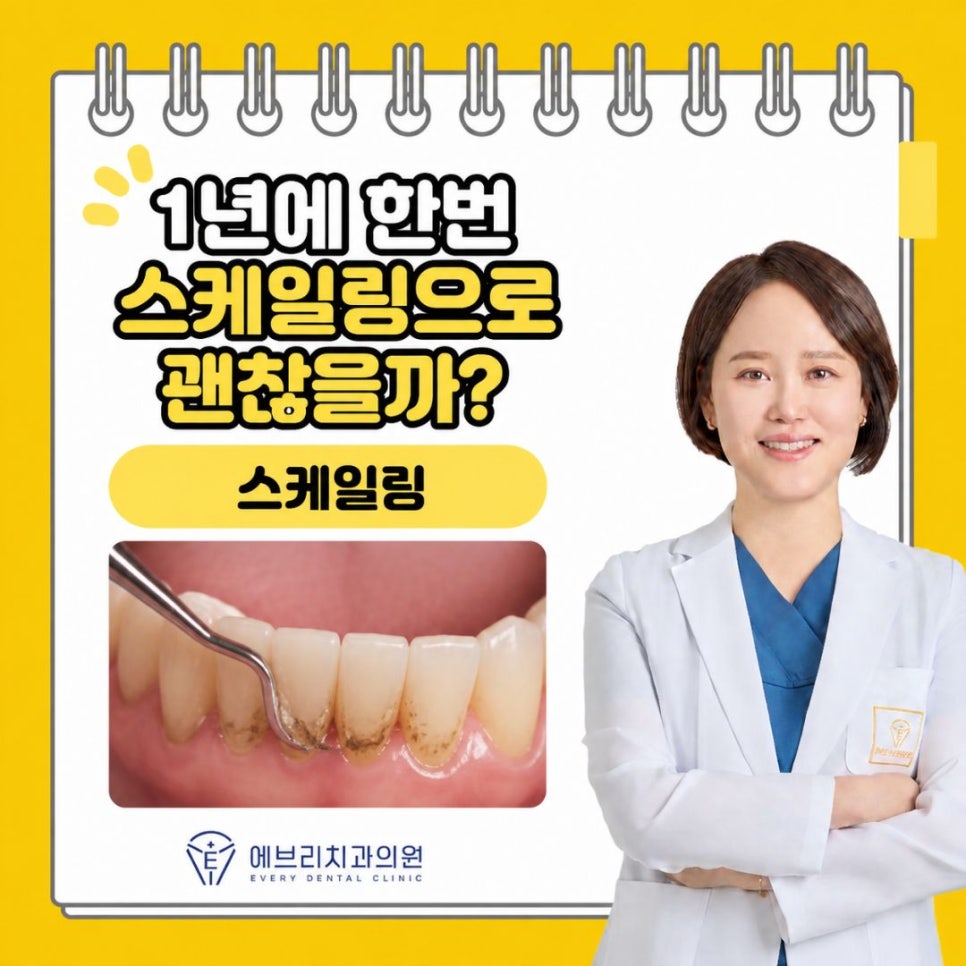
Every Family, Every Smile, Every Dental
"Your Family Dentist, Every Dental"
"Doctor, I had scaling last year. Do I need to have it done again?"
This is a question we hear very often in the examination room.
Some people experience sore or bleeding gums,
while others wonder whether scaling is really necessary when they have no particular discomfort.
In fact, scaling is less a treatment you receive because something hurts and more a basic form of care that protects your gums before problems develop.
Even if you brush diligently, plaque and tartar gradually build up in areas that a toothbrush cannot reach.
At first, there may be no noticeable symptoms.
Over time, however, the gums may swell and bleed, bad breath may worsen,
and if the condition progresses further, even the jawbone supporting the teeth may become weakened.
So today, at Every Dental in Naebalsan-dong, I would like to explain simply
what I always discuss with my patients during treatment:
"Whether scaling once a year is enough, and when gum treatment is necessary."
- Scaling is covered by insurance once a year.
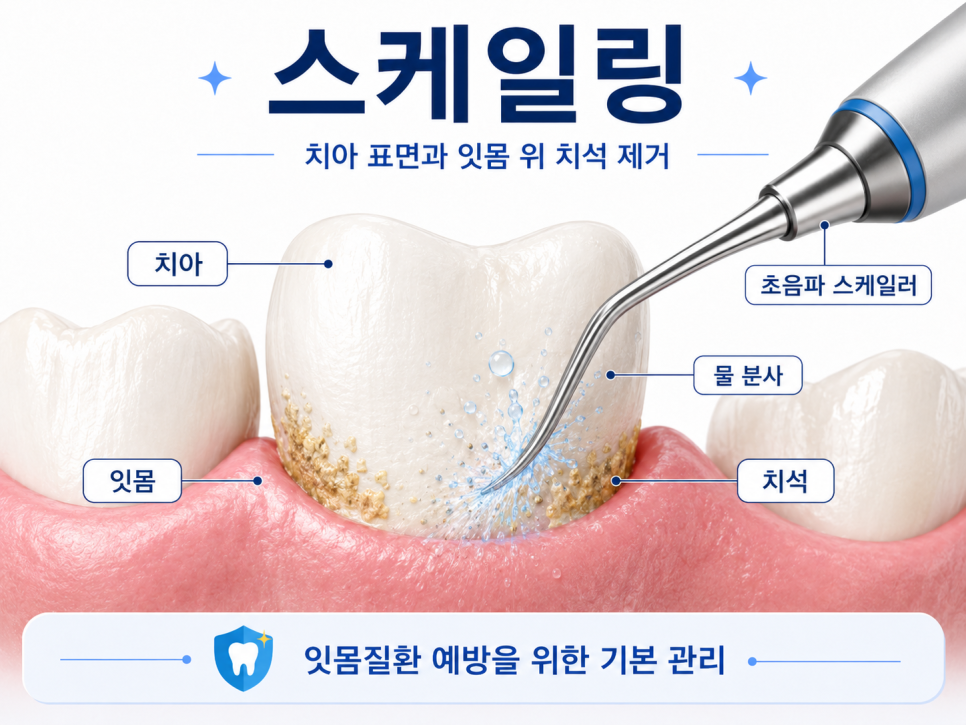
Many people think of scaling simply as "cleaning the teeth thoroughly."
It is true that removing tartar makes the tooth surface smoother and leaves your mouth feeling refreshed.
However, the most important purpose of scaling is not cosmetic; it is the prevention of gum disease.
In Korea, people aged 19 or older who are enrolled in National Health Insurance or are dependents can receive scaling covered by health insurance once a year, even if they have no particular symptoms.
It is covered once a year from January 1 through December 31, and if you do not receive it that year, it cannot be carried over to the following year.
So you should make sure to receive it once every year, right?
However, there is one important point.
Once a year is not sufficient for everyone.
People who build up tartar easily,
people who smoke,
people whose gums bleed frequently,
people with diabetes,
and people with existing periodontitis
may find that once a year is not enough.
In these cases, care is often needed at three- or six-month intervals.
The frequency of scaling should not be determined simply by the calendar;
it should vary according to the condition of each patient’s gums.
- If you keep postponing scaling, tartar can move below the gumline.
Tartar initially adheres thinly between the teeth and gums.
At this stage, it can be removed thoroughly with scaling alone.
The problem is when this condition is left untreated for a long time.
As tartar continues to accumulate, the gums become inflamed,
and they may begin to swell or bleed even when you brush your teeth.
At this stage, the condition may still be considered mild gingivitis,
and many cases improve with annual scaling and proper brushing care alone.
However, if the inflammation continues for a long time, tartar is no longer found only above the gums;
it moves below the gumline, toward the tooth roots.
From this point on, it is difficult to resolve the problem with simple scaling alone.
Even if the tartar visible from the outside is removed, inflammation and tartar remaining deep inside the gums can continue to weaken the supporting jawbone.
This is what we commonly call "periodontitis" or "gum disease."
Unlike a cavity, periodontitis is not a condition that suddenly becomes severely painful one day.
Rather, it often progresses slowly and is discovered only when the teeth begin to move
or when you feel that you have less strength when chewing.
That is why extra caution is needed.
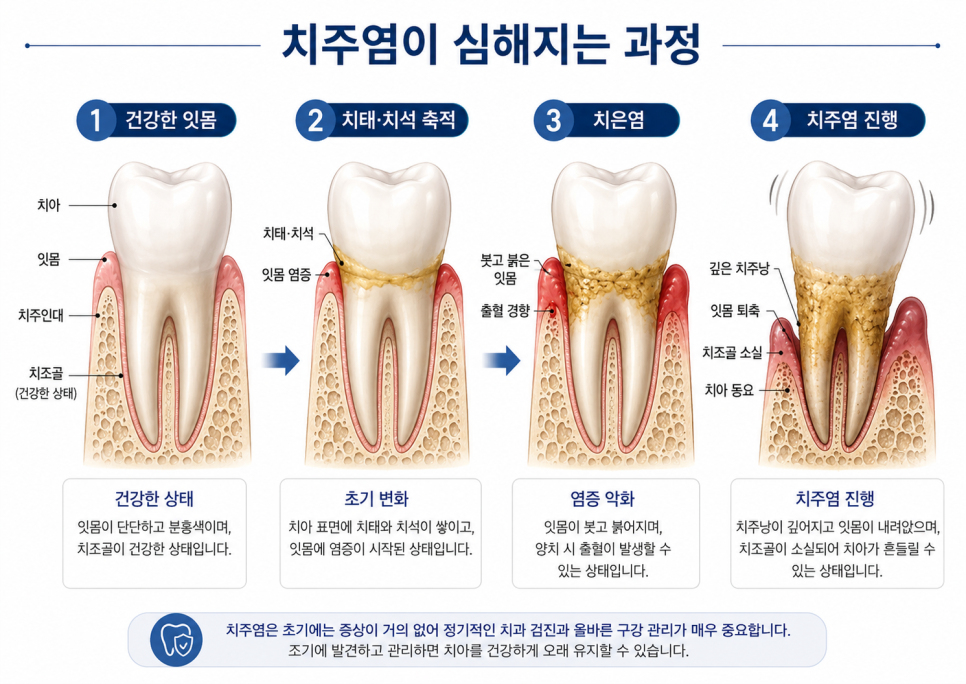
Patients often ask, "Why has the bone supporting my gums been lost when I never felt any pain?"
However, gum disease often progresses without significant pain in its early stages.
If your gums bleed, swell frequently, your breath has become noticeably worse, or you feel that spaces are opening between your teeth,
these may be signals from your gums.
Gum Disease Checklist
-
My gums bleed when I brush my teeth
-
My gums are swollen
-
My bad breath has worsened
-
I feel a dull ache when chewing
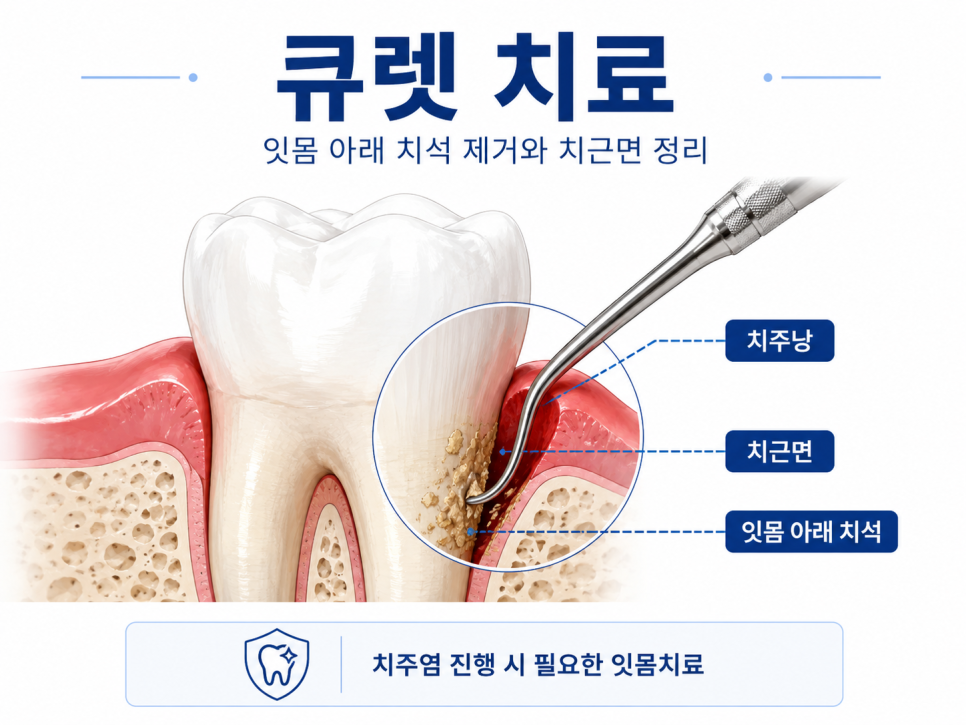
- If periodontitis has progressed, gum treatment—not scaling—is needed.
Scaling is a basic treatment that removes tartar from the tooth surface and above the gumline.
However, when periodontitis has progressed and the gums are swollen or uncomfortable, what is needed is gum treatment.
Some patients have received gum treatment before, while others are having it for the first time.
Gum treatment is one of the most effective treatments for preventing and treating periodontitis.
Another important point is that gum treatment is also covered by health insurance.
Therefore, rather than simply worrying about the cost,
it is important to first check what stage your gum condition is currently in.
I would like to show you a photo of a patient with severe periodontitis whom I treated today.
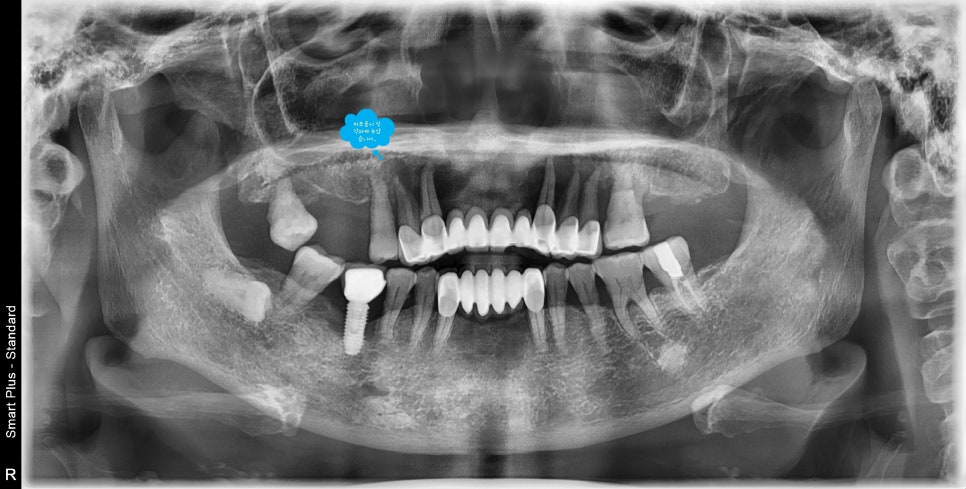
The cases I find most unfortunate during treatment are those in which patients come in too late,
and teeth that could have been used for many more years with proper care ultimately have to be extracted.
Once natural teeth are lost, they cannot be brought back.
Although implants are certainly a good treatment option,
it is best to preserve and use your own teeth for as long as possible.
In that sense, gum treatment is one of the most basic
and highly effective treatments for preserving natural teeth.
Because I consider gum treatment so important, I personally provide it for each patient.
That is why some patients return because they say their gums feel especially clean and refreshed afterward.
Some patients even say, "I came because I heard that the director personally provides the gum treatment."
At Every Dental, we do not view gum treatment as something to simply delegate to a dental hygienist and consider finished.
Gum treatment is not a one-time procedure that ends after a single visit; it is the beginning of care aimed at helping you use your own teeth for a long time.
If you have postponed scaling for a long time, your gums bleed when you brush, or your gums swell frequently,
do not simply dismiss it as fatigue.
It is a good idea to have your gums examined at least once.
Every Dental in Naebalsan-dong calmly explains the treatments needed so that patients can use their natural teeth comfortably for as long as possible.
If you are wondering whether you are at the stage where scaling is needed or whether gum treatment is also necessary,
please feel free to visit us and have your current gum condition checked.