Hello.
I’m Dr. Soo-kyung Lee, a dental specialist and director of Every Dental Clinic.
One question I hear most often during implant consultations is:
“How much does an implant cost?”
It is a perfectly reasonable question.
Cost is important.
However, after seeing patients in the dental office for many years, I often find myself thinking that implants are not a treatment that can be judged by price alone.
With an implant,
is it really enough just to have it placed to be able to use it comfortably?
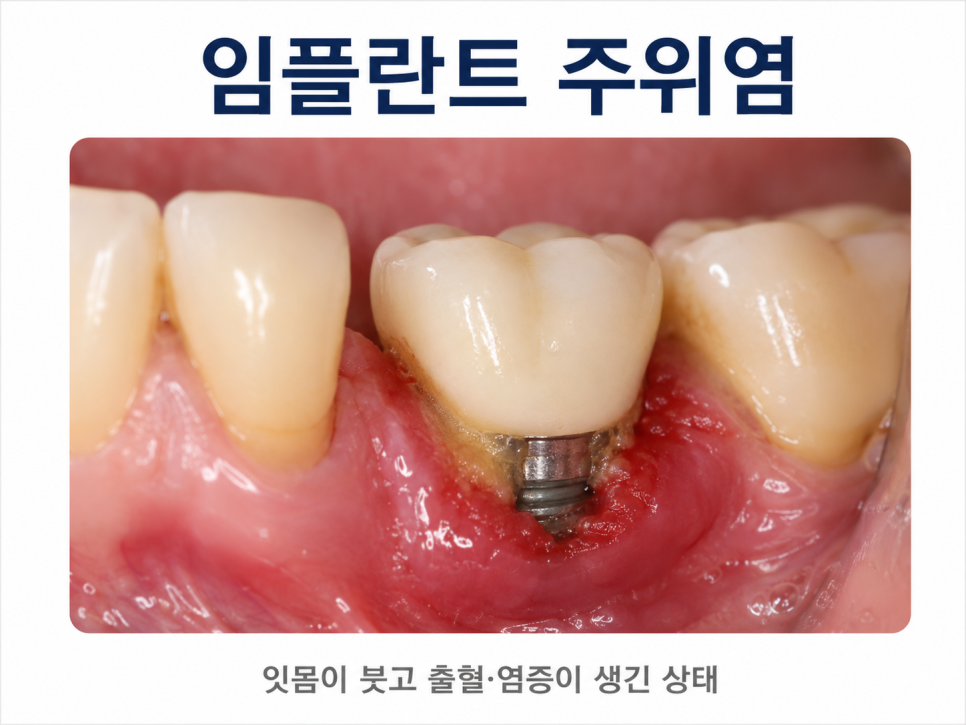
“I’m uncomfortable because of the implant, and I can’t chew with it.”
Many people come to us saying this.
An implant is not simply a treatment involving the placement of a single screw.
An artificial tooth root is placed where the tooth is missing, and an abutment and prosthesis are connected on top of it.
We chew with that tooth every day.
An implant receives force hundreds of times a day.
It encounters hot and cold foods and sometimes has to withstand the force of clenching the teeth.
That is why, when I explain implants, I say:
“How much you pay for placement is important,
but where and how it is placed, what type of prosthesis is placed on it, and how it is maintained
are more important.”
An implant’s lifespan is not the same as the lifespan of the product.
It is closer to the “result of planning and maintenance.”
- The implant’s position determines its lifespan.
The first thing to consider with an implant is the placement position.
It is not simply placed wherever there is bone.
The shape of the tooth that will be placed later and the forces involved in chewing must also be calculated.
Natural teeth have a cushioning structure called the periodontal ligament.
It absorbs small amounts of force when you chew.
However, implants are directly integrated with the bone.
The way they receive force is different.
That is why the direction of force is important.
Ideally, chewing forces are transmitted stably along the center of the implant.
Conversely, if a great deal of force is applied sideways, problems may occur.
The screw may loosen.
The prosthesis may break.
The surrounding bone may be placed under excessive stress.
In some cases, the implant may even become exposed, as shown in the photo below.
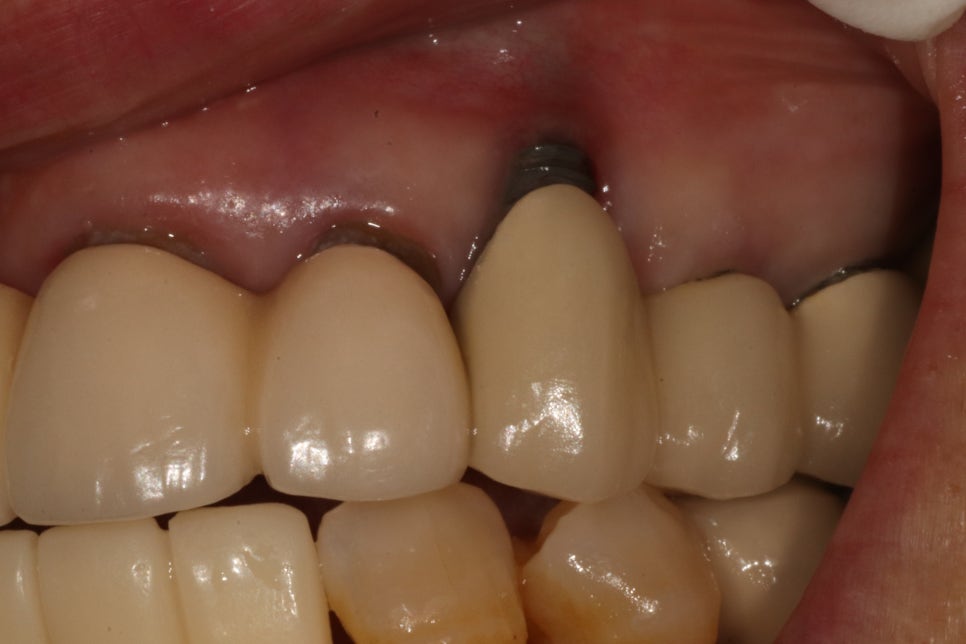
This is why the direction of occlusal forces must be considered from the time of surgery.
You need to find a position where you can chew comfortably for a long time—not merely a position where the implant can be placed.
Whether this is considered when performing implant surgery,
or whether surgery is simply performed wherever there is bone,
is an important distinction.
The placement depth is also important.
If it is too shallow, the shape of the prosthesis may be unfavorable.
It may create a shape that traps food easily, meaning you may have to worry about food becoming stuck every time you chew.
If it is too deep, gum care may become difficult.
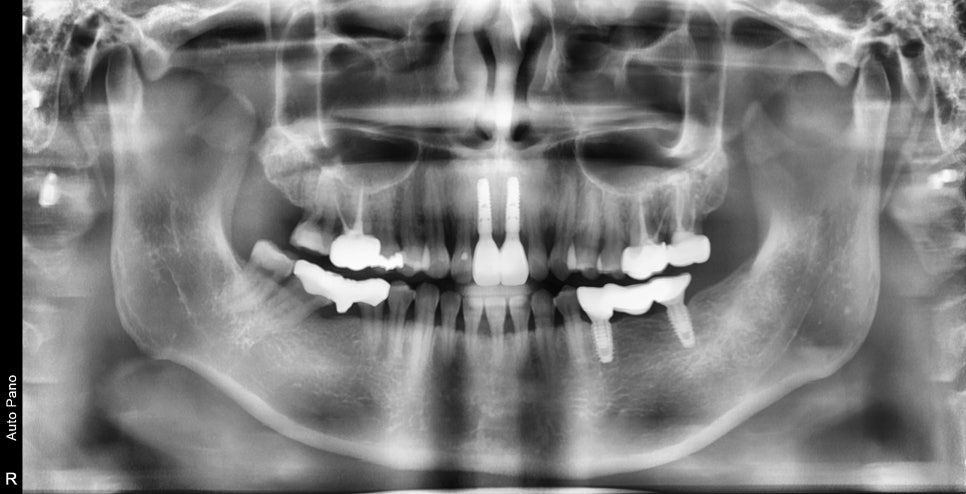
At Every Dental Clinic, we use 3D CT before implant surgery to check the width and height of the bone.
We also examine the location of the nerves, the location of the maxillary sinus, the distance from the surrounding teeth, and the direction of the occlusal forces that will be applied during chewing in the future.
When necessary, we use a digital guide to implement the planned position and direction more consistently.
A digital guide is not equipment that replaces the dentist’s judgment.
It is a tool that helps carry out diagnosis and planning more accurately.
Good implant surgery does not simply mean fast surgery.
It means placing the implant in the planned position, in the planned direction, and to the necessary depth.
- Prosthetic design determines the implant’s lifespan
Is an implant finished once it has been placed?
No.
The design of the prosthesis on top of the implant has a significant effect on how long it can be used.
Patients are generally very interested in the implant root.
They ask which company made the product, whether it is domestic or imported, and how much it costs.
Of course, the material is also important.
However, the part used to chew food every day is the prosthesis placed on top.
The component that connects the prosthesis to the implant is the abutment.
An abutment is the intermediate structure that connects the implant fixture and the crown.
In some cases, a prefabricated abutment is used,
while in others, a custom abutment is made to fit the patient’s gums and the position of the implant.
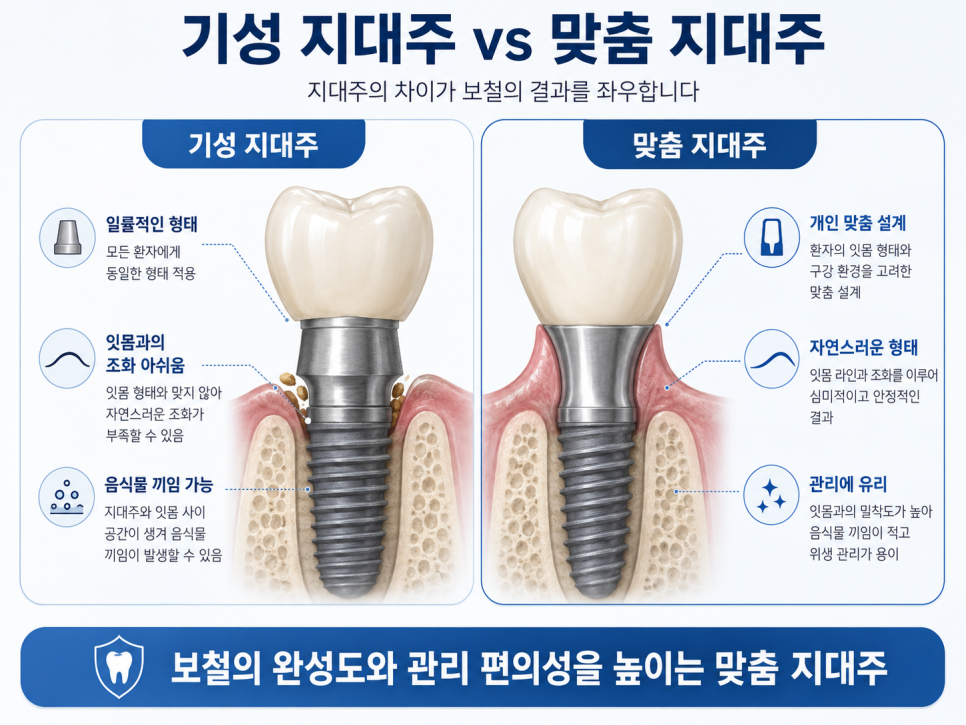
Whenever possible, Every Dental Clinic prefers custom abutments.
Although laboratory and material costs are much higher than those for prefabricated abutments, we provide custom abutments.
The reason is simple.
Everyone has a different gum shape. The location of the missing tooth also differs from person to person.
The angle at which the implant is placed is different as well.
A prefabricated component with the same shape cannot always fit every patient.
In some cases, the area between the gums and the prosthesis may feel unnatural.
The shape may also allow food to become trapped easily.
A structure that is difficult to clean may be created.
Custom abutments take the implant’s position and the shape of the gums into account
and help the prosthesis emerge in a more natural way.
They are important in areas where appearance matters, such as the front teeth.
They are also important in areas that receive strong chewing forces, such as the molars.
When creating implant prostheses, I do not look only at whether they have an attractive shape.
I check whether they can be cleaned easily.
I check whether they are less likely to trap food.
I check whether chewing forces are concentrated on one side.
I also check whether they can be inspected and maintained later.
These factors are ultimately connected to the implant’s lifespan.
Among people who come for consultations about re-treatment, some began experiencing discomfort because of the prosthetic shape rather than the implant itself.
They come in because food keeps getting trapped, their gums swell, or there is an odor.
Upon examination, inflammation may have progressed in the gums around the implant.
Of course, the cause cannot be attributed to just one factor.
Brushing habits, smoking, diabetes, and existing periodontal disease can also have an effect.
However, it is clearly important to design the prosthesis from the beginning in a form that is easy to maintain.
Implant treatment requires both the skill to place the implant and the skill to make it function for chewing.
That is why Every Dental Clinic carefully considers the prosthetic stage after surgery as well.
- Implants designed for long-term use begin with maintenance.
Have you been receiving regular care since having your implant placed?
The period after an implant is placed is even more important.
Regular checkups are necessary.
The bite must be examined.
It is necessary to check whether the screw has loosened.
It is also necessary to check whether food is becoming trapped around the prosthesis.
I always tell patients who have received implants:
“You should come in even if you have no pain.”
By the time pain develops, inflammation has often already progressed.
Implant maintenance should not begin after pain appears.
The key is to detect problems while they are still minor.
People who have a habit of clenching their teeth or who grind their teeth should be especially careful.
If excessive force is repeatedly applied, problems may develop in the prosthesis or screw.
If necessary, bite adjustment or a night guard may be considered.
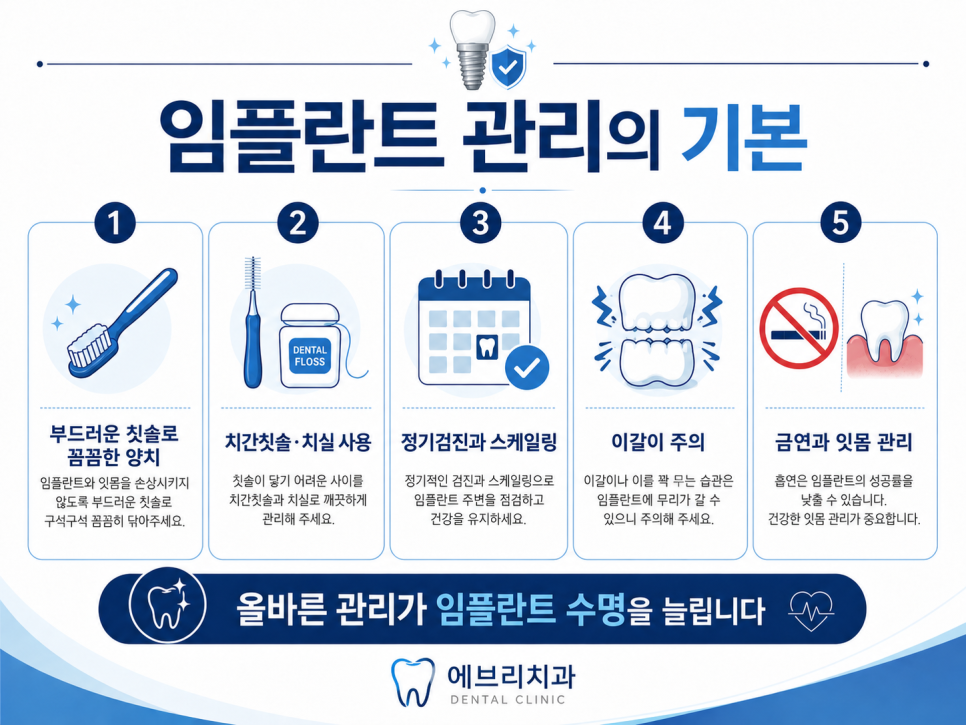
At Every Dental Clinic, we continue to examine both gum condition and the bite after implant treatment.
We do not want to stop at simply saying, “It has integrated well.”
We check how you are chewing, where the most force is being applied, and whether the implant is easy to maintain.
An implant is not a treatment that ends once it has been placed.
It is a treatment that involves ongoing care so that you can use it for a long time.
The price of an implant is important.
However, it is difficult to judge whether an implant is good based on price alone.
Accurate diagnosis. A placement direction that takes the bite into account. An appropriate placement depth.
A surgical plan using a digital guide. Custom abutment and prosthetic design. And regular maintenance.
All of these processes together determine an implant’s lifespan.
A good implant is not determined only on the day of surgery.
It should be considered treatment designed to allow you to chew comfortably for a long time.
At Every Dental Clinic in Naebalsan-dong, we use 3D CT to check the condition of the bone and the location of the nerves.
When necessary, we use a digital guide.
During the prosthetic stage, we consider both the bite and ease of maintenance.
Rather than focusing on the moment the implant is placed,
we consider the time during which you can chew comfortably with that tooth for a long time to be more important.
If you are considering an implant, before comparing prices alone, ask yourself:
“Is this implant being planned so that I can use it for a long time in my mouth?”
Every Dental Clinic will explain the process carefully
and work with you to establish a treatment plan suited to your condition.