"There are so many lifting methods—thread lifting, laser lifting, radiofrequency lifting, ultrasound lifting, ... I’m confused about which one is right for me."
"When people are worried about sagging skin, plastic surgery doctors usually recommend ‘thread lifting.’ Why is that?"
Hello, this is Sinsa Station Ribbon Plastic Surgery.

The questions above are ones I have heard very often from patients while performing lifting-related procedures and surgeries.
Whenever I hear questions like these, I usually say, "The recommended method differs depending on the purpose."
However, when there is sagging skin, many patients want an immediate lifting effect.
So, if we look only at the "effectiveness" aspect, thread lifting can be said to be more immediate and longer-lasting compared with other procedures.
In addition, thread lifting produces a stronger effect and appears faster than other procedures.
Because the result varies depending on how much force is applied with the inserted threads and in what direction they are pulled, the outcome can differ greatly depending on the practitioner's skill.
Naturally, the more experience a plastic surgery specialist has with thread lifting, the more stable the results they can help produce, which is why it is more often recommended.
In my case as well, I have been performing thread lifting since around 20 years ago, when it was introduced in Korea, so I have a great deal of experience with it and am quite confident in this area.
If you have concerns like the ones below, I recommend thread lifting, so please focus a little and read the rest of this post to the end.

#Thread lifting is especially suitable for people like this compared with other lifting methods!
| ▲ Sagging skin is clearly visible!▲ I want noticeable lifting results with a single procedure!▲ I need point-specific lifting rather than lifting the entire face!▲ I want both collagen regeneration and lifting effects at the same time! |
Thread lifting: how does it lift the skin?
We should first take a moment to look at the concept of "lifting."
Lifting means face lifting, or pulling the skin upward.
As aging progresses, the regenerative ability of cells declines, spaces form between cells, and the body's own tissues lose strength, causing the overall skin to sag downward.
The overall process of improving this kind of "sagging" can be understood as "lifting."

"But doctor, many people distinguish thread lifting from ultrasound, radiofrequency, and laser lifting, right?"
Because there are so many procedures with the name "lifting," patients often get confused.
Devices that use lasers, ultrasound, or radiofrequency target the skin and subcutaneous tissue layers, intentionally causing some damage, and then use the principle of collagen regeneration during the recovery process.
Of course, there may be slight differences in effectiveness depending on the device and the energy principle, but because the core is "tissue regeneration," there is the inconvenience of having to repeat the procedure continuously to expect the desired lifting effect.
In other words, while it is meaningful in terms of restoring the skin's structure in a healthy way, if you look only at "lifting" itself, it still has certain limitations in terms of results.
However, thread lifting involves inserting threads that are harmless to the body into the skin and pulling with physical force, so if you want visible external changes, it can be a more reasonable choice.
Also, depending on which product is used, thread lifting can be performed either for tightening (collagen remodeling) or for lifting, depending on the goal, which is an advantage that makes it applicable from younger adults to middle-aged adults.
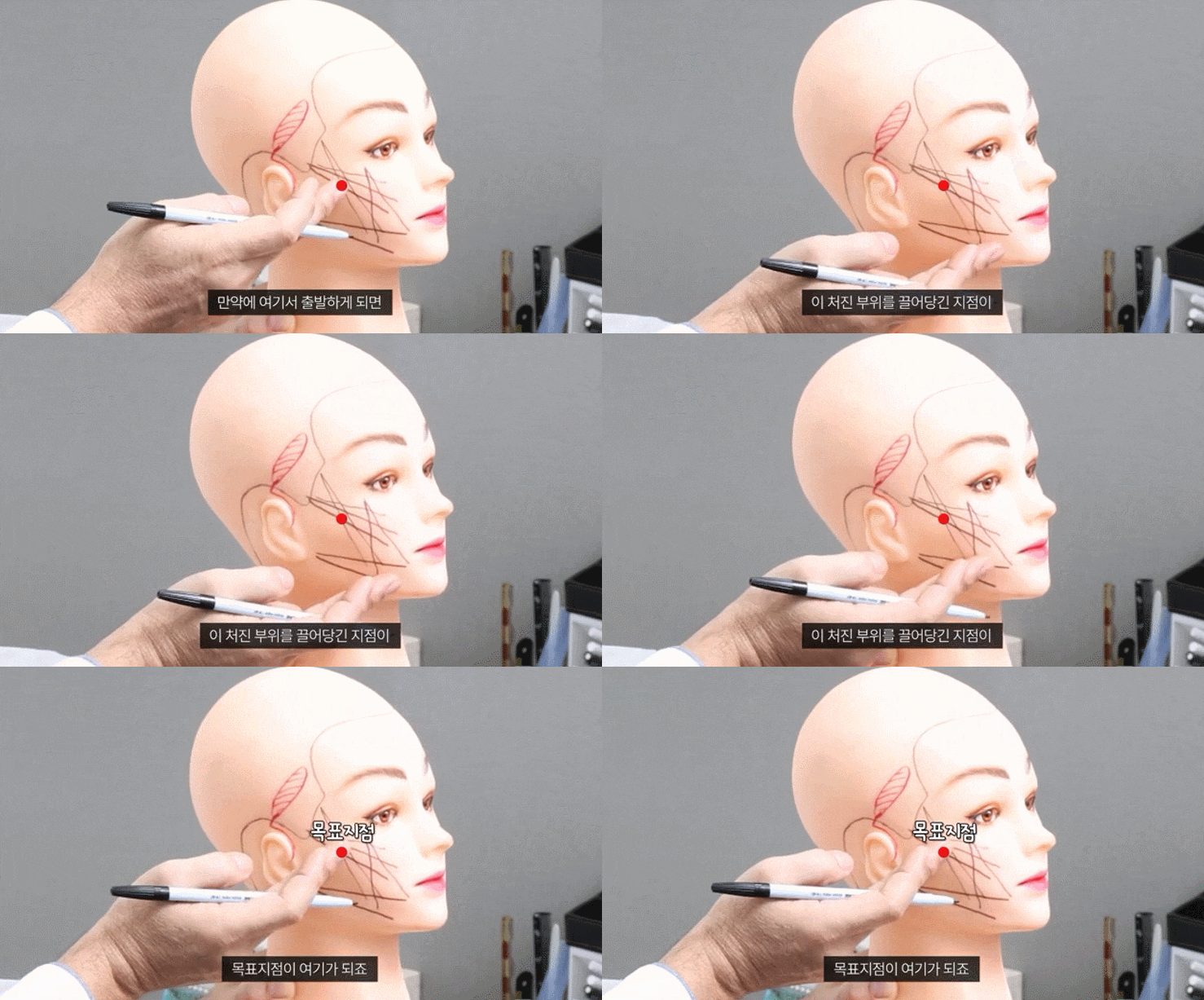 What is the key point of thread lifting?
- Point-specific lifting is possible
In general, lifting procedures using laser, ultrasound, or radiofrequency devices have the inconvenience of making it difficult to lift only a specific area.
So, at minimum, about one-third of the face area should be secured for the procedure.
By contrast, thread lifting allows point-specific lifting only for the area that needs attention—such as neck wrinkles, nasolabial folds, or buccal fat/jowl area—so it can be a good choice if there is a particularly concerning area.
- Relatively long maintenance period
For those who find frequent visits difficult, or who feel burdened by repeated procedures, thread lifting can be a reasonable alternative.
Since the type and number of threads suited to the purpose are determined before the procedure and then designed accordingly, repeated procedures are rarely needed until the maintenance effect is completely lost.

However, because thread lifting is a procedure in which surgical design is important, it is somewhat influenced by the practitioner's skill.
If the practitioner lacks experience, it is that much harder to achieve good results.
Therefore, if you are considering the procedure, please first check the experience of the medical staff who will perform it directly, and be sure to confirm how carefully the design is planned in advance.
If you need help, you can also contact Sinsa Station Ribbon Plastic Surgery.
Thank you for reading this long post.