Hello, this is Sinsa Station Ribbon Plastic Surgery.

If you are reading this post, you may be looking into ptosis correction because your eyes give you a sleepy impression.
But wait a moment.
Is there another surgery besides ptosis correction that can improve a sleepy-looking impression?
If you search about this, you will actually find several surgical methods, such as ptosis correction, ptosis repair, or upper blepharoplasty.
From a patient’s perspective, it is natural to feel confused about which surgery is suitable and what the differences are between them.
Of course, if you visit a plastic surgery clinic, we will guide you to the surgery that fits the current condition, circumstances, and needs of your eyes. But if you have a general idea of what each surgery does before coming in, the consultation can proceed more smoothly.
So in today’s post, we would like to take a look at the parts people commonly confuse, based on ptosis correction.
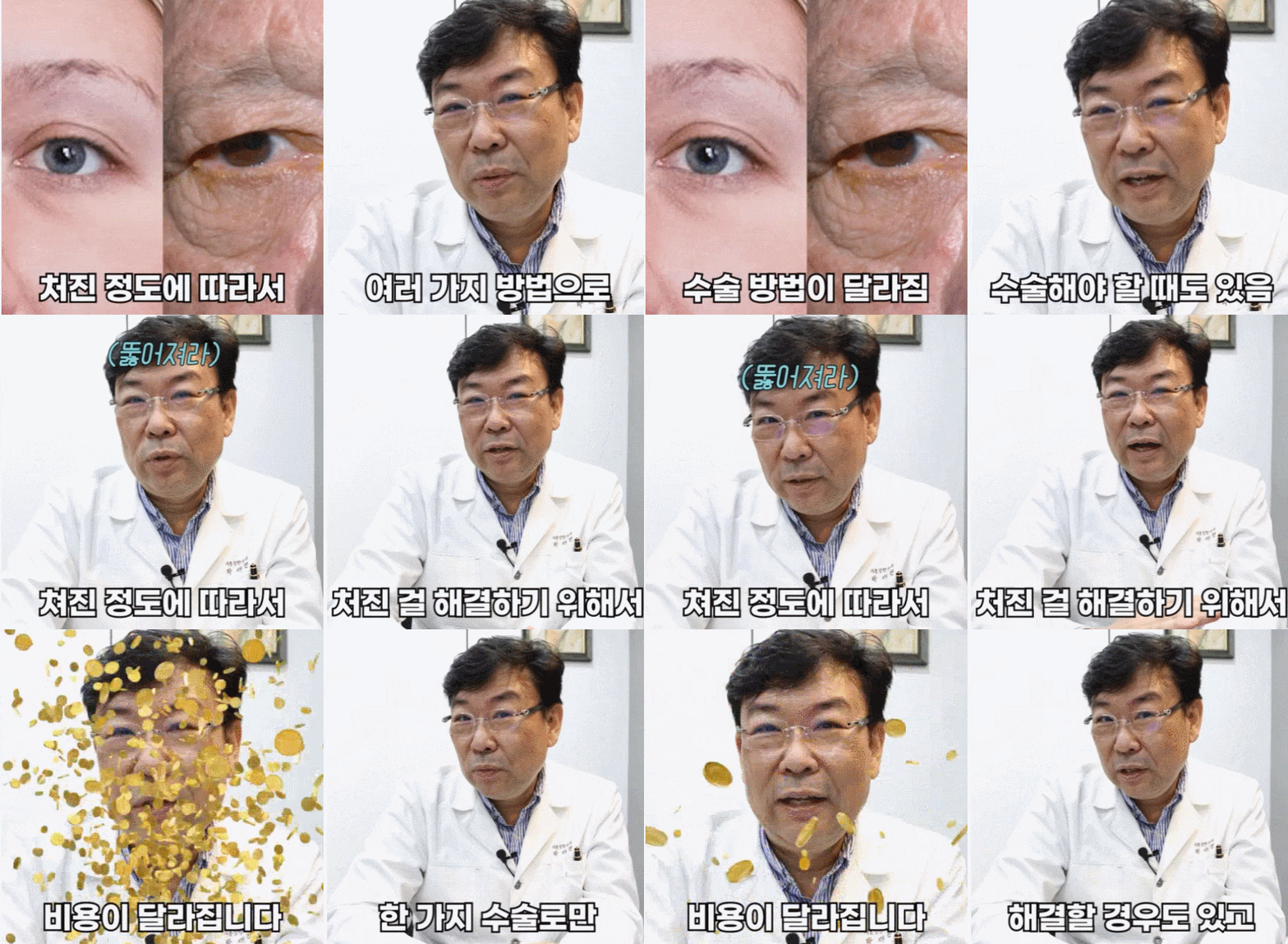
Our lead surgeon, Dr. Park Jae-hyun, a board-certified plastic surgery specialist, will explain only the key points, so please read comfortably and feel free to contact us anytime if you have questions.
Let’s begin.
Q. What is ptosis correction?
Ptosis correction is a surgery that corrects drooping upper eyelids caused by weakening of the levator palpebrae superioris muscle, which opens the eyes.
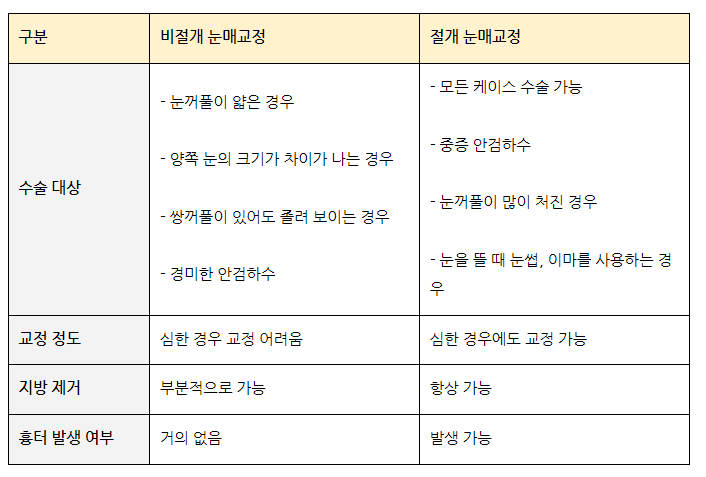
There are two types of ptosis correction: incisional and non-incisional.
Non-incisional ptosis correction can be performed for people with thin eyelids, those whose eyes still look sleepy even with double eyelids, and cases of mild ptosis.
In severe ptosis, correction may be difficult. Fat removal can also be done only in part, but the risk of scarring is lower, so the burden of surgery is relatively light.
On the other hand, incisional ptosis correction is used for people with severe ptosis, markedly drooping eyelids, or thick eyelid skin.
It can also be performed even in cases of very severe ptosis, which is an advantage because it can be applied to a wide range of cases.
Since the eyelids are drooping, a sufficient amount of fat can also be removed.
However, there is a possibility of scarring, so this must be considered during the procedure, and scar prevention through proper aftercare after surgery is necessary.
If you look at the table below, you can easily see the differences between non-incisional ptosis correction and incisional ptosis correction.
─
What is the difference between ptosis correction and upper blepharoplasty?
Ptosis correction is used when the levator palpebrae superioris muscle, that is, the muscle’s strength has weakened and caused the eyelid to droop.
On the other hand, upper blepharoplasty is a method used to address problems caused by tissue in the upper eyelid sagging downward due to aging.
Upper blepharoplasty method
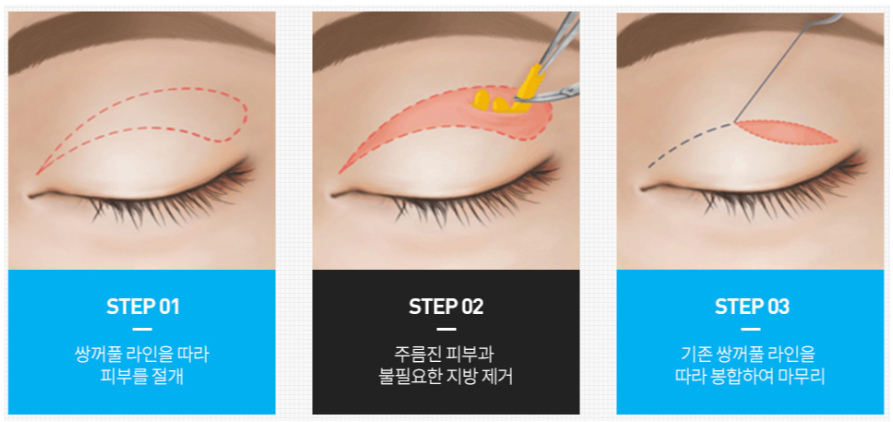
Therefore, ptosis correction is usually recommended for younger patients in their 20s and 30s who have a sleepy-looking impression, while upper blepharoplasty is recommended for middle-aged patients in their 40s and 50s and older.
Sometimes there are people in their 20s who look sleepy because of ptosis.
Usually, when people have this concern, many think that double eyelid surgery will be the alternative.
However, if you already have sleepy-looking eyes and only undergo double eyelid surgery without ptosis correction, the double eyelid line may become larger, creating a risk of a “sausage eye” appearance, where the eyes look even smaller.
In addition, while the muscle that opens the eyes, the eyebrows, and the forehead remain involved, the eyes can look even sleepier.
In particular, there is a chance that the eyes may still appear closed or that the result may loosen, so among younger patients who have a sleepy-looking impression, we recommend combining ptosis correction with double eyelid surgery.
We have answered only the points that many of you tend to confuse, so we hope this has helped clear up some of your questions. ^^
You can also get more detailed information about this through our Ribbon Plastic Surgery blog or YouTube channel.
The best option is to visit us in person and receive a direct diagnosis of the surgical method that fits the condition of your eyes.
If you need help, please come in for a consultation.
Thank you for reading this long post.