Hello, I’m Park Jae-hyeon, the CEO and lead surgeon of Ribbon Plastic Surgery near Sinsa Station. ^^

If you are considering lifting, it is worth taking a closer look at the signs of skin aging.
Our body is made up of bones and flesh.
Flesh surrounds the outside of the bones. In some areas it is firmly attached to the bone, while in most areas it is loosely attached, leaving a certain amount of space underneath.
In the face, the front area is loosely attached, which allows for a wide range of facial expressions, but it is also a structure that sags relatively easily. On the other hand, the side areas with the hairline are firmly attached to the bone, so sagging tends to be less noticeable.
Even if the skin was taut when you were young, as you age that space becomes looser, so the skin starts to sag forward, some areas bulge out, and others become severely sunken. That is how aging progresses into an uneven shape.
The epidermis and dermis, which make up the outermost layers of the skin, are mainly aged by ultraviolet rays.
As collagen and elastin decrease, problems such as loss of elasticity and wrinkles occur.
However, aging is not limited to just these layers.
In the subcutaneous fat layer beneath them, volume decreases and the tissue sinks downward, while the muscles also lose elasticity and become less able to firmly support the skin.
At times like this, a lifting procedure is something to consider.
Lifting is broadly divided into two types: procedures intended to improve the elasticity of the epidermis and dermis, and procedures that physically pull the skin.
Because the former is mainly about tightening, plastic surgery clinics often perform procedures centered on the latter, such as facelifts or thread lifting.
Among these, today I’d like to look at the "3-Step Temple Lift," which is good to have together with thread lifting.
Because it involves only a small scalp incision near the temple area, recovery is relatively quick and the scar is not visible from the outside.
However, in most cases, it is not performed as a temple lift alone; rather, it is done together with thread lifting to increase fixation and maximize the benefits of the thread lift.
I will cover this in more detail in the following article, so please read comfortably and I hope you find it useful. ^^
—
Why is the 3-Step Temple Lift good to combine with thread lifting?
Thread lifting is often compared with facelifts.
If we look only at the strength of the lift and how long it lasts, a facelift can offer better results.
A facelift is performed by making an incision along the hairline, pulling the skin in the desired direction and with the desired amount of tension, removing excess tissue, and then suturing it closed. This makes its effects more definite.
However, it also places a greater surgical burden on the body, and the results may vary depending on how the dissection is performed, so it is important to keep that in mind.
Thread lifting, on the other hand, uses a relatively simple material called threads, so it has the advantage of allowing immediate results without surgical burden.
That said, even thread lifting can produce different results depending on how it is performed.
The areas most commonly treated with thread lifting are the nasolabial folds and the deep cheek area.
To pull these areas up, threads are usually inserted at a level horizontal to the ear—in other words, in the space between the ear and the eye. At that point, depending on the pulling force, tissue may gather around the cheekbone.
Because the threads are relatively short, if they are inserted on the outer side of the cheekbone and hooked below the deep cheek area before being pulled, the force naturally concentrates only up to the cheekbone, making that area look larger.
If the lifting strength is not very high, this is not a major issue, but if multiple threads are needed, the increased tension can create problems.
This is where the 3-Step Temple Lift comes in.

—
Why is the 3-Step Temple Lift necessary?
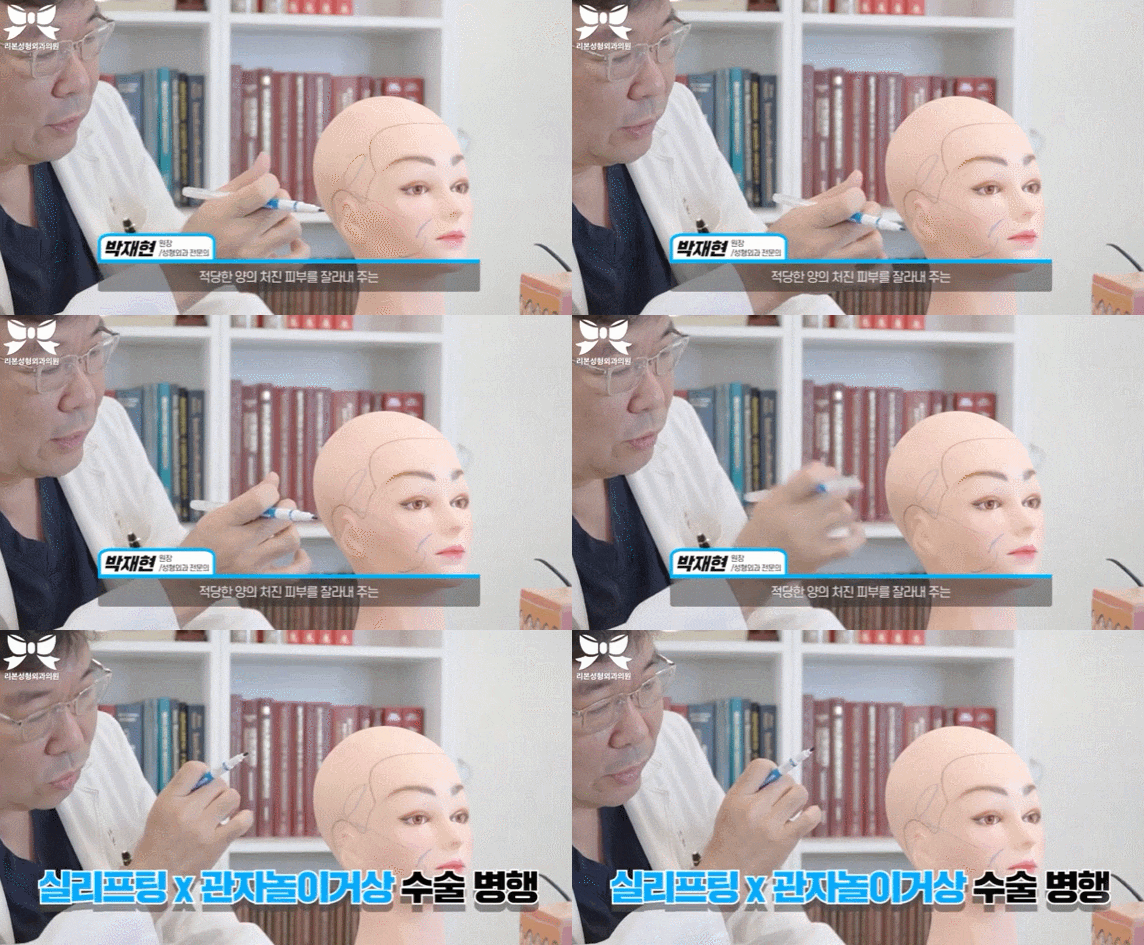
The 3-Step Temple Lift is a surgery in which an incision is made much higher than the area where the threads are inserted, that is, in the hair-covered temple area, and then a portion is removed and sutured closed.
When thread lifting is performed, the tissue that has been pulled up to the cheekbone is lifted even farther upward and then sutured in place, which can lead to a much more satisfying result.
In addition, as I mentioned earlier, the side area of the face, such as the scalp, is firmly attached between the bone and the flesh, so sagging tends to progress more slowly and less severely than in other areas.
By performing the 3-Step Temple Lift, it helps the effects last longer than when lifting is done only in the front part of the face, so it can compensate for the shortcomings of thread lifting.
Therefore, rather than doing thread lifting alone, I recommend combining it with a temple lift to make up for its drawbacks and keep its advantages for longer.
Today, we looked at the need for the 3-Step Temple Lift.
Next time, I will explain how it differs from the conventional temple lift.
Because there are not many places that focus lifting on the temple area, this may feel somewhat unfamiliar.
However, as a board-certified plastic surgeon who has been performing thread lifting since the early days when it first entered Korea, I hope you will understand that this is a surgical method designed based on years of research.
If you visit the clinic in person, you can also check before-and-after photos and surgery reviews from other patients, so please contact us if you need help.
That’s all for today’s post.
Thank you for reading this long post. ^^