Hello, I’m Park Jae-hyun, the chief director of Ribbon Plastic Surgery at Sinsa Station. ^^

As autumn arrives, ultraviolet levels rise and humidity drops significantly, so the number of patients complaining about “skin sagging” has been increasing.
Around this time, inquiries about “thread lifting” also come in more often than usual.
Since I have been performing the procedure since the early days when thread lifting first began in Korea, it seems many people who visit our clinic have a particular interest in lifting procedures.
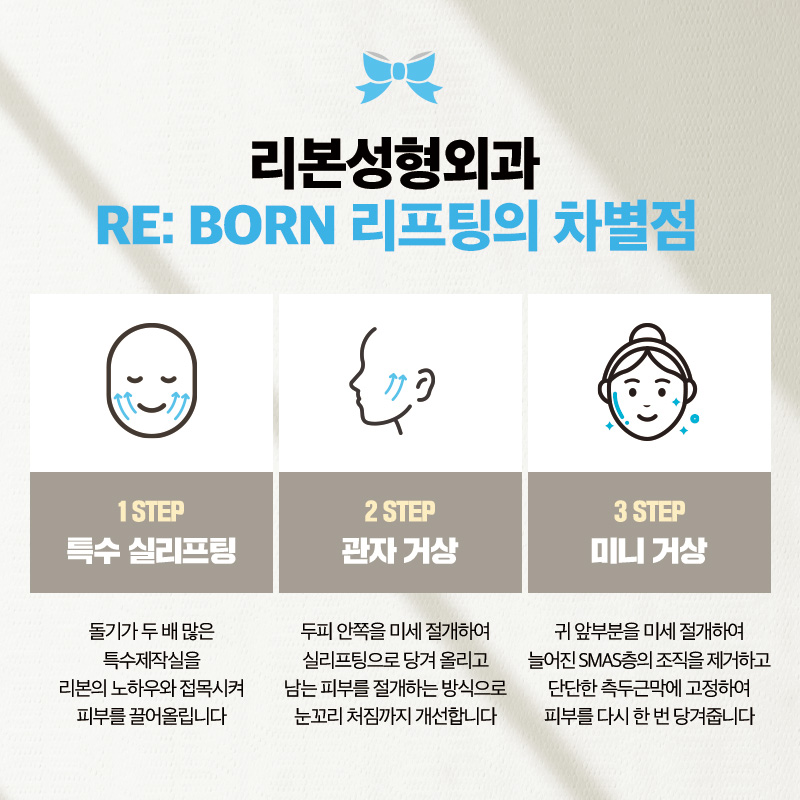
Among them, the 3-step temple lift is one of our representative procedures, which we recommend alongside thread lifting.
It is a more advanced version of the traditional temple lift, designed to produce firmer and more stable results.
Many people are already familiar with information about thread lifting and facelift surgery, but there are still many who do not know much about the “temple lift,” right?
With that in mind, today I’d like to share honest explanations from the perspective of a board-certified plastic surgeon by gathering the questions you often ask about the 3-step temple lift.
I’ll explain why it is done together with thread lifting, why the temples need to be lifted in the first place, and whether it is risky, so please read comfortably and feel free to contact Ribbon Plastic Surgery anytime if you have any questions.
Q. What is the 3-step temple lift?
Simply put, it is a surgery in which an appropriate amount of skin from the area covered by hair—namely, around the temple—is removed, lifted upward, and sutured in place.
An oval-shaped incision is made in the upper scalp, and the weakened SMAS layer and sagging skin surface are lifted at the same time.
Because both temples are lifted, it has the effect of noticeably tightening sagging cheeks and the skin around the jawline.
 Q. Why do you perform it together with thread lifting?
The areas where thread lifting is most commonly used are the bulging deep cheek area and the nasolabial folds in front of it.
At this time, the thread is inserted between the eyes and ears—that is, above the cheekbone—then anchored to the desired area and pulled.
The problem is that because the thread is inserted near the cheekbone and the thread itself is relatively short, the more force you apply, the more the force concentrates on the cheekbone, which can make the area look fuller.
People sometimes say their cheekbones look bigger after thread lifting, and this is the reason.
In a way, the 3-step temple lift can be seen as an additional procedure that helps address this issue.
When significant pulling is needed, it compensates for tissue gathering around the cheekbones by removing and lifting the tissue above them at the temples.
This helps create a smoother lifting line, from the nasolabial folds and deep cheek area all the way up to the hairline, without interruption.
 Q. Why specifically lift the temples?
The scalp is the tissue in our face that is most firmly attached to the bone.
As aging progresses, the scalp also sags downward, but the degree of sagging is clearly less than that of the facial skin.
That is why, even during facelift surgery, the procedure is usually performed by making an incision in the scalp along the hairline, lifting the skin, and securing it to the scalp.
The temple area is also part of the scalp located above the ears, so lifting this tissue can help the effects of thread lifting last much longer.
I have studied thread lifting for a long time, so I am also aware of its limitations.
By lifting the temples together, we can compensate for these shortcomings of thread lifting and enhance the convenience of the procedure, which is why our clinic performs these two procedures together.
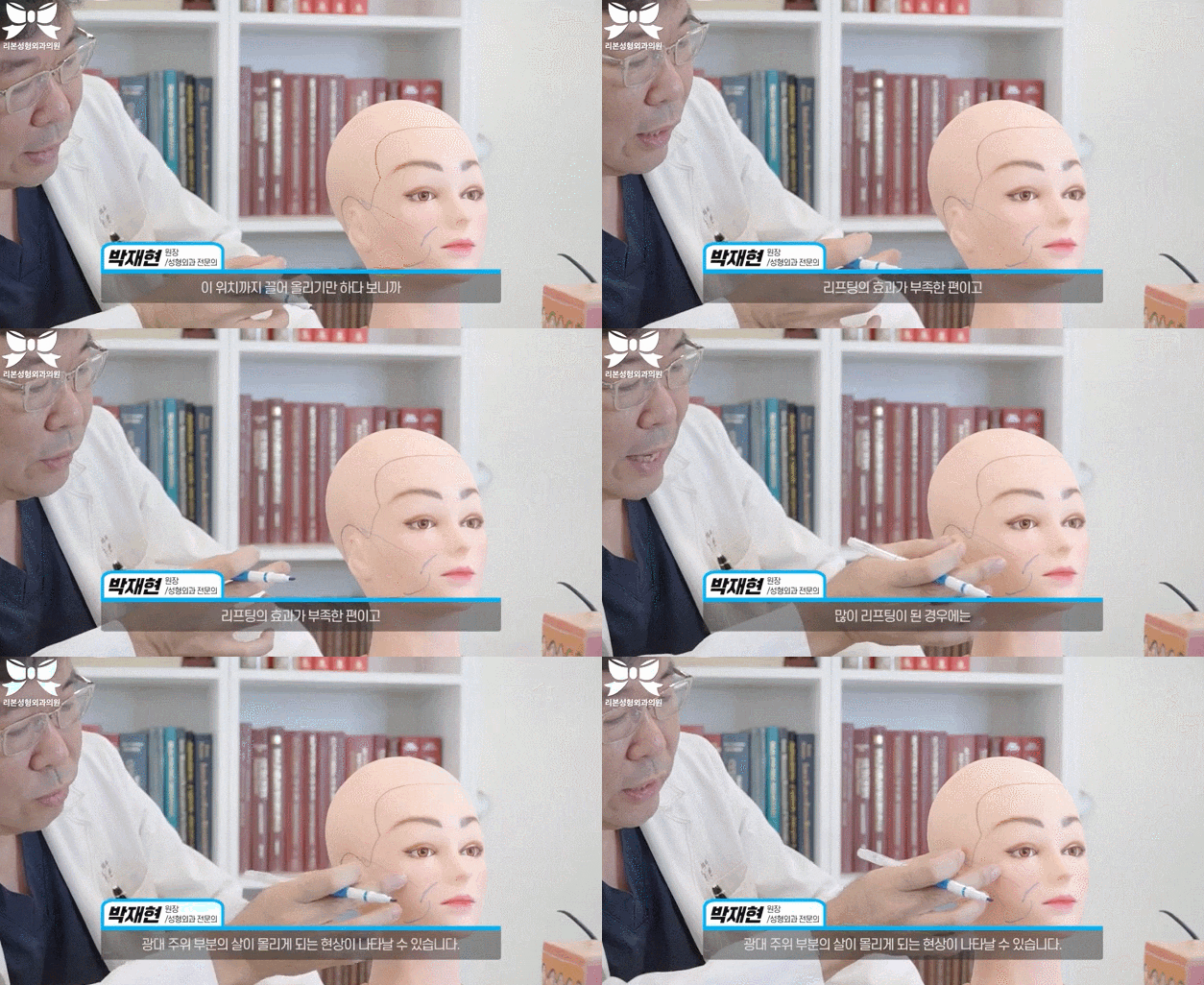 Q. Are there any side effects?
Important nerves and blood vessels pass through the temple area.
So, the key point for success is careful dissection while protecting this area.
Our clinic makes a small incision in the upper scalp to ensure safety, and the incision is performed in a way that preserves the hair roots, so there is not much need to worry about scars after surgery.
Some people are concerned that the scar may be severe, but if the hair roots are protected, hair will grow back over the incision area during the recovery process.
After about six months, even if you lift the hair to check, the incision area is barely visible.
Because only the necessary amount is incised, the surgery time is short, and recovery is relatively faster than with facelift surgery.
Since not many places perform the 3-step temple lift, I’m sure there are patients who find it unfamiliar.
As mentioned earlier, the 3-step temple lift can be done together with thread lifting, and because it can also be expected to last a long time, it is a recommended approach.
Rather than performing unnecessary surgery, we only recommend it when it is truly needed, so if you have any questions about this, please feel free to contact Ribbon Plastic Surgery at Sinsa Station anytime.
Thank you for reading this long post. ^^