Hello, I’m Park Jae-hyun, the chief director of Ribbon Plastic Surgery at Sinsa Station. ^^

"There are so many lifting methods that I’m not sure which one is right for me."
"When you go to a plastic surgery clinic, they usually recommend thread lifting. Why is that?"
"Thread lifting is said to be different from laser lifting. What is the difference?"
It is no exaggeration to say that people spend their entire lives fighting aging.
In particular, skin aging causes a great deal of stress because its effects appear visibly on the surface.
I have also been meeting patients in the clinic for a long time, but if there is one procedure that has been receiving the most attention recently, it would definitely be "lifting."
The questions above are ones I hear from patients very often.
In particular, I am often asked about the differences between thread lifting and other lifting methods, and why plastic surgery specialists especially prefer thread lifting.
The purpose of plastic surgery is to restore tissue that has an outward complex or has been affected by congenital or acquired changes.
To put it more simply, you could say it is a field that places more emphasis on "physical change" than other specialties.
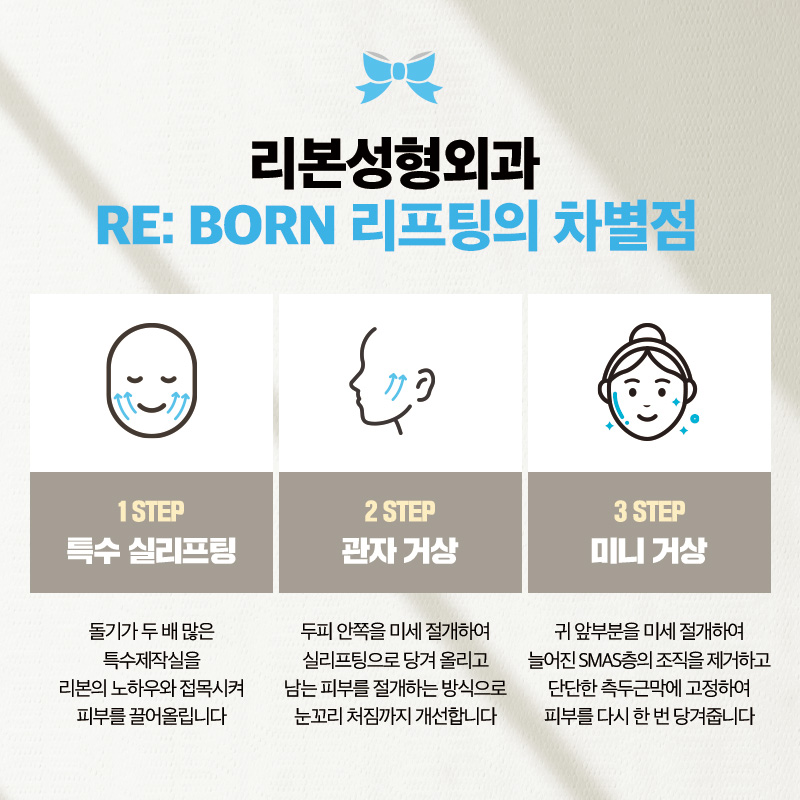
Thread lifting is a procedure in which physical changes are more clearly noticeable than with ultrasound, radiofrequency, or other laser lifting methods.
When many people think of lifting, they prefer a method where they can feel a change even after just one treatment.
This is exactly the kind of procedure worth considering at that time.
You should understand that each department has a slightly different main purpose when inducing anti-aging.
In some cases, the goal is to stimulate collagen by tightening deep within the skin, while in others, such as plastic surgery, the main purpose is to induce physical changes.
In other words, thread lifting is a method recommended for those who want to experience a noticeable change with a single treatment. ^^
In today’s post, I will explain the thread lifting method we perform at our clinic.
Please read comfortably, and I hope you can take away useful information.
─
Let’s look at the characteristics of thread lifting.
Thread lifting refers to a procedure in which dissolvable medical threads are inserted under the skin to induce collagen remodeling and lifting.
Procedures using lasers, ultrasound, or radiofrequency devices have generally had the drawback of making it difficult to lift only specific areas.
For example, if everything else is fine but you are particularly concerned about a double chin or prominent buccal fat, it is difficult to focus lifting on just that area.
That is why, when performing the procedure, it has a characteristic of needing to cover at least one-third of the face.
However, thread lifting allows point-specific lifting for targeted areas such as the nasolabial folds or buccal area.
Because it focuses on lifting specific areas, it allows for much more detailed design and stronger lifting.
Also, since the type and number of threads are decided and designed at the time of a single insertion, repeat procedures are rarely needed until the effect begins to diminish.
Of course, compared with surgical lifting such as a facelift, the maintenance period is shorter.
To address this, our clinic uses the following approach.
─
Combination with the 3-step temple lift
Of course, thread lifting can also be performed on its own.
That is, if you are considering thread lifting because surgical lifting feels burdensome.
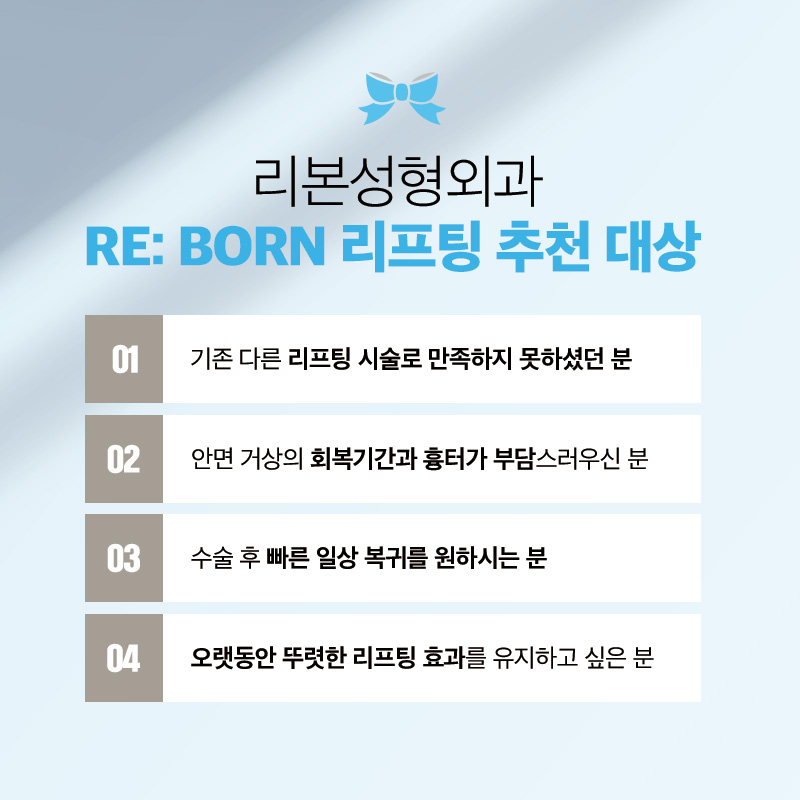
However, for those who want a longer maintenance period and want to reduce the side effect of the cheekbones appearing more prominent, we recommend combining it with the "3-step temple lift."
The 3-step temple lift is a surgery in which a moderate amount of tissue covered by the hair, that is, a much higher area than where the threads are inserted during thread lifting, is removed.
Our skin and muscles are attached to the bone, and the amount of space included in this area varies slightly by region.
For example, the more toward the front you go, the more space there is and the more sagging occurs, while the scalp and sides are attached much more firmly to the bone, so there is less sagging.
Accordingly, lifting the temples together slows skin sagging and provides a much longer-lasting effect.
In addition, thread lifting is usually performed by inserting threads between the cheekbone and the ear.
At this time, if the sagging is too severe, more threads may be used, which can increase the force concentrated around the cheekbone.
This can cause the tissue around the cheekbone to look wrinkled or make the upper face appear larger.
By lifting this area further through partial removal of temple tissue, a much smoother lift becomes possible.
In this way, our clinic performs the 3-step temple lift together with thread lifting to maximize its advantages and compensate for its drawbacks.
(As mentioned earlier, please remember that thread lifting can also be performed on its own.)
Because the incision is made while protecting the hair follicles, after a certain recovery period following surgery, hair grows over the incision site and covers it neatly.
However, since the temples are a somewhat sensitive area, surgery should always be performed by a plastic surgery specialist with sufficient experience.
Please keep this in mind, and if you need help, feel free to visit Ribbon Plastic Surgery at Sinsa Station at any time.
We will only recommend surgery when it is truly necessary.
Thank you.