Hello, I’m Dr. Park Jae-hyun of Ribbon Plastic Surgery at Sinsa Station. ^^

As we age, skin aging changes our overall impression.
A youthful face is one with volume and a smooth shape without irregular contours, but as aging progresses, areas that should have volume become sunken, and areas that should be flat may bulge, sometimes creating a stubborn-looking impression.
In particular, the under-eye area, where the skin is relatively thin, loses elasticity and the fat that was located inward can become noticeably protruded.
When the tear trough becomes deeply hollowed, dark circles can look more pronounced and make you appear much older.
At this point, the surgery to consider is lower eyelid surgery.
Some people often confuse it with under-eye fat repositioning surgery.
Under-eye fat repositioning is a procedure in which an incision is made in the conjunctiva that appears on the inside when the lower eyelid is turned out, and the fat underneath is repositioned.
Therefore, there is no visible scar, and the surgery is relatively simple to complete.
However, lower eyelid surgery involves making an incision just below the lower eyelid lash line and repositioning the fat.
Because visibility is much better, it has the advantage of allowing for a wider range of corrective actions than under-eye fat repositioning.
For example, under-eye fat repositioning focuses on the “repositioning of fat” itself, while lower eyelid surgery also helps improve lower eyelid elasticity and reduce wrinkles.
So, under-eye fat repositioning is generally performed in people in their 20s to 40s, while lower eyelid surgery is typically done in people in their 40s to 50s and older.
However, even if your condition is suitable for lower eyelid surgery, it is best to be aware of several precautions before proceeding.
Today, I’d like to address exactly that and, as a plastic surgery specialist, guide you through what “proper lower eyelid surgery” means.
I hope you can read comfortably and take away some useful information. ^^

Why does under-eye fat protrude?
As people age, cell regeneration slows down, and the size of fat can decrease.
Then why? For what reason does under-eye fat protrude?
The most common cause is abnormal distribution of the under-eye fat.
Inside the lower eyelid, there are three areas of orbital fat, and these are surrounded by a pouch called the orbital septum.
However, because this pouch called the orbital septum is also composed of cells, its elasticity decreases with age, making it harder to firmly hold the orbital fat inside.
In other words, as the membrane loosens, the fat that was inside begins to protrude outward.
In particular, at the lower orbital bone area, the submuscular fat that should exist at a certain thickness may disappear or sag downward, making the skin look as if it has become sunken.
As a result, not only does the under-eye area bulge, but the fat also looks uneven, creating a rougher impression.

If the protruding fat is removed in large amounts, will it always be effective?
The more the under-eye area protrudes, the more patients tend to think that removing as much fat as possible will help.
However, as mentioned earlier, fat also gradually decreases with age, so this must be taken into account when performing surgery.
It is also important to understand in advance that the reason for fat protrusion is not necessarily the amount of fat itself, but rather the loosening of the orbital septum.
Among patients who have undergone lower eyelid surgery, some say, “The under-eye area looks too sunken now.”
In many cases, this is likely because too much fat was removed during the first surgery for immediate results.
In this way, lower eyelid surgery should be planned not only for its immediate effect, but also with future age-related changes in mind to expect stable results.
In other words, the key to lower eyelid surgery is to remove and reposition only the necessary amount of fat, preserve the fat volume, and tighten the membrane surrounding it so that the inward fat does not protrude.
To summarize,
-
Removing a lot of fat during lower eyelid surgery does not help at all. (It may require revision surgery later)
-
In addition to removing an appropriate amount of fat, the surrounding skin must be firmly lifted.
-
For both immediate results and long-lasting results, you should go through a board-certified plastic surgeon with sufficient experience.
These are the three points to keep in mind.

Lower eyelid surgery is much more difficult than general under-eye fat repositioning surgery because it has to deal with loosened skin.
Keeping this in mind, I hope you will carefully look at the surgeon’s expertise rather than the location or size of the plastic surgery clinic, or price conditions.
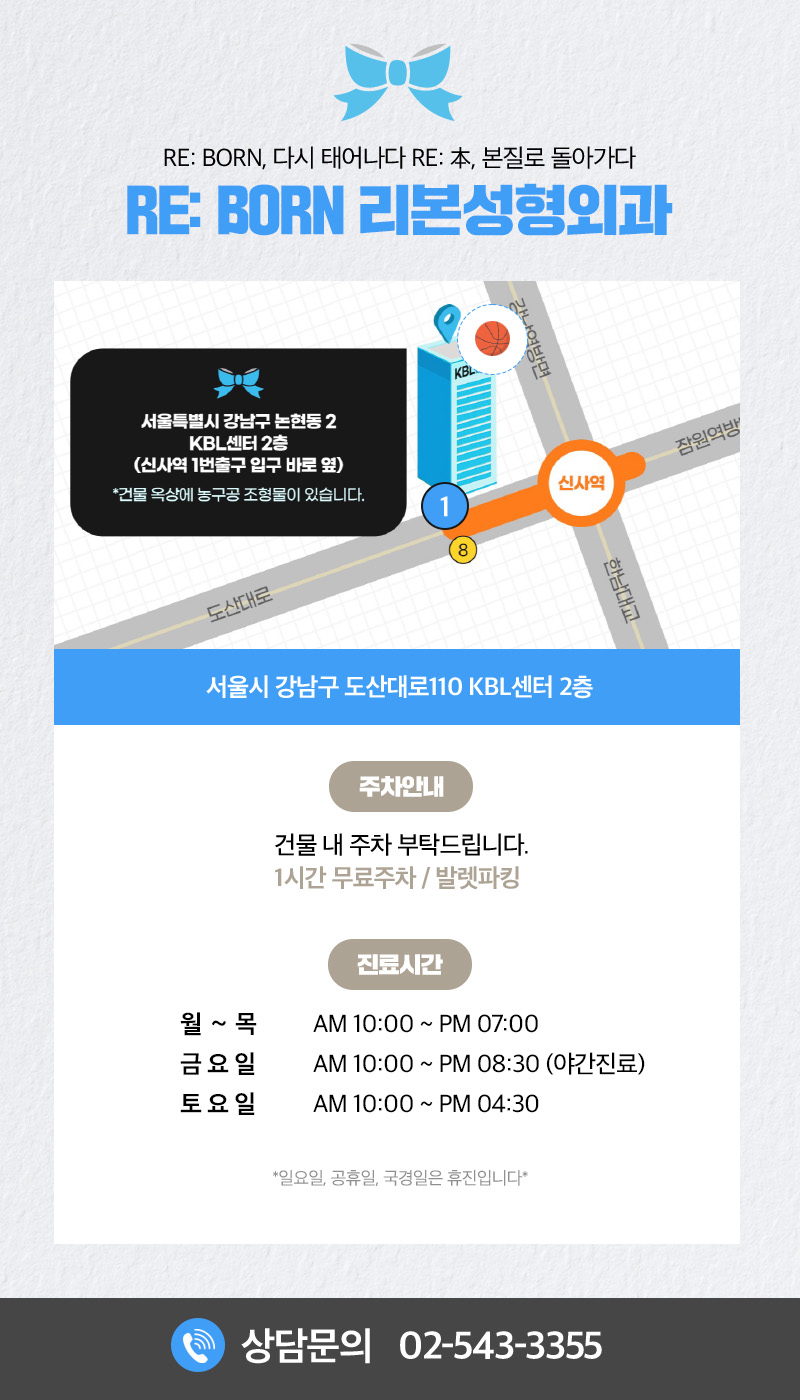
If you need help, you may also contact Ribbon Plastic Surgery at Sinsa Station.
We will meet you in person and provide a detailed diagnosis.
Thank you for reading this long post. ^^