Hello, I’m Park Jae-hyun, chief director of Ribbon Plastic Surgery at Sinsa Station. ^^

"It feels like my eyes don’t open easily with the strength of my eyelids alone. Every time I open my eyes, I end up using my forehead muscles, and the wrinkles seem to get more noticeable... Will ptosis correction help?"
"My left eye is a little smaller than my right eye. Because of that, my impression looks too unattractive, so I’m considering ptosis correction."
Because the eyes are the first feature people notice when meeting someone, many people prefer eyes that are large and clearly defined.
In such cases, what usually comes to mind is double eyelid surgery, but double eyelid surgery is closer to a procedure that changes the overall look and atmosphere rather than one that makes the eyes bigger.
If you have uneven eyes or feel discomfort when trying to open your eyes widely, you should consider ptosis correction.
Recently, perhaps because it is seen as a procedure done together with double eyelid surgery, there are quite a few people who think of ptosis correction as just one option among many.
However, since ptosis correction is originally performed for people with ptosis, it should be applied after examining the functional condition of the eyes.
With that in mind, today I would like to look at ptosis correction and also go over how to choose a plastic surgery clinic.
Please read comfortably and I hope you gain useful information. ^^
—
What is ptosis correction surgery?
The reason the upper eyelid can naturally close and open.
It is because the muscle that opens the eye is located in this area.
However, compared with other tissues, the eyelid is much thinner, so it is also an area that ages more quickly.
This muscle is no exception.
As aging progresses, the muscle that opens the eyes can weaken, causing the eyeball to be covered by the eyelid.
This is commonly called "ptosis," and it can create a sleepy or tired-looking impression.
Ptosis correction surgery is performed with the goal of improving this ptosis.
It is known as a way to correct sleepy eyes and uneven eyes, and is broadly divided into the incisional method and the non-incisional method.
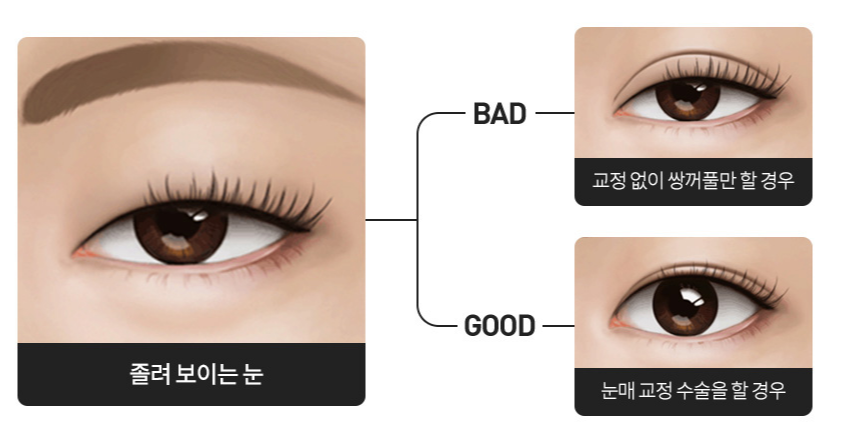
- Non-incisional ptosis correction
Non-incisional ptosis correction, as the name suggests, is a method that shortens the levator muscle without making an incision in order to correct mild ptosis.
It can be considered when the eyelids are thin or when there is a noticeable difference in size between the two eyes.
Recently, even in cases without ptosis, a small amount of levator shortening is sometimes performed to make the eyes appear larger.
When this is done, the upper eyelid rises higher, creating more clearly defined eyes.
However, please keep in mind that, in principle, this is a procedure applied to eyes with ptosis.
- Incisional ptosis correction
On the other hand, incisional ptosis correction is suitable when ptosis is severe.
It is also appropriate when the eyelids sag severely or when the eyebrows or forehead are used to open the eyes.
Severe ptosis causes the upper eyelid to droop significantly and cover the pupil, leading to functional problems with the eye.
It mostly occurs in middle-aged people in their 50s and older, but if ptosis is congenital, it can also appear in younger people in their 20s and 30s.
In such cases, it is important to further shorten the levator muscle to improve the functional problems of the eyes.

—
What are the criteria for choosing a plastic surgery clinic for ptosis correction?
As mentioned earlier, ptosis correction is now performed in many cases, so it seems that some people view it as a simple procedure.
Of course, the technique itself is not especially difficult, but since it is, in principle, a procedure performed for "ptosis," there are many factors to consider, including not only aesthetics but also function.
Also, even if you have been diagnosed with ptosis, the intensity of the surgery will differ depending on the degree of the condition.
Therefore, rather than choosing a plastic surgery clinic based only on price, you must choose a clinic with extensive experience in this type of surgery.

At our clinic, we provide 3D virtual surgery consultations so that you can directly check the results of ptosis correction.
Since the results can be checked through photos, patients often say this helps them greatly when evaluating their satisfaction after surgery.
We do not automatically recommend surgery just because someone has ptosis; we only provide guidance when we believe an ideal result can be achieved after considering multiple conditions.
Therefore, I encourage you to make sure to undergo a thorough diagnosis first and then determine whether the procedure is appropriate.
If you need help, you may contact Ribbon Plastic Surgery at Sinsa Station.
We will meet you in person and provide a precise diagnosis. Thank you. ^^