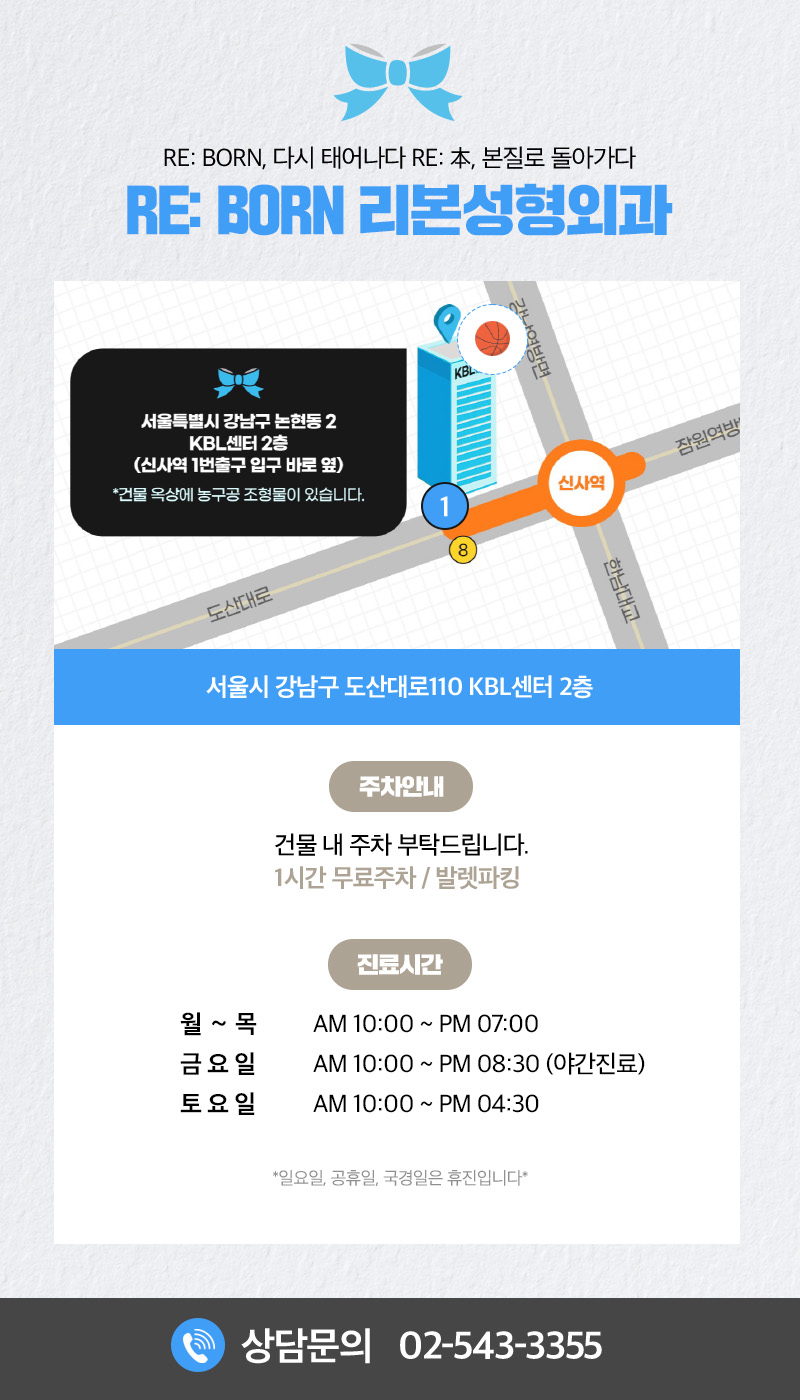
Hello, I’m Dr. Park Jae-hyun, the chief surgeon at Ribbon Plastic Surgery near Sinsa Station. ^^

"There are so many lifting procedures that I’m curious about what effects each one has~"
"Is there any lifting procedure that can deliver visible results with just one session?"
Because lifting procedures are so diverse, we have recently been receiving quite a few inquiries from patients wondering which procedure is suitable for them.
Even among the lifting procedures that have been drawing attention lately, there seem to be many options to discuss, such as radiofrequency, ultrasound, laser, and threads.
However, before distinguishing between these, it may be necessary to first explain the concept of "lifting."
The Concepts of Lifting and Tightening
Lifting means pulling the skin upward.
On the other hand, tightening means making it firmer.
Many people sometimes confuse lifting and tightening. Of course, they cannot be seen as completely different concepts, but in terms of visible results, it seems necessary to distinguish them to some extent.
The ultrasound, radiofrequency, and laser treatments mentioned earlier are procedures that induce thermal damage through specific energy to create a tightening effect that firms the skin.
If these treatments are repeated continuously, the degree of skin contraction will increase, and a lifting effect can be seen.
However, because there are limits to considering them as having a noticeable lifting effect with just one session, it is more appropriate to understand them as procedures that focus more on tightening than lifting.
By contrast, thread lifting focuses on hooking and pulling the skin with a special product called a thread, and it is generally preferred when the goal is to induce physical changes surgically.
This is why thread lifting is commonly performed in plastic surgery, where change is emphasized.
Those of you reading this article are probably also considering thread lifting for visible results.
However, even with thread lifting, simply pulling without restraint does not guarantee good results, so it is important to understand the principle correctly and approach it properly.
 What Principle Does Thread Lifting Use to Pull the Skin?
The materials used in thread lifting are very diverse, including PDO and PLLA.
Whether or not the thread has barbs also changes whether the focus is on collagen regeneration or on lifting.
In general, products with barbs are used to pull the skin upward, and this applies to both PDO threads and PLLA threads.
However, PLLA threads gradually dissolve within the skin itself and help promote the formation of collagen, so if you want to improve not only lifting but also volume, skin tone, and skin texture, they may be a more reasonable choice.
One of the biggest features of thread lifting is that it allows for point-specific treatment.
In particular, it is often used to improve the jawline, a sagging double chin, nasolabial folds, and jowls by pulling them in the proper direction.
However, there are still a few points to keep in mind here.

Precautions During Thread Lifting and How to Improve Its Limitations
- The cheekbones may appear more prominent
When performing point-specific treatment, threads are usually inserted between the ears and eyes and then hooked onto the desired area before being pulled.
At this time, if the number of threads is too large or excessive force is applied, the force may concentrate around the cheekbone area, causing this area to appear more prominent.
This is why some people feel that their cheekbones look more protruded or that their face looks bigger after thread lifting.
To improve this, our clinic offers two alternatives.
- Use of threads custom-made at our clinic
The threads currently on the market are relatively short in length, so for correcting the lower face, such as jowls, a double chin, and nasolabial folds, the insertion of threads inevitably has to be done in a noticeable area.
In addition, as mentioned earlier, if force is not properly controlled, it can cause the cheekbones to look more prominent.
That is why at Ribbon Plastic Surgery, we use much longer threads that are custom-made at our clinic.
Using longer threads makes it possible to move the insertion site up to the hairline, where it can be hidden by hair, and it helps prevent force from concentrating around the cheekbone area, thereby preventing various side effects.

- Combined 3-step temple lift
If you want a firmer and longer-lasting effect, combining it with a "3-step temple lift" is another option.
The temple area is firmly attached to the skin and bone, so compared to the facial area, it is a region where tissue sagging is less pronounced.
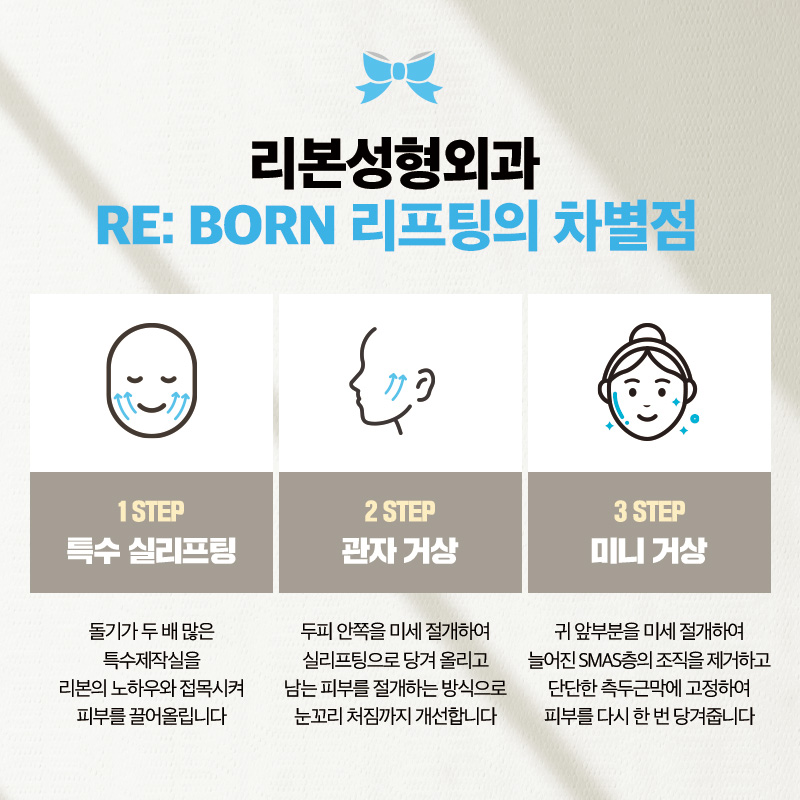
A temple lift, which is a type of mini facelift, refers to a surgery in which a small incision is made near the temple, some of the sagging tissue is removed, and then it is sutured.
In this way, the tissue gathered around the cheekbone area is lifted upward, which can compensate for the shortcomings of thread lifting, and because the tissue is physically removed, a longer maintenance period can be secured.
However, since nerves and blood vessels are concentrated in the temple area, it is advisable to go through a board-certified plastic surgeon with sufficient experience.
To summarize today’s article,
-
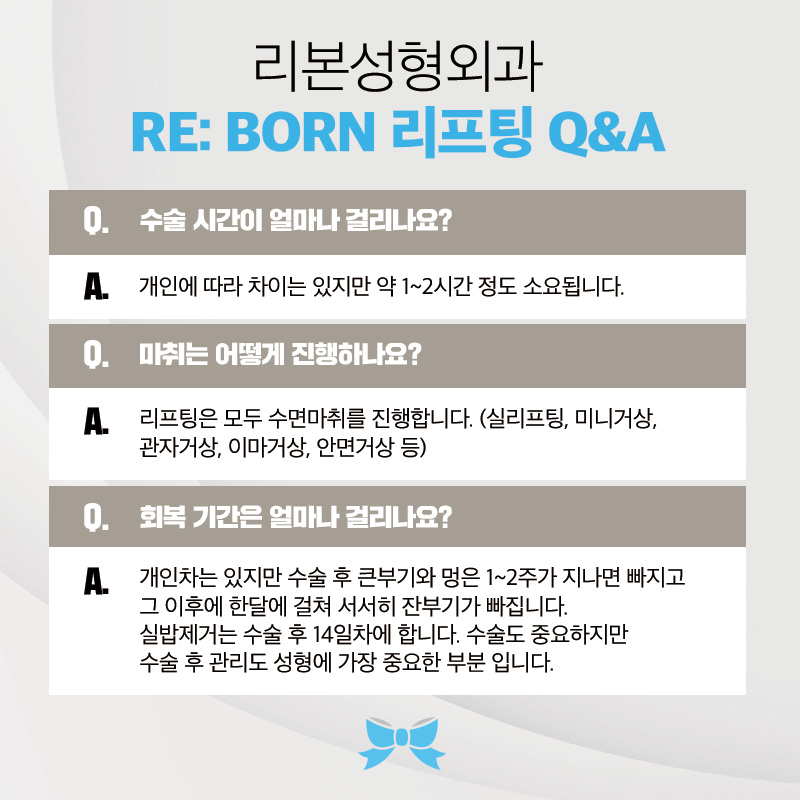
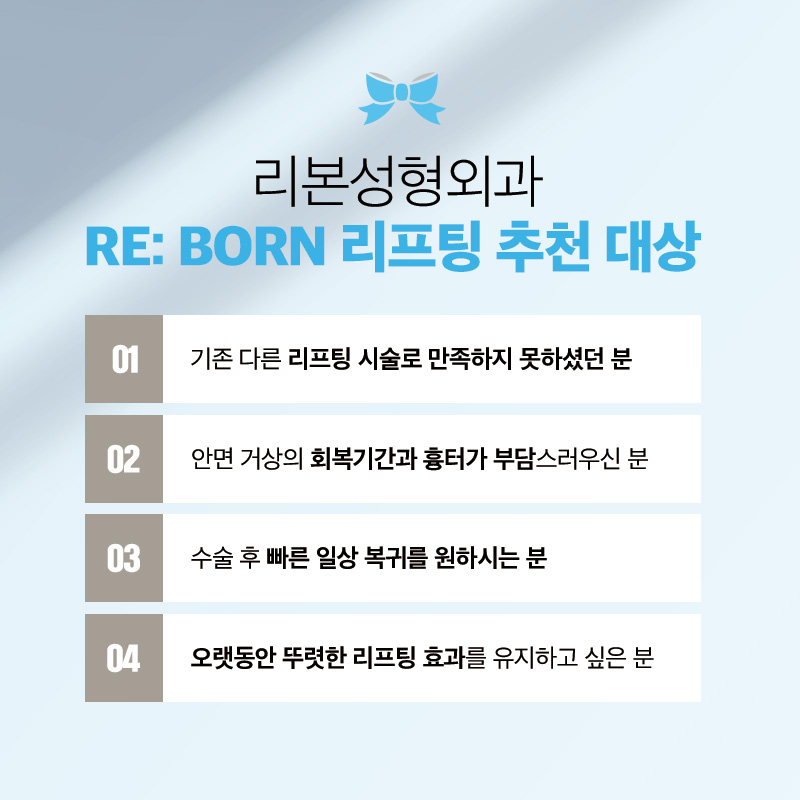
Thread lifting can produce visible results with a single session.
-
However, like any procedure, there may be limitations, so it is better to consider this in advance when deciding whether to undergo the procedure.
-
Ways to compensate for the shortcomings of thread lifting include using longer threads or combining it with a temple lift.
That would be the summary.
If you visit Ribbon Plastic Surgery in person, you can receive more detailed information about this.
You do not need to make a surgery decision right away.
Please discuss it in a consultation and consider it only if it is truly necessary.
Thank you for reading this long post.