Hello, I’m Dr. Park Jae-hyun, the chief director of Ribbon Plastic Surgery at Sinsa Station. ^^
| If the skin has sagged so much that the boundary between the jaw and neck is unclear, and you are considering lifting because of reduced elasticity from aging. There are many different lifting methods, but since I work at a company, I want a method that reduces the burden of recovery. Thread lifting seems like the best option, but I’m worried because I heard its lasting power is shorter than surgery. Quick recovery, long-lasting results. Is there any lifting method that suits my needs? |
Many people seem to feel confused about whether they should choose lifting surgery or a lifting procedure because of concerns like the one above.
"Would surgery be too burdensome right now?"
"But if I get a procedure, I’d like it to last longer..."
If your goal is not "tightening," which makes the skin feel firmer, but rather "lifting," which physically pulls the skin upward, this is a concern almost anyone would have at least once.
Among lifting surgeries, there are broadly full facelift surgery and mini facelift surgery, which is performed on a smaller scale focusing on specific areas.
There are various types of lifting procedures, but the most representative procedure focused on surgical lifting is thread lifting.
Many people think these two should be clearly separated and done individually, but in reality, they are often performed together depending on the need.
For example, the 3-Step Temple Lift and thread lifting that I will introduce today are one of the representative combinations.
The 3-Step Temple Lift is a type of mini facelift that lifts by partially excising the area around the temples.

When performed together with thread lifting, it can compensate for various issues, so recently many patients who want long-lasting results and a less burdensome recovery period have preferred it.
Today, I’d like to take the time to answer the questions we receive most often about the 3-Step Temple Lift.
If you have any personal questions, you are also welcome to contact Ribbon Plastic Surgery separately.
Q. What is the 3-Step Temple Lift?
It refers to a mini facelift performed by making a tiny incision inside the scalp and partially removing the sagging skin tissue.
Then the question naturally arises: why lift the temples?
Let’s compare the temples with the facial skin area.
First, the facial skin area has relatively thick tissue and accumulated fat, so there is some space in the areas where the bone and tissue are attached.
As aging progresses, this space becomes even looser, causing the skin to sag downward.
However, the temple area has relatively thinner and firmer skin and is more firmly attached to the bone, so even with aging, the degree of sagging appears weaker.
In other words, if this area is excised and lifted, the skin around the cheekbones and jawline below it moves upward, making it possible to maintain the effect for a much longer time compared with a facial lift.
This is why the 3-Step Temple Lift is recommended together with thread lifting to improve the shorter-lasting effect of thread lifting compared with surgery.

Q. Besides longevity, is there another reason to combine thread lifting with the 3-Step Temple Lift?
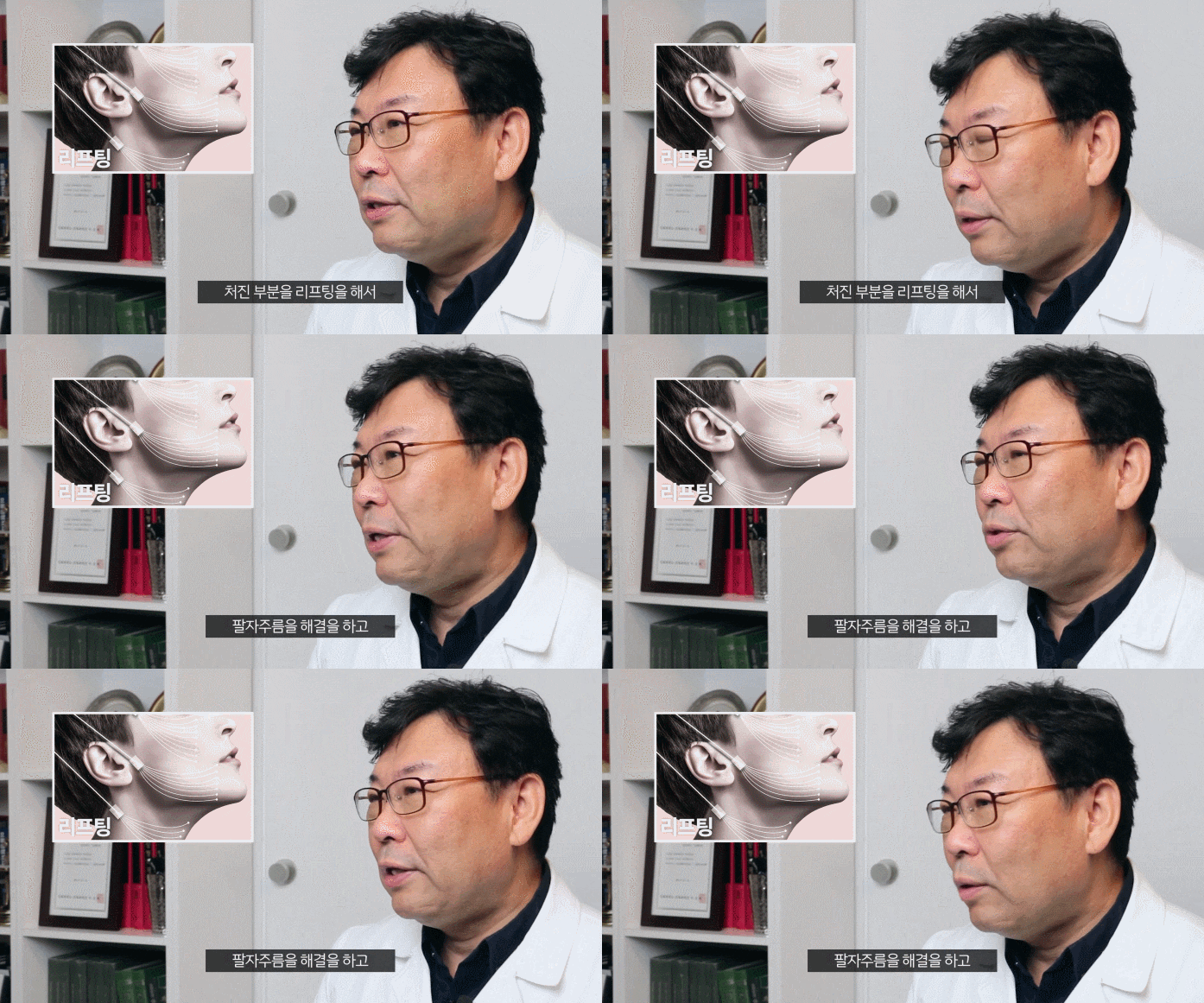
Thread lifting refers to a procedure in which threads are inserted into the skin, hooked onto the desired area, and then pulled upward to lift sagging tissue.
Before the procedure, through sufficient consultation and design, we determine which threads to use and in which direction and with how much force they should be pulled.
However, if the skin sagging is particularly severe, quite a lot of threads are used, and the force becomes stronger accordingly, which can cause tissue to bunch up around the cheekbones while pulling the threads.
Of course, in our clinic, we use our own manufactured threads, so the frequency of this issue is very low. But when regular threads are used, this is a common problem.
At this point, combining the 3-Step Temple Lift can further pull the tissue that has gathered around the cheekbones upward and help compensate for the issue of the cheekbones becoming more prominent.
This allows for a much smoother lift from the nasolabial fold and the area below the deep cheek fat up to above the cheekbones.
Q. Since this is in the hairline area, what if hair doesn’t grow back later?
Because this area is covered by hair above the ears, many patients worry about this.
Hair is produced in small pockets called hair follicles.
If hair does not grow due to an incision or wound, that means the follicle or hair root has been damaged.
Conversely?
If the surgery is performed in a way that protects the hair follicles and roots, there is no problem with hair growth.
At our clinic, the incision is made in a way that preserves the hair roots, so after a certain recovery period following surgery, hair grows above the incision and covers the area.
Scarring is barely visible to the naked eye, and there is no issue of the hair looking sparse, so you can feel at ease.

However, because the temple area contains some important blood vessels and nerves, it is essential to undergo the procedure with a board-certified plastic surgeon who has experienced expertise.
If you visit Ribbon Plastic Surgery, you can receive detailed consultation about this, so please feel free to contact us anytime.
Thank you for reading this long post. ^^