Hello, this is Ribbon Plastic Surgery at Sinnonhyeon Station Exit 1. ^^
A doctor is someone who diagnoses and treats patients, and at the same time, someone who continually evaluates and studies diseases and procedures (in plastic surgery, this would include all aesthetic areas such as anti-aging). Just because someone has obtained the qualification for a particular department does not make them a doctor; a true doctor is someone who keeps researching and knows how to provide practical help to patients with that mindset.
Plastic surgery originally emerged with the purpose of restoring structural deformities caused by congenital anomalies or trauma, but as quality of life has continued to improve, there are now many cases in which it is approached for cosmetic purposes. ^^ But looking good alone is not enough.
It is basic that the result is aesthetically pleasing to the patient, but surgery can only be called a “successful operation” when we also consider how well that result can be maintained and how much the possibility of side effects can be reduced. In that sense, Ribbon Plastic Surgery continues to work with a research-oriented mindset to pursue “better procedures and surgeries.” We can confidently say this even in today’s topic, thread lifting, because we use threads that we developed ourselves.
Threads used for thread lifting are classified by material into PDO, PLLA, and others, and can also be divided by whether they have cogs or not. Threads without cogs are often called “mono threads,” and they were the first type to be introduced when thread lifting began.
The reason these non-cog threads are still used today is that, although their lifting force may be modest, they can still stimulate the skin continuously and help encourage collagen regeneration.
For younger people in their 20s and 30s whose skin sagging is not very severe, using multiple mono threads layered together or using them along with other cog threads can help create a more delicate lifting design, which is why many clinics prefer them.
After that, cog threads with cogs were developed and are now widely used in procedures for the purpose of “lifting.” Cog threads can also be divided into several types depending on the shape of the cuts or the structure of the cogs attached to them. Cut-type threads have a shape that looks as if the thread has been slightly notched in places like spikes.
More recently, threads have also been released that keep the shape of the thread itself while the cogs protrude outward from it. Depending on the product, round cogs shaped like corn may also be used.

Ribbon Plastic Surgery has been performing lifting procedures using threads continuously since the early days, when thread lifting first began in Korea. We have used almost all of the mono thread, cut-thread, and cog-thread products described above. Thread lifting has a major appeal in that it can be an alternative to a facelift and can pull up the skin without incision, but it was somewhat lacking in meeting the satisfaction of patients with more severe sagging.
In particular, the short length feels like the biggest limitation. The products are about 17 to 18 cm long, but for various reasons, the actual portion of the cog that grips the skin is only about 6 cm.
If we imagine placing threads in the lower face to improve jowls or nasolabial folds and pulling them upward, there were many cases where the pulling force on the threads was transferred to the cheekbone area, making the cheekbones appear more prominent or causing the overall facial balance to look off.
That is why Ribbon Plastic Surgery develops and uses its own threads to minimize these issues as much as possible, and because this approach retains the ingredients of existing threads while compensating for their problems, the safety level is relatively high as well.

-
As a fix type, the cogs extending in both directions hold the skin, which increases the pulling force.
-
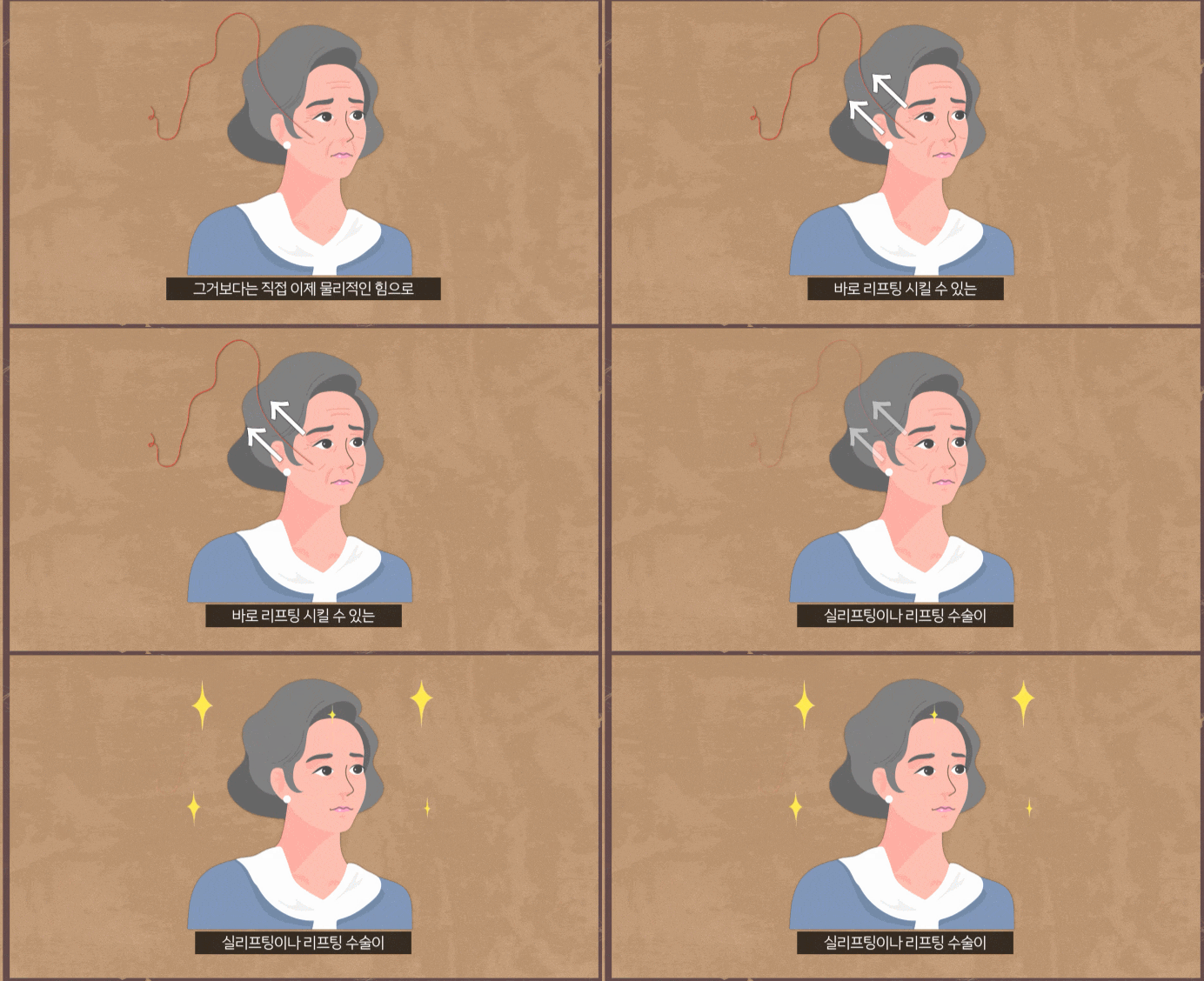
Compared with ordinary threads, it is much longer, making it possible to insert it into the temple area hidden by hair and lift upward without catching the cheekbones.
The threads developed by our clinic can be summarized into these two main features.
In general thread lifting, when a thread is loaded into a cannula and inserted under the skin, it becomes fixed to the tissue in that state, so it is often difficult to shape it exactly as desired.
The threads we produce allow for more detailed fixation and are longer, reducing discomfort such as cheekbone catching. Of course, this does not mean that our clinic’s threads are superior to every thread on the market. We also use a variety of threads together, and each has its own advantages and disadvantages, so please take this into account in advance and have a thorough consultation.