Hello. This is Reborn Plastic Surgery, located at Exit 1 of Sinsa Station. :)
When we talk to people who are considering a mini facelift, many of them say they are looking into it because a full facelift feels too financially burdensome.
Of course, a full facelift lifts the entire face from the forehead to the area around the jawline, so among facelift procedures it is the most intensive and has the longest-lasting effect.
However, it is also true that many people hesitate because of the high price and the burden of a large incision.
So relatively younger people often consider procedures instead of surgery.
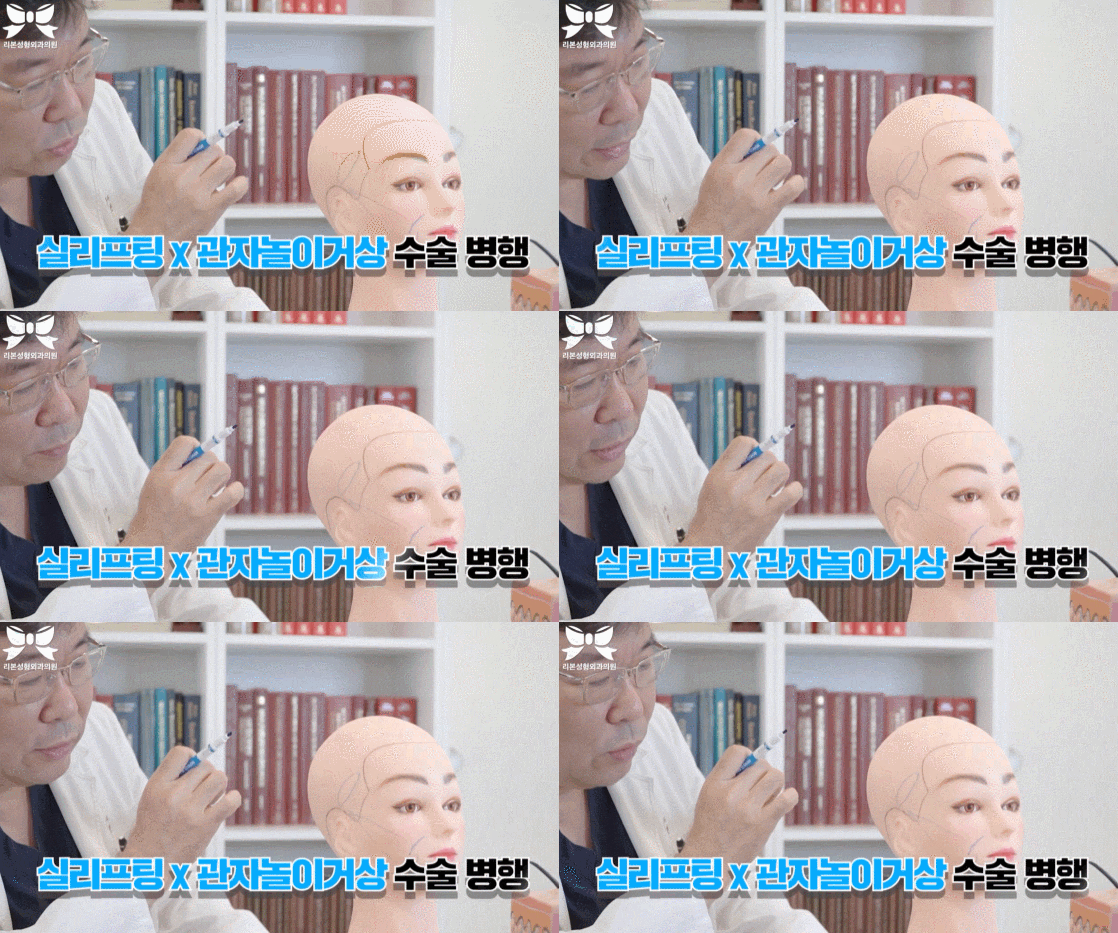
Among procedures, a representative method that can provide visible lifting is thread lifting. However, thread lifting is also less intensive and less long-lasting than surgery.
Although it may be relatively inexpensive, because the skin must be supported by threads, it is inevitably weaker in intensity compared with a lift that pulls up to the SMAS layer.
That is why many people who have had thread lifting several times choose to undergo a mini facelift alone, or combine the two, in order to maintain the effect consistently and reduce the financial burden.
In particular, the temple lift (3-step temple lift) involves making an incision on the side of the scalp and lifting, so it can help improve the sagging jawline (contour), nasolabial folds, sagging cheekbones, and jowls all at once.
Through the rest of this article, we will explain why, so please read comfortably and I hope you find it helpful. :)
"What changes happen when the temples are pulled up?"
Medically, the temple refers to the area from beside the eyes and above the ears to the back portion covered by hair.
Our 3-step temple lift is a procedure in which a small incision is made in the hair-covered area, the side line of the face is pulled upward, some of the sagging skin is removed, and then the area is sutured.
Naturally, the incision is hidden by the hair and not visible from the outside, and recovery is much faster than with a full facelift.
Traditional facelift surgery involved a wide incision along the hairline and behind the ears, so problems such as skin folding sometimes occurred.
The recovery period was also very long, and in many cases people had to live with swelling or visible signs of surgery for about a month.
However, lifting the temple area can improve facial contour and sagging deep cheek fat that many people worry about with aging, while also helping to offset some of the drawbacks of a facelift.
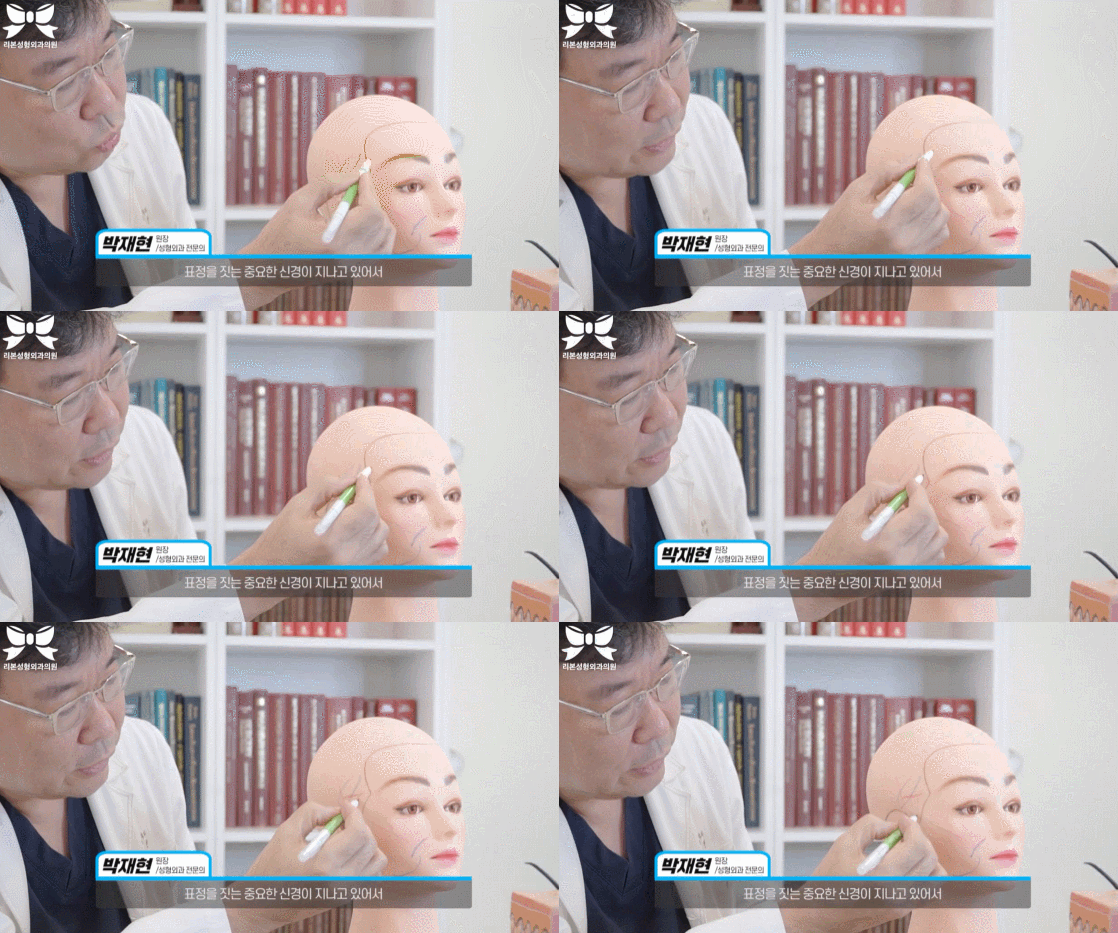
Then why pull up the temple area?
The temple is an area that lies closer to the side of the scalp than to the face.
The scalp is designed to protect the skull, so the skin is firm and there is not much space between it and the skull.
Because of this, the likelihood of sagging over time is much lower than in the face, and lifting the temple area has the advantage of relatively long-lasting support.
It can also help address one drawback of thread lifting: when the force of the threads concentrates around the cheekbones and makes them appear larger, lifting again up to the temple area can compensate for that problem.
For this reason, the 3-step temple lift is sometimes performed on its own, and sometimes together with thread lifting to balance each method’s strengths and weaknesses.
"Why safety should be checked before price"
The temple refers to the hollow area between the eyes and ears, and it is made up of very complex structures such as the skin, subcutaneous tissue, galea aponeurotica, reticular tissue, temporal fascia, buccal fat pad, and temporalis muscle.
That is why when you move your jaw, the temple area moves along with it, because the temporalis muscle is connected there.
Since the temporal branch of the facial nerve passes directly through this area, it is a very sensitive structure.
When making an incision in this area, even if it is only a small amount, it must absolutely be done by an experienced board-certified plastic surgeon.
Otherwise, the nerve may be affected, causing paralysis symptoms, and the hair roots may be damaged, which can lead to hair not growing.
To prevent these problems, Reborn Plastic Surgery has the director, who has decades of experience, personally performing the surgery.
Using an oblique incision in a way that protects the nerves and avoids touching the hair roots, you should be able to confirm that hair grows even in the incision area after surgery.
The temple lift is effective in terms of lasting power and the range of lifting, but the procedure itself is challenging.
It is not too late to decide after checking whether it is possible through 충분히 consultation, so please make your decision carefully.
Thank you for reading this long post. :)


□Helpful posts□
https://blog.naver.com/reborn1999/223334681286
https://blog.naver.com/reborn1999/223316154957