Hello. We are Ribbon Plastic Surgery, meeting you at Exit 1 of Sinsa Station. :)
If you have even the slightest interest in eye surgery, you may have heard of “ptosis correction” at least once. As the name suggests, it is a surgery that helps correct the eye shape and create a more defined line, but its original purpose is different.
That is because ptosis correction is used to improve blepharoptosis.
Some patients also say, “I heard the effect is better if it’s done together with double eyelid surgery?”
When blepharoptosis is present, doing only double eyelid surgery can make the drooping of the eyelids appear more noticeable. In that case, ptosis correction must be performed together to improve the sleepy-looking impression.
It is also true that, as this procedure has come to be recognized as an option for cosmetic purposes today, more people want to have ptosis correction together with double eyelid surgery.
Of course, ptosis correction can also be applied even if blepharoptosis is very mild or absent. It is performed by shortening the muscle that functions to open the eyes, and the intensity varies depending on how much shortening is done.
For those with mild blepharoptosis, even a very small amount of shortening can be enough to achieve good results, which is why more people are receiving ptosis correction for cosmetic purposes.
But before that, we need to understand its original purpose: improving blepharoptosis.

What is blepharoptosis?
Blepharoptosis refers to drooping of the upper eyelid. When the drooping is caused by sagging skin, it is called pseudoptosis, and when it is caused by loosened muscle, it is called true blepharoptosis.
In particular, when the muscle is loosened, even if the skin above it is folded once, the sagging of the muscle in the deeper layer remains, which makes the person look even sleepier.
That is why we recommend ptosis correction together with double eyelid surgery for people with blepharoptosis.
What changes after ptosis correction?
Ptosis correction is a surgery performed for people with true blepharoptosis.
Let’s touch the skin of the upper eyelid together. What does it feel like?
Compared to other skin, it is thin like a shell and blinks frequently, so you can tell it is a very active and unstable area.
The original purpose of this eyelid is to protect the eyeball.
To keep foreign substances out of the eye and to allow tears to stay in place, the eyelids move tens of thousands of times a day.
Because sebaceous glands are not well developed, moisture retention is also weak. But does that mean it is structurally simple? No, it does not.
Like ordinary skin, it has all of the epidermis, dermis, subcutaneous fat layer, and muscle layer, and ptosis occurs when the muscle layer becomes loosened.
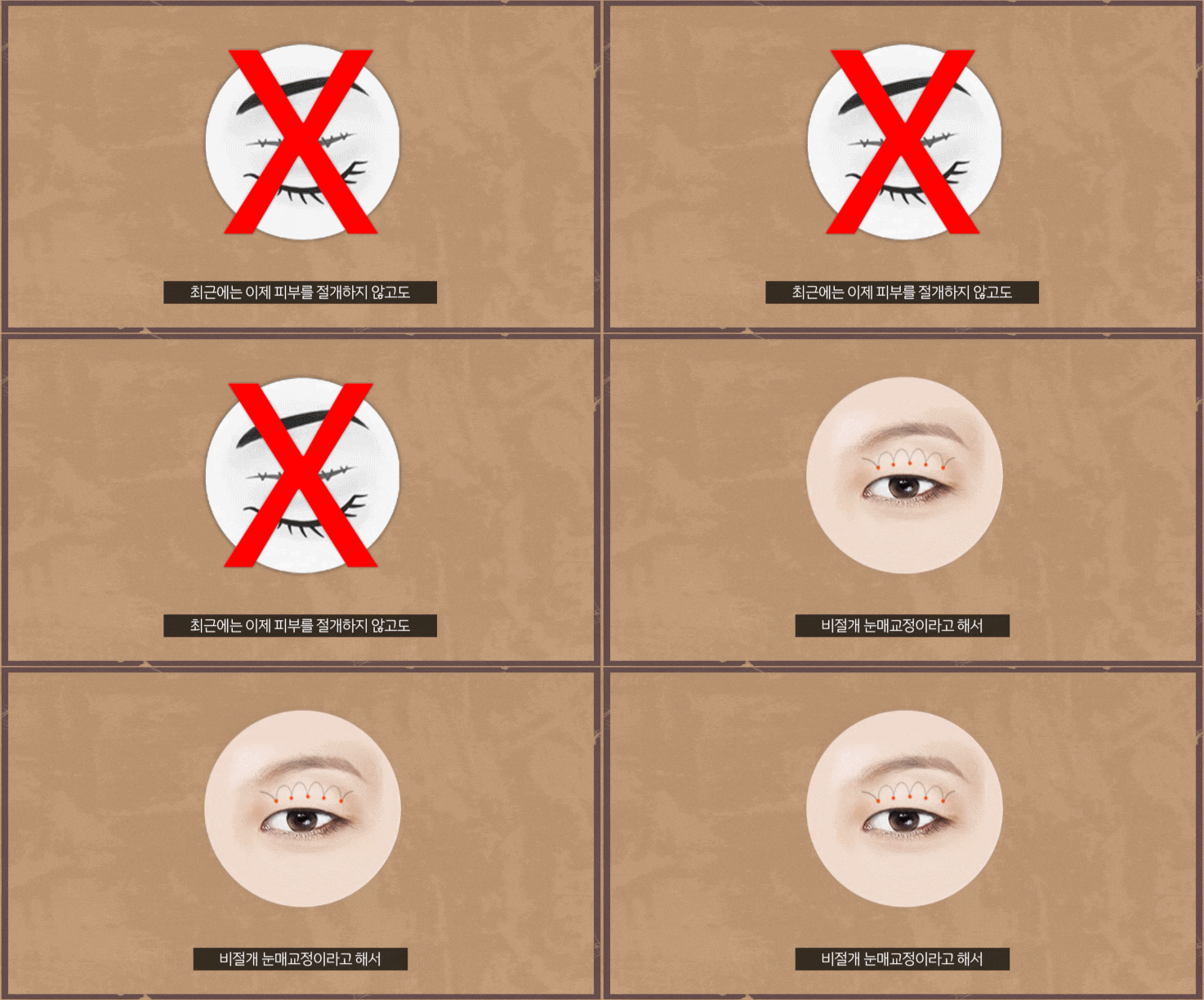
Ptosis can be present from birth, but in most cases it is degenerative ptosis caused by aging.
Both the skin and muscles sag at the same time, but from the outside it often looks as though only the skin is sagging, so many people try to solve it with double eyelid surgery.
However, if blepharoptosis is present, the inner muscle must definitely be strengthened through ptosis correction in order to secure a much larger and clearer field of vision.
If blepharoptosis becomes severe, it can completely obstruct the field of vision and cause various problems.
It is also this blepharoptosis that causes one eye to look larger and the other smaller, creating what is called uneven eyes.
After ptosis correction, these issues can be improved, and safety can be promoted by securing the field of vision.

Non-incisional ptosis correction and incisional ptosis correction
There are broadly two methods of ptosis correction: the incisional method and the non-incisional method.
Non-incisional ptosis correction is a method that corrects mild blepharoptosis by shortening the levator palpebrae superioris without making an incision.
It can be considered when the eyelid is thin or when there is a significant difference in eye size between both eyes (uneven eyes).
On the other hand, incisional ptosis correction is a surgical method that can be applied when the degree of blepharoptosis is very severe.
If the eyelids sag severely, requiring the use of the eyebrows or forehead muscles to open the eyes, and if the field of vision is not secured, blepharoptosis must be improved through incisional ptosis correction.
Severe blepharoptosis accounts for an overwhelming proportion of patients in their 50s and older.
However, if blepharoptosis is congenital, it can also appear in people in their 20s and 30s, and in such cases, incisional ptosis correction is recommended even for the sake of securing the field of vision.
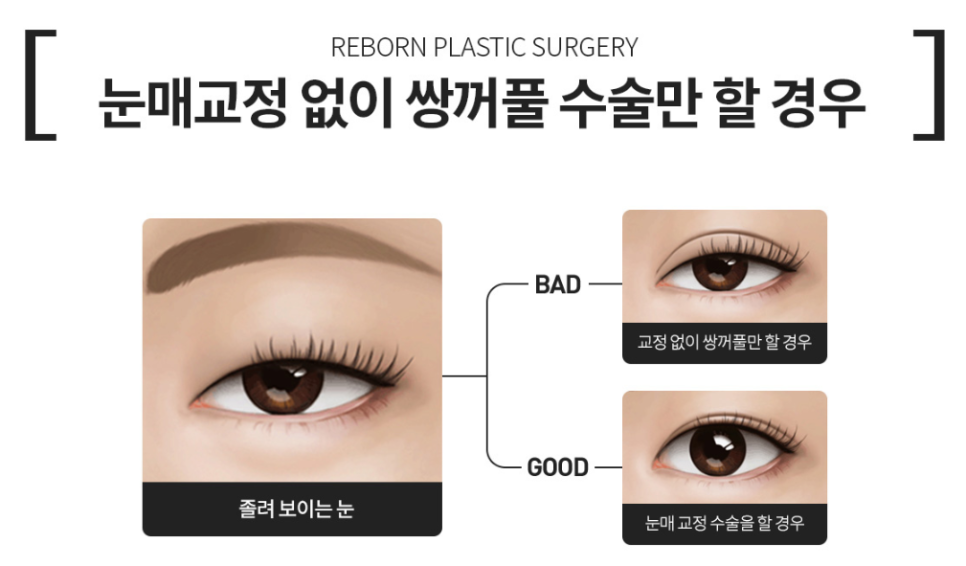
To summarize, ptosis correction is:
· people with true blepharoptosis
· people who use the eyebrows or forehead muscles to open their eyes
· people whose eyelids droop and cover the black of the eye
· people with uneven eyes
· people who are likely to look sleepy after creating double eyelids
· people whose field of vision is not properly secured
In these cases, it can be said to be a surgery that must be performed.
If you contact us separately at Ribbon Plastic Surgery, we will provide more detailed guidance. Please do not think of ptosis correction too lightly, and be sure to look carefully and choose your plastic surgery clinic wisely. Thank you. :)