It is spring, a season that is both dry and has strong UV exposure. Around this time of year, the number of people visiting our clinic because of “sagging skin” tends to increase slightly.
Collagen in the skin begins to deteriorate little by little around the age of 20.
By the late 20s, reduced elasticity and tightness from within the skin can appear, and once you enter your 30s, fine lines and similar signs may become noticeably visible.
If you look at White people, don’t many of them appear much more aged even at the same age? This can be interpreted as meaning that UV rays have a considerable effect on skin aging.
White people have less melanin in their skin, so there are inevitable limits to protecting the skin from UV rays. The same applies to East Asians, but compared with White people, they do have more pigmentation, so the rate of aging is slowed accordingly.
What about people who do not apply sunscreen properly in daily life? As I always say during consultations, “No matter the season or weather, if the sun is out, you must apply sunscreen.”
At the moment, there may not seem to be much difference, but after your 30s, it becomes clearly noticeable.
Recently, inquiries about thread lifting have also been increasing at our Reborn Plastic Surgery Clinic, and when we talk with people in their 20s and 30s, many have neglected skincare and maintenance in their daily lives.
Thread lifting is an effective procedure for achieving noticeable lifting when the skin has sagged. But if there are advantages, there are also disadvantages.
Today, I would like to explain the “disadvantages” of thread lifting and also guide you through solutions for how they can be supplemented.
Thread lifting can be performed by anyone from their 20s to those in their 60s and older. So how can you get it done well?
What kind of procedure is thread lifting? (About the disadvantages of thread lifting)
"When I search online, it only shows the advantages, so why are you telling me about the disadvantages?" Some of you may find this puzzling.
If you are promoting a procedure, of course the advantages should stand out—but what about the disadvantages? Still, every surgery and procedure has disadvantages on the other side of its advantages.
From the perspective of the person receiving the procedure, if you go forward knowing only the advantages and not understanding these points at all, you may end up with results that fall far short of what you expected, and even before that, your 기준 for choosing a plastic surgery clinic can become unclear.
Thread lifting refers to a procedure in which threads that are harmless to the human body are inserted under the skin and pulled to lift the area.
Unlike device-based lifting, it does not need to be repeated, and because noticeable results can be seen with just one session, it has recently gained popularity among many people starting in their 20s.
However, thread lifting can sometimes cause issues such as making the face look larger or making the cheekbones appear more prominent.
Many of the threads currently available are short in length because they are designed to lift concerns such as prominent jowls and nasolabial folds. As a result, the final force is more likely to concentrate around the cheekbones.
When this happens, pressure becomes focused on the cheekbone area, which can ultimately make the cheekbones look larger or appear bulged and protruding.
Even if this can be adjusted to some extent in relatively younger people in their 20s and 30s because fewer threads are needed, people in their 50s and 60s or older are more likely to be exposed to this issue as stronger threads are required.
So, is there no way to address these disadvantages of thread lifting? At our Reborn Plastic Surgery Clinic, we present a more natural thread lifting approach without emphasizing the cheekbones through two methods.
Ways to supplement the disadvantages of thread lifting
- Combine it with the 3-step temple lift!
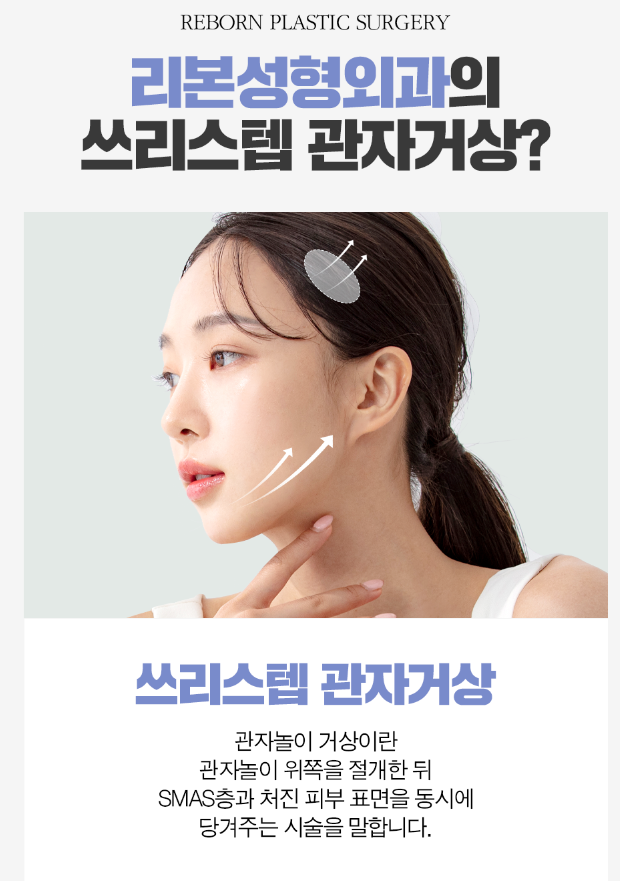
As mentioned earlier, the reason the cheekbones appear larger is because the force is concentrated on them.
That is why our clinic combines temple lifting when necessary to reduce this burden.
The temple area is covered by hair. If a small incision is made there, the sagging skin is removed and then sutured, the force that had concentrated on the cheekbones is pulled upward, allowing for a much more natural result.
Also, temple lifting can provide side lifting, so it is useful for improving sagging outer eye corners and a drooping jawline.
Because the skin tissue itself is attached close to the scalp, another major feature is that the effect lasts longer compared with facial lifting.
Our clinic makes a diagonal incision to protect the hair follicles, so you do not need to worry, “What if hair doesn’t grow after the surgery?”

- Custom-making longer threads!
In addition, our Reborn Plastic Surgery Clinic custom-makes and uses threads that are much longer in length. When people hear “custom-made,” they may worry that it is unsafe, but the thread material is the same as PDO.
Since only the length of the thread is extended using an approved material, the force does not concentrate on the cheekbones and can instead be distributed to the area above them, helping prevent side effects.
In fact, at our Reborn Plastic Surgery Clinic, all thread lifting is performed with custom-made threads, so you can achieve a certain level of the results you expect from thread lifting alone.
However, if skin sagging is very severe or if you want to lift the sides of the face and the outer eye corners together, I strongly recommend considering the 3-step temple lift.
That’s all for today’s post.
If you have any questions, inquiries to Reborn Plastic Surgery Clinic are always welcome.
Then I’ll see you in the next post~ Thank you. ^^