When I went to a plastic surgery clinic to get double eyelid surgery, I was told that I would also need ptosis correction.
The explanation was given to me, but there is so much overtreatment these days that it is confusing how much I should believe.
I know many people get ptosis correction when they have double eyelid surgery, but I wonder whether it is really necessary for me.
When should ptosis correction be performed, and what do the effects and side effects look like?
Some people think they should have double eyelid surgery and ptosis correction at the same time for a clearer impression, but there are also many people who are surprised when they hear this from the medical staff even though they had never considered it before.
If you had no prior information about ptosis correction, you might think, “Isn’t this overtreatment?”
In principle, ptosis correction is a surgical method recommended when there is ptosis.
Ptosis refers to a condition in which the muscle that opens the eyes has weakened, causing the eyelids to droop downward. Ptosis correction is a surgery that strengthens this muscle.
If double eyelid surgery is performed while ptosis is present, the muscle position remains the same, and as the eyelid folds, only the double eyelid crease forms higher up. This can make the eyes look even sleepier.
That is why ptosis correction is recommended first, followed by double eyelid surgery.
Recently, there are cases where surgery is performed for cosmetic purposes even when there is no ptosis at all. It may be possible depending on the situation, but please remember that, in principle, this is a surgery to consider when ptosis is present.
So, what exactly is ptosis correction, what effects does it have, and what side effects can occur? In today’s post, I will organize all of this on one page.
🙂 Topics of today’s post
① What is ptosis correction? (Surgical method and effects)
② What are the side effects of ptosis correction and how are they addressed?
Let’s begin.

① What is ptosis correction? (Surgical method and effects)
To put ptosis correction in simple terms, it could be called “a surgery that makes the eyes look bigger.” Another way to describe it is a surgery that makes the black part of the eye more visible.
Its formal name is ptosis correction surgery, and the surgical method may differ depending on the severity.
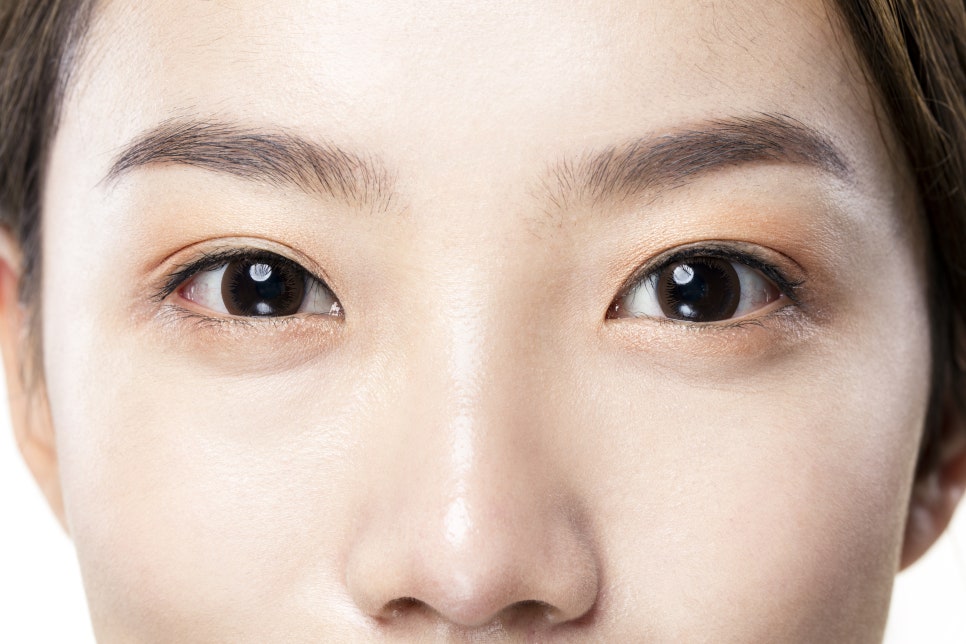
When explained theoretically, beautiful eyes are said to have the black part of the eye, including the pupil and iris, covered by only about 5 to 10% of the eyelid.
To explain what that means, it refers to a state in which only the upper part of the black part of the eye is slightly covered when viewed from the front. When the covered portion exceeds this standard, it is called ptosis.
If the eyelid covers too much of the black part of the eye, it can outwardly create a sleepy or tired appearance, and functionally it can also make the eyes feel obstructed and harder to see through, making correction necessary.
Ptosis correction is the surgical method performed in such cases.
To restore the normal ratio between the eyelid and the visible black part of the eye, the levator aponeurosis or the superior levator muscle fascia is attached to the tarsal plate to strengthen the force used when opening the eyes.
This weakening of the muscle may be congenital, but it can also occur as a result of aging or trauma when the tarsal plate is detached.
Ptosis correction can be understood as a surgery that pulls a loosened muscle back to the normal range, much like cutting a stretched rubber band and reconnecting it, or layering it several times to make it stronger.
② What are the side effects of ptosis correction and how are they addressed?
In principle, it is performed when there is ptosis, but depending on the person, standards of beauty differ, so there are people who want ptosis correction even without ptosis.
Therefore, ptosis correction can be performed when you have concerns like the following:
-
When you want your eyes to look bigger than they do now
-
When your eyes are expected to look sleepier after double eyelid surgery
-
When the sizes of the two eyes are uneven
However, if you want to make the eyes excessively large or undergo ptosis correction even when there is no need at all, there is a risk of side effects.
Also, ptosis correction is generally performed on both eyes at the same time.
This is because when one eye is not opening well due to uneven eye size, the following phenomenon can occur.

★ Hering’s law
Originally a hypothesis used to explain binocular vision, but it also applies to ptosis.
Our eyes move under equal nerve control on both sides, and in patients with drooping eyelids on one side, the upper eyelid levator muscle is maximally stimulated through the third cranial nerve in an attempt to lift the drooping eyelid as strongly as possible.
Conversely, this means that the normal eye on the opposite side experiences upper eyelid retraction.
So, if only one eye is operated on, this nerve control remains, and the previously normal eyelid may develop ptosis.
Depending on the situation, only one eye may be operated on, but in general, both eyes need to be operated on to prevent this side effect.
Isn’t ptosis correction more complicated than you expected? Our clinic does not pursue overtreatment at all. We only provide guidance when it is truly necessary, so please keep this in mind.
Thank you for reading until the end. ^^

https://blog.naver.com/reborn1999/223402423167
https://blog.naver.com/reborn1999/223410709957