| - For those who want to improve deep facial wrinkles and loss of elasticity - For those who did not see results from thread lifting or laser lifting - For those troubled by severe cheek sagging due to reduced facial elasticity - For those who want relatively fast recovery - For those worried about scars after facelift surgery - For those who want a clear lifting effect and long-lasting results |
You are probably one of the people who fit the items above. You may be looking for a facelift procedure because you want a more definite effect than threads or lasers can provide.
On the other hand, because surgery can feel burdensome, you may be looking into the relatively simple-sounding mini facelift.
Reborn Plastic Surgery has spent more than 20 years performing a variety of anti-aging procedures such as facelifts and thread lifting, and it follows the principle of thorough, personalized treatment.
That is why many people contact us with questions about facelifts. The most common concern is the burden of surgery itself.
We also understand this concern well, which is why, after years of research, we developed the 3-step temple lift.
It is a surgical method that creates a facelift effect through a small incision near the temple area, and, if necessary, adds thread lifting for a highly satisfying lifting result.
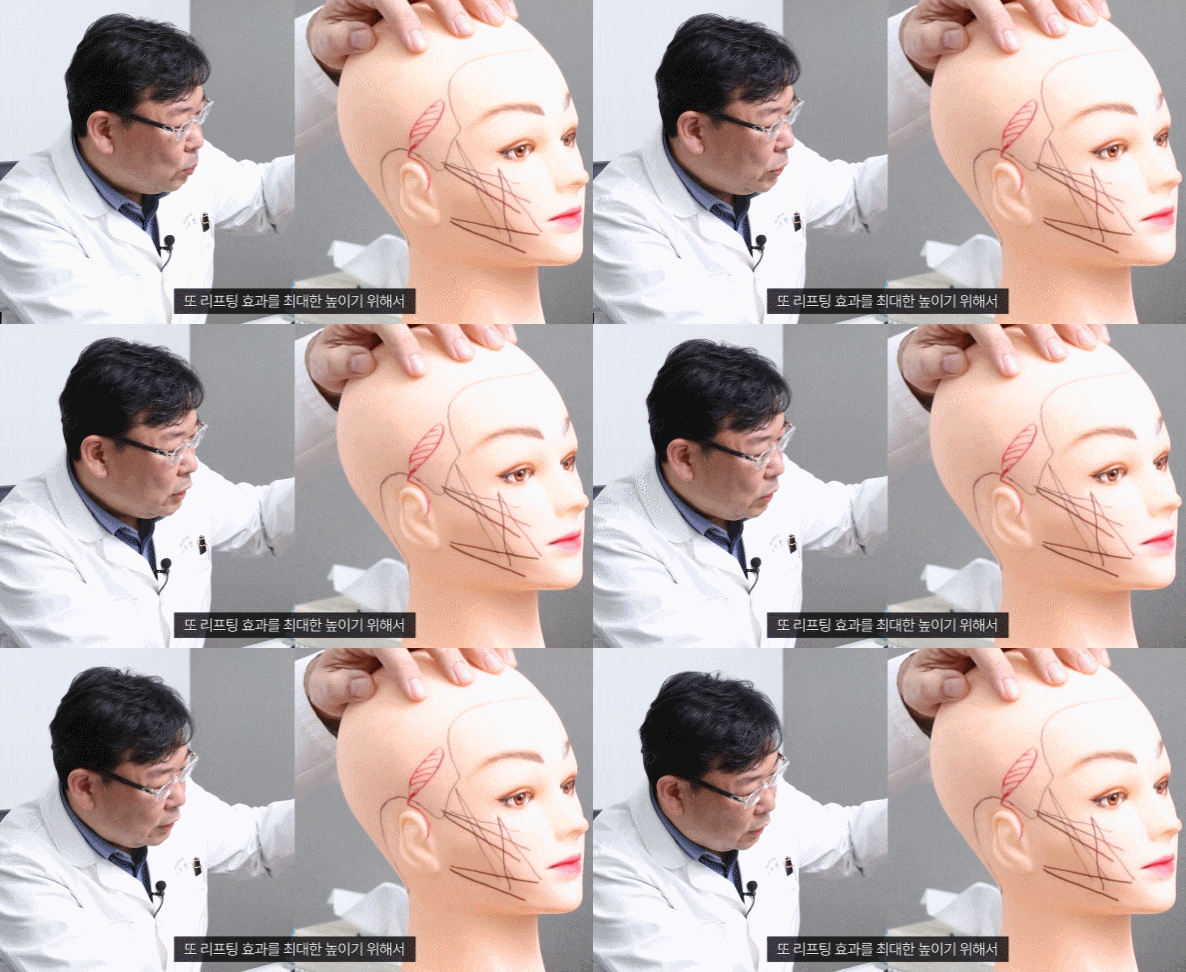
3-step temple lift?
The 3-step temple lift is a surgical method that adds Reborn Plastic Surgery’s own know-how to the existing temple lift procedure.
A temple lift is a procedure in which an arc-shaped incision is made on the upper scalp, that is, the area above the temples, and then the surgeon pulls up the muscle layer that has lost elasticity and the skin surface at the same time.
Because it directly improves sagging from beneath the skin, it can address the underlying cause of aging.
By noticeably tightening the sagging skin around the cheeks and jawline, it can create a more lifted contour and a younger-looking impression.
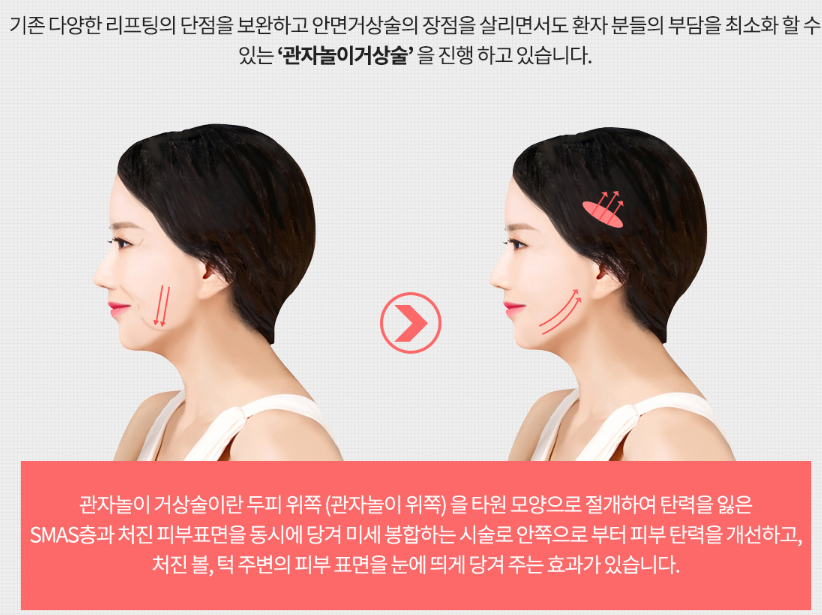
How it differs from the existing facelift procedure
In the case of the existing facelift procedure, incisions are made over a relatively wide area, from in front of the ear and, depending on the case, to behind the ear.
Because of this, problems such as scarring and skin folding may occur from time to time, and the recovery period and cost in particular were often a major burden.
In contrast, the "3-step temple lift" accesses the area through a minimal incision in the scalp near the temples, reducing concern about scars.
It also has the advantage of a relatively short procedure time and short downtime, allowing a quicker return to daily life.
When I say that the incision is made in the scalp near the temples, some of you may worry, "Will hair no longer grow in that area?"
At our clinic, based on years of experience and know-how, the incision is made without damaging the hair roots, so there is no problem with hair growth.
Because the incision is small, and hair later covers the area, you can think of the concern about scars as being minimal.
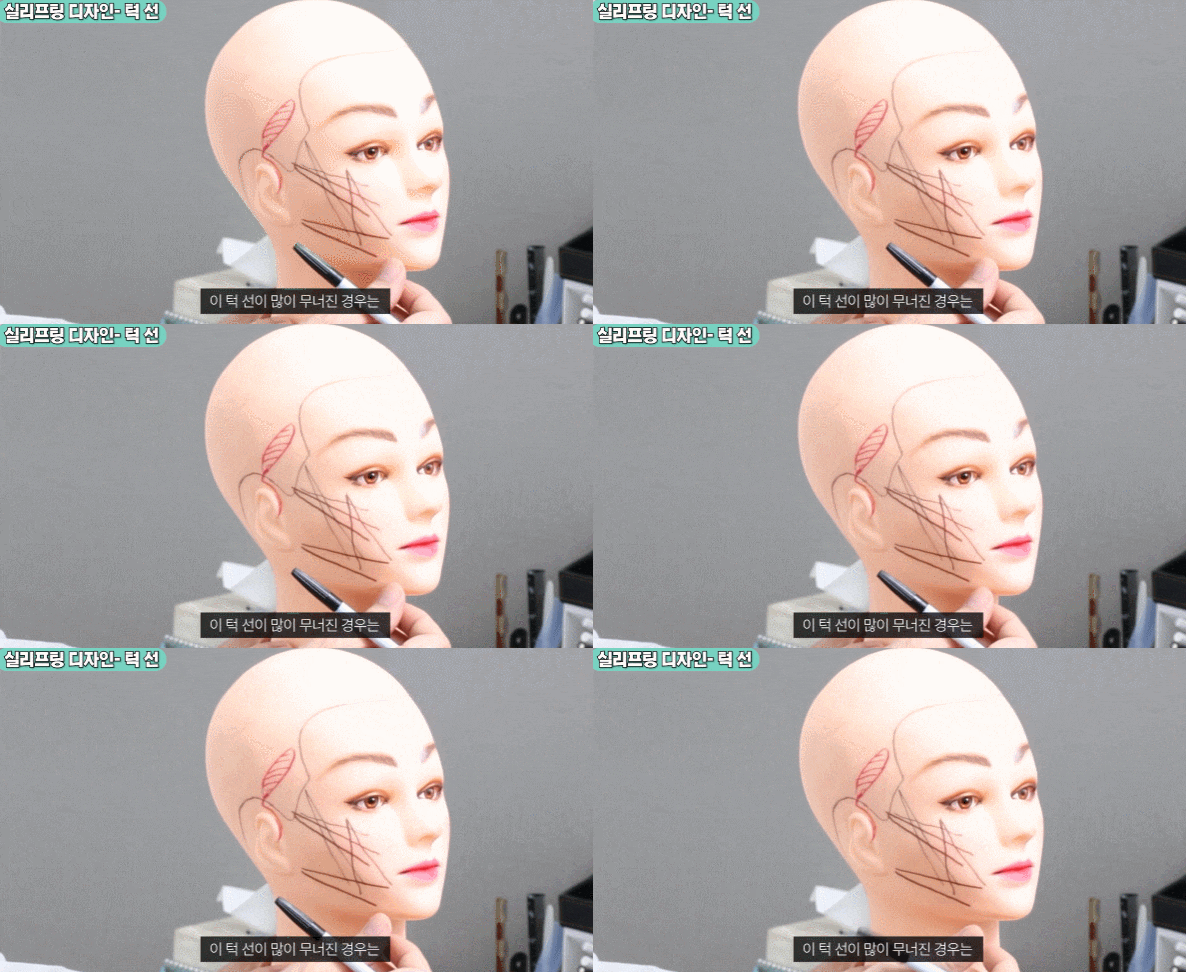 Why choose the 3-step temple lift?
Then let me explain why it is good to approach lifting through the temple area.
The skin of our face has recessed areas depending on the shape of the skull.
These include the area around the orbital bones surrounding the eyes and the area below the cheekbones. Because there is space between the skin and the skull in these regions, sagging tends to be especially severe there.
Even when lifting is performed through thread lifting or lasers, sagging returns quickly for exactly this reason.
By contrast, the temples are areas that are relatively close to the skull. (If you touch the area around your eyes and below your cheekbones with your hand, and then touch your temples, you will likely feel the difference.)
For that reason, this is also an area where the skin tissue sags less compared with other areas.
So, if the incision is made in this area, and the loosened muscle and skin are pulled up and sutured, the corrective effect is strengthened and a greater lifting result can be expected.
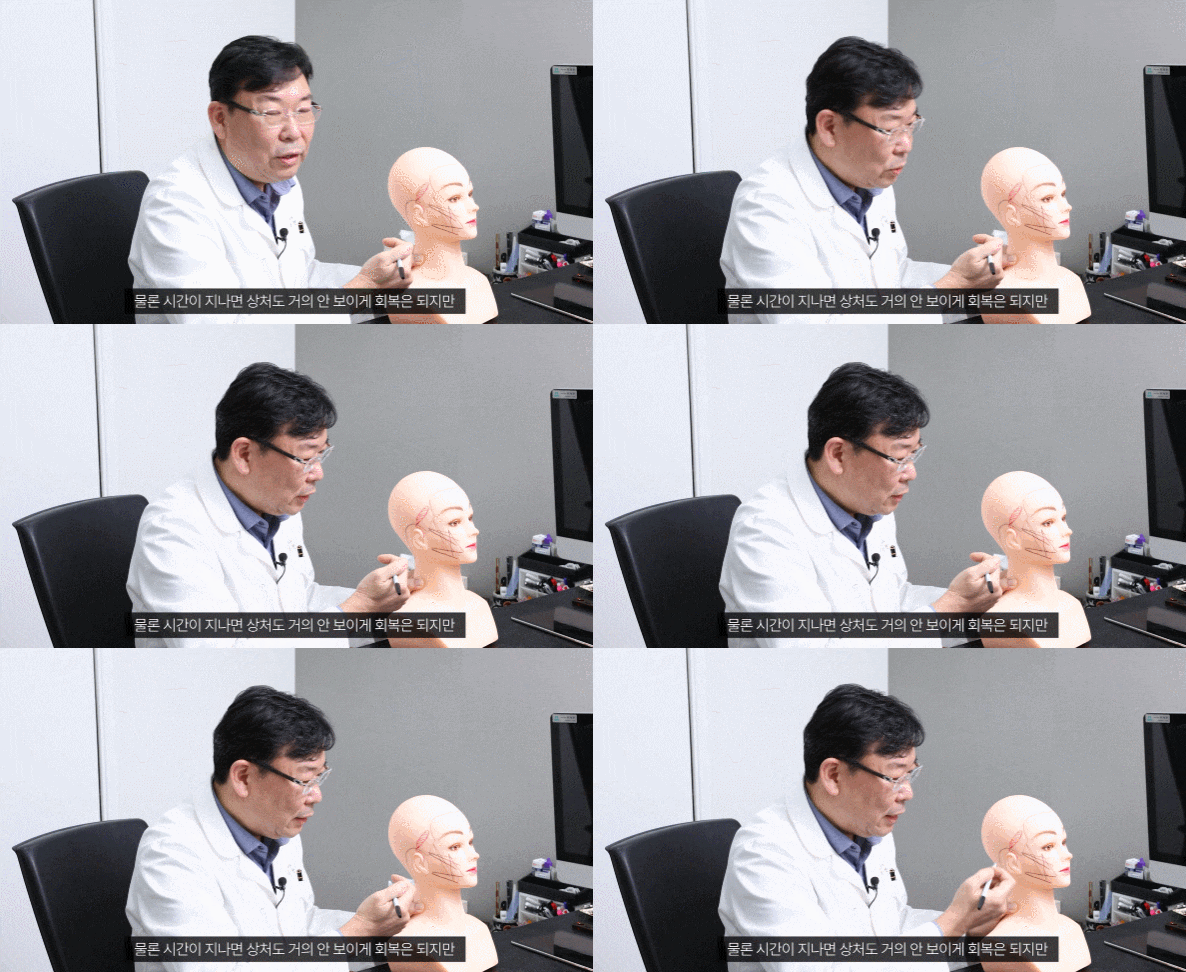 What is the difference between the 3-step temple lift and thread lifting?
-
For those who want a greater effect than thread lifting can provide, or who were not satisfied after thread lifting procedures
-
For those who feel burdened by the cost or recovery period of the existing facelift procedure
I think many people looking for a mini facelift fall into the two categories above.
Of course, some people undergo thread lifting alone, but in fact, if wrinkles or sagging are severe, it is difficult for it to deliver very satisfying results.
Even if there is an effect, after 1 to 2 years it returns to the original state, so if you want a lasting effect, repeat treatment is needed.
Our 3-step temple lift is suitable for people who want something more convenient than a facelift but a stronger effect than thread lifting.
Of course, a temple lift can also be performed on its own, but depending on the need, thread lifting can be performed together.
Because the threads are inserted through the temple where the incision is made, it has advantages that differ from conventional thread lifting.
Since the insertion point for the threads is higher than in conventional thread lifting, it can help prevent the cheekbones from becoming too prominent, and it may provide a stronger thread-lifting effect.
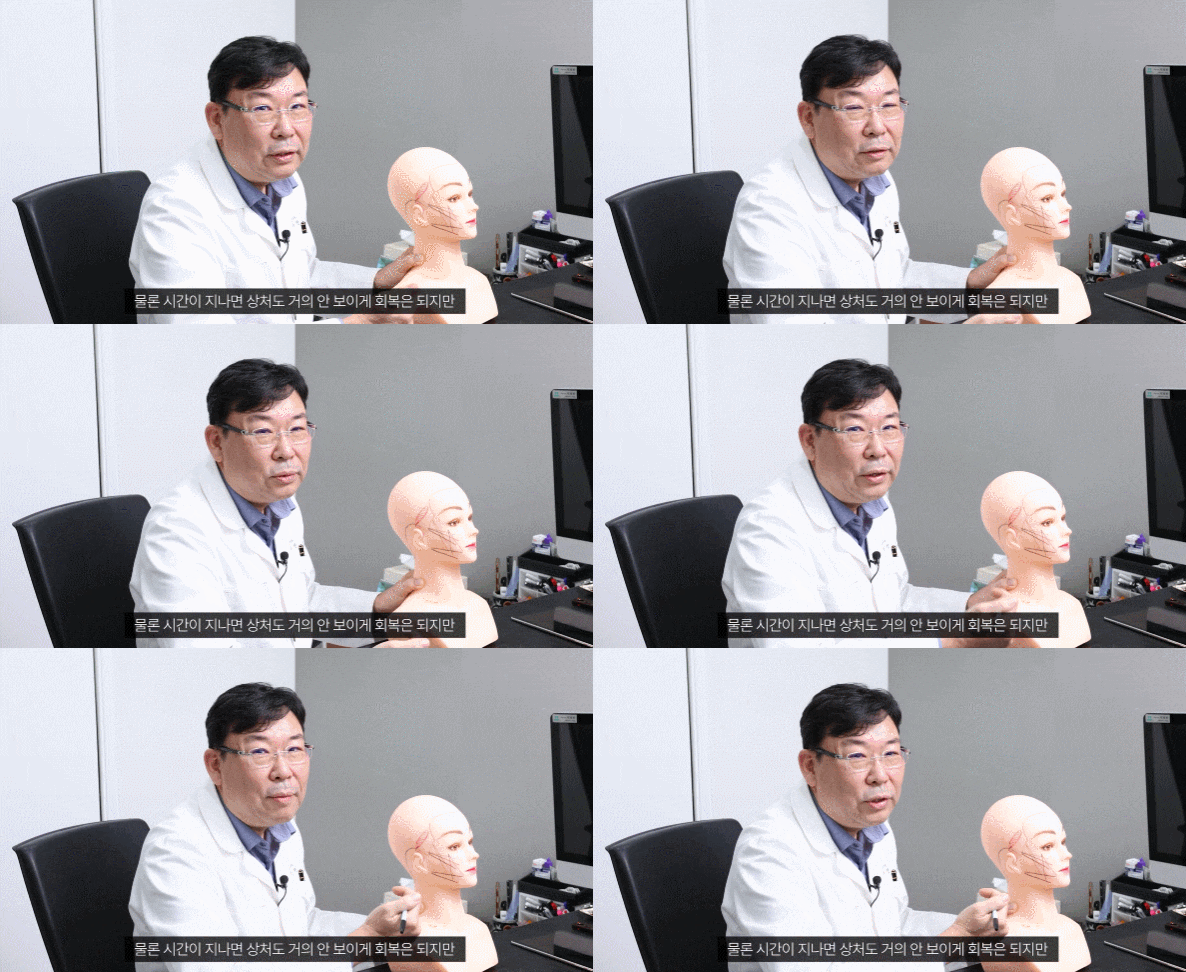
Today, I talked about the 3-step temple lift performed at our clinic. It feels like I only talked about the advantages. ^^
Just because you read this article and visit us does not mean you will automatically be able to receive this procedure.
That is because, after closely assessing each person’s degree of skin sagging, skin type, and areas of concern, we provide surgery only when we determine that this procedure is appropriate.
Of course, we also perform basic facelift procedures, thread lifting, and treatments using laser devices, so we can suggest a solution that fits your skin condition.
If you need our help, you are welcome to visit us for a consultation.
We will do our best to find the solution that is just right for you.
Thank you.