Hello. This is Ribbon Plastic Surgery, located at Exit 1 of Sinsa Station, specializing in mini facelift surgery.
If you search for <facelift surgery> in a dictionary, you’ll find this explanation:
“Plastic surgery that pulls the skin of the face backward toward the ears in order to improve wrinkles across the face.” Just from the description, it sounds like a dream surgery, but once you hear the detailed specifics, it’s true that many people feel nervous right away.
A full facelift involves making a wide incision along the hairline from one ear to the other, dissecting the SMAS layer from the jawline to the forehead, lifting it upward, removing excess skin, and then suturing it closed.
While it has the advantage of improving wrinkles across the entire face and producing semi-permanent results, it also comes with significant cost, and because the incision area is wide, it can naturally feel burdensome for patients.
Recently, to reduce this burden, the mini facelift, which lifts only the areas causing problems at the moment, has been drawing attention.
Mini facelift surgery can largely be divided into two types depending on the area: <forehead lift> and <temple lift>.
In this post, we’ll look at <temple lift> and explain its effects and precautions.
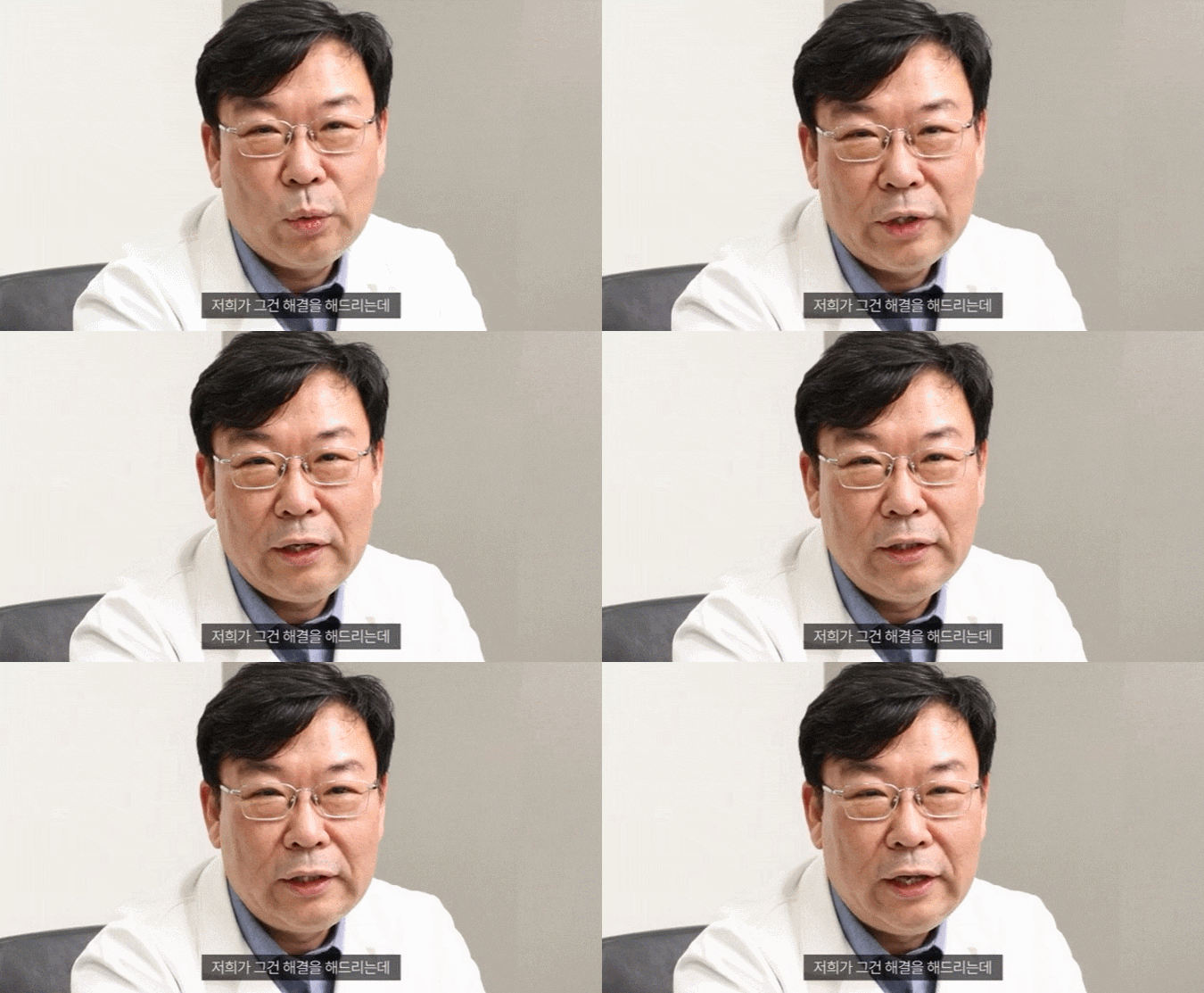
Why lift the ‘temple’?
At our clinic, temple lifting is referred to as the ‘three-step temple lift.’
That’s because it can lift three areas: the eyes, which increasingly sag downward with age; the deep cheeks, which bulge outward; and the sagging jawline.
There are two main reasons for specifically lifting the ‘temple’ among so many areas.
First: because it is located on the scalp, the scar is hidden.
When people hear “temple,” many think of the skin tissue beside the eyes and ears.
However, medically speaking, the temple is a broad area that also extends to the scalp behind it.
During a three-step temple lift, a very small incision is made in this area, so even right after surgery, if you let your hair down, the incision is not visible and you can return to daily life right away.
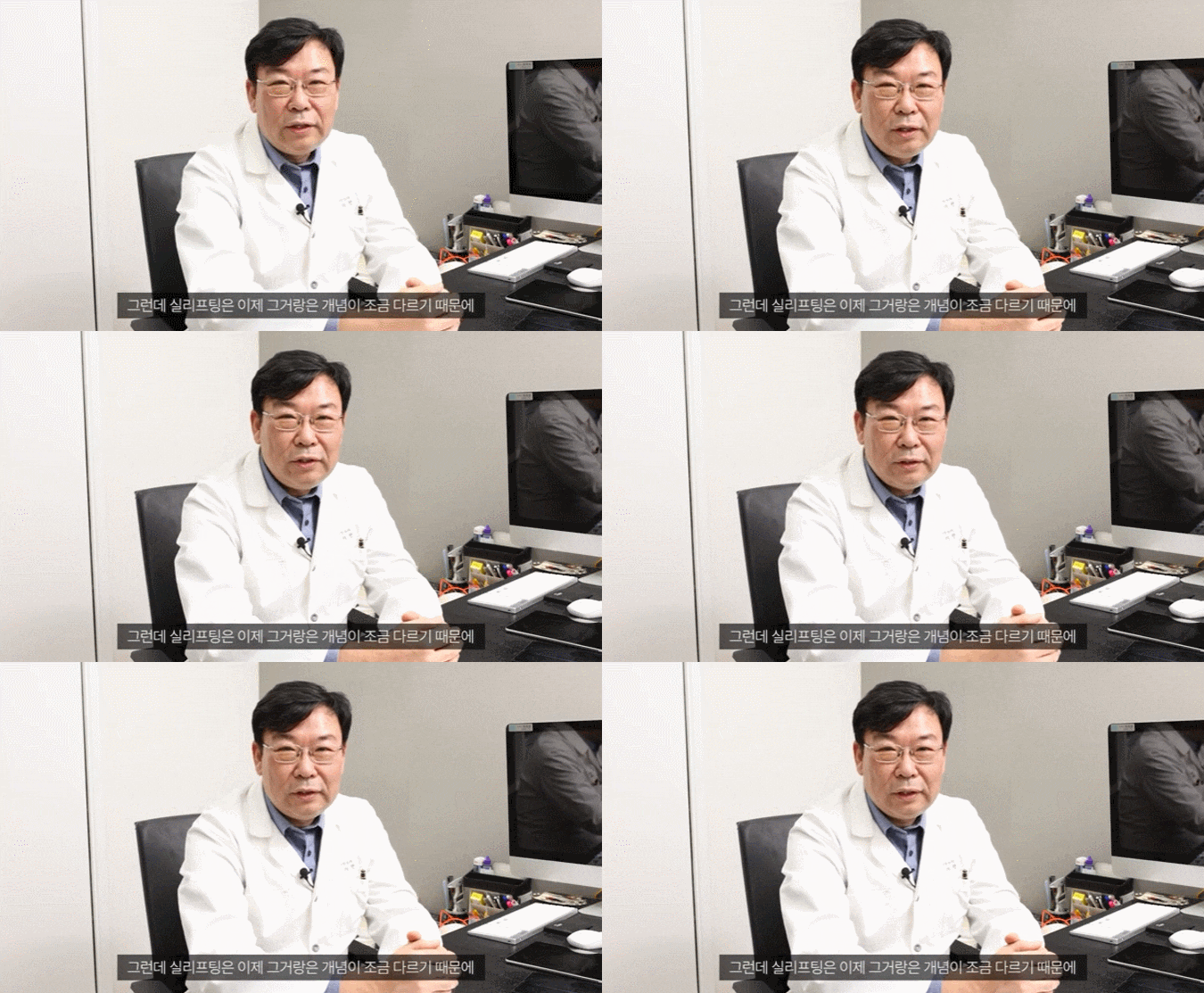
Second: because of the unique characteristics of the scalp.
Would you try touching your skin with your hand once?
You’ll likely notice that the feeling is clearly different when you touch your cheek versus when you touch your scalp.
Looking at the human skull, the area surrounding the brain is tightly covered with bone without any gaps, while the face has open areas in several places.
Those open areas are filled in with fat or muscle tissue.
Because of this, the likelihood of sagging increases as people age, and in fact, among people in their 40s and 50s and older, the number of those concerned about deep cheeks, cheeks, or cheekbone area fullness increases noticeably.
But the scalp is different.
It has very few gaps and is closely attached to the skull bone, so sagging of the skin tends to appear more slowly than on the front of the face.
That is why lifting the temple can provide a longer-lasting effect.
Three-step temple lift, recommended for the following people~
| ▲ Those whose outer corners of the eyes are sagging▲ Those who want to shape the outer corners of the eyes into the form they want▲ Those who want to correct an uneven side line of the face▲ Those whose cheek area has sagged, making the nasolabial folds look more severe▲ Those whose face looks generally broad due to excess volume |
Three-step temple lift: what should you be careful about during surgery?
The temple is a sensitive area. If you clench your jaw and tighten your molars, you can see the ‘masticatory muscle,’ which is involved in chewing food, bulge outward.
At the same time, the area where the temple is located also bulges outward.
The reason is that the masticatory muscle is connected all the way to the temple.
Whether it is a full facelift or a mini facelift, a lift is a surgery that carefully separates the SMAS layer, a very thin membrane between the subcutaneous fat layer and the muscle layer, and pulls the skin upward.
At this point, if the muscle is accidentally damaged, there is a risk of injuring the masticatory muscle beneath it, which would mean loss of chewing function. For this reason, the procedure must be performed by plastic surgery medical staff with sufficient experience.
Also, since the incision is made in an area with hair, if the hair follicles are damaged during the incision process, hair may not grow back permanently, so this is another point to be careful about.
To prevent these problems in advance, the surgeons at Ribbon Plastic Surgery use an oblique incision, allowing a stable incision without damaging the hair follicles.
As time passes, you’ll be able to see that hair naturally grows back, so you can rest assured.
A difficult three-step temple lift like this.
Choose a board-certified plastic surgeon with many years of experience.
This has been Ribbon Plastic Surgery. Thank you. ^^