Hello, we are ‘Re:本 Plastic Surgery,’ meeting you at Exit 1 of Sinnonhyeon Station.

Thread lifting is a non-surgical procedure that lifts sagging areas by mechanically pulling the skin after inserting a medical thread called PDO into the skin.
Unlike lifting with equipment, it does not involve the burden of surgery, and many people seek this procedure because it creates visible, immediate changes.
However, if thread lifting is not performed properly, various problems such as a foreign-body sensation or more prominent cheekbones may occur.
Thread lifting?
Thread lifting is a procedure that does not require an incision in the skin; instead, threads are inserted into the dermal layer through tiny holes to physically lift the face.
In general, the threads used for lifting can be divided into two types depending on their shape.
They are cog threads with barbs and mono threads without barbs.
Cog threads are designed with barbs along the thread so they can effectively pull up skin tissue.
Mono threads without barbs are used to stimulate collagen production and improve skin elasticity.
Recently, threads with various barb shapes and ingredients have been released.
Which thread should be used should be determined comprehensively after a close diagnosis based on each individual’s skin characteristics and current condition.

Why cheekbones can appear larger
Thread lifting procedures use cog threads, which have barbs.
However, the barbs are generally located about 7 to 8 cm apart.
When the area that needs lifting is in the lower part of the face, such as the nasolabial folds or jowls, the thread is inserted right next to the cheekbone for lifting.
In such cases, the pulled skin may be pushed toward the cheekbone area, making this part stand out more than usual and causing the face to look flatter or appear larger overall.
Re:本 Thread
To solve this problem, Re:本 Plastic Surgery makes and uses its own thread, called ‘Re:本 Thread,’ for lifting.
Re:本 Thread is longer than existing threads and has barbs throughout, allowing much stronger lifting over a much wider area than conventional thread lifting.
In addition, because its barbs are shaped to distribute force across the entire area, it helps prevent skin from gathering in one place and causing that area to protrude or appear larger.
Re:本 Plastic Surgery’s ‘Re:本 Thread’ is made only with ingredients approved by the Ministry of Food and Drug Safety, so it is also reassuring in terms of safety.
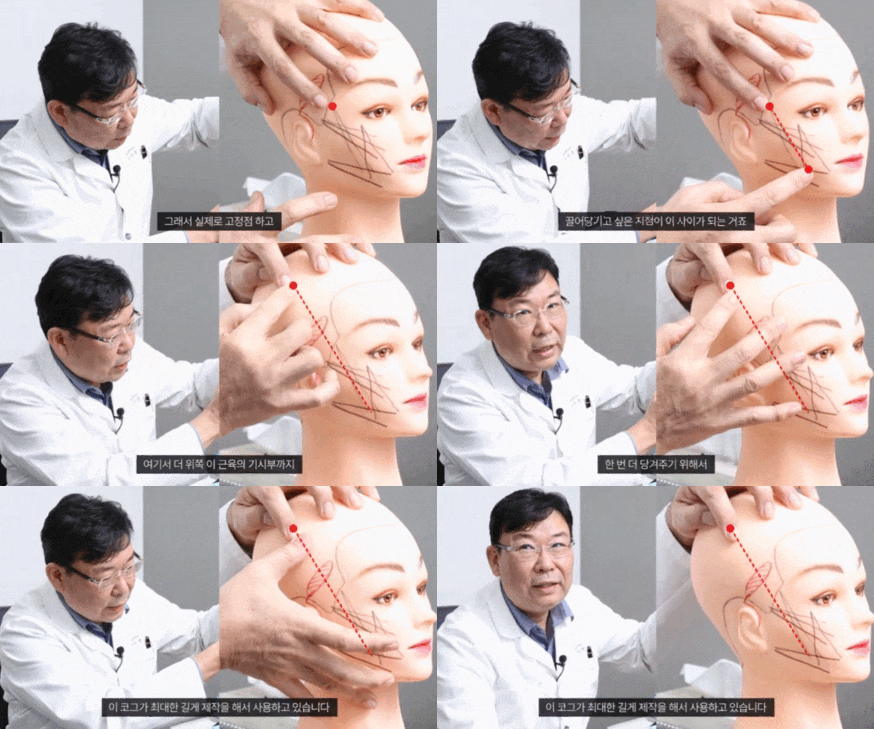
Thread lifting: the practitioner’s skill and experience also matter.
The effect of thread lifting varies depending on the type, thickness, and ingredients of the thread.
More important than that is the practitioner’s know-how and skill.
That is because the result can differ greatly depending on which direction the thread is pulled and how much force is applied.
Even a difference of 1 mm or 1 degree can change the outcome, so from the design stage onward, the individual’s facial condition, direction of aging, skin type, and skin thickness must all be considered.
If these factors are ignored and the focus is only on pulling, or if the procedure is repeated using only one method, the effect will decrease.
For example, when using an existing short lifting thread to pull up sagging skin in the lower face, the area must first be lifted from the cheekbone and then the force must be redistributed upward.
However, this too can be designed differently depending on the person’s facial features.
Thread lifting is not simply about lifting; it is also a procedure that redesigns the contours of the face depending on the direction in which the thread is lifted.
Therefore, we recommend undergoing the procedure only after receiving a comprehensive, multifaceted diagnosis from a board-certified plastic surgeon with experience and know-how, and after sufficient consultation.
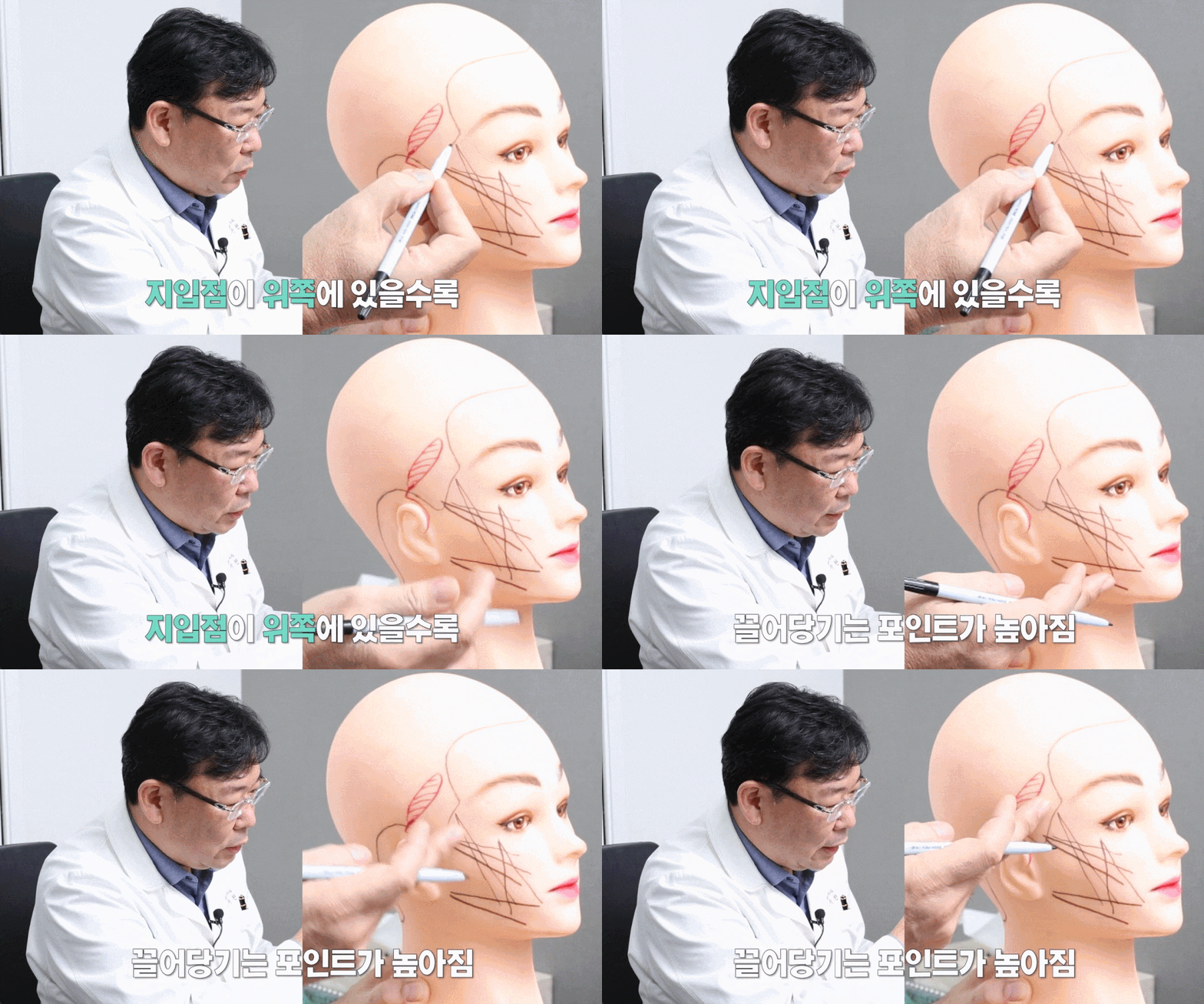
As we age, skin elasticity decreases, and skin affected by gravity sags downward.
As a result, the volume in the lower face becomes relatively larger, leading to sagging jowls and deep wrinkles such as nasolabial folds and marionette lines.
However, even when trying to improve facial sagging in the same way, the thread used, as well as the force and direction in which it is inserted and pulled, should differ according to each person’s characteristics.
If the procedure is performed while ignoring individual differences, there is a risk of unexpected side effects.
Re:本 Plastic Surgery’s medical team, composed of board-certified plastic surgeons, consults with you directly and recommends only the procedures you need in a 1:1 customized approach.
If you are concerned about a sagging face, deeper nasolabial folds, and uneven contours, please visit Re:本 Plastic Surgery through the link below.
Thank you.