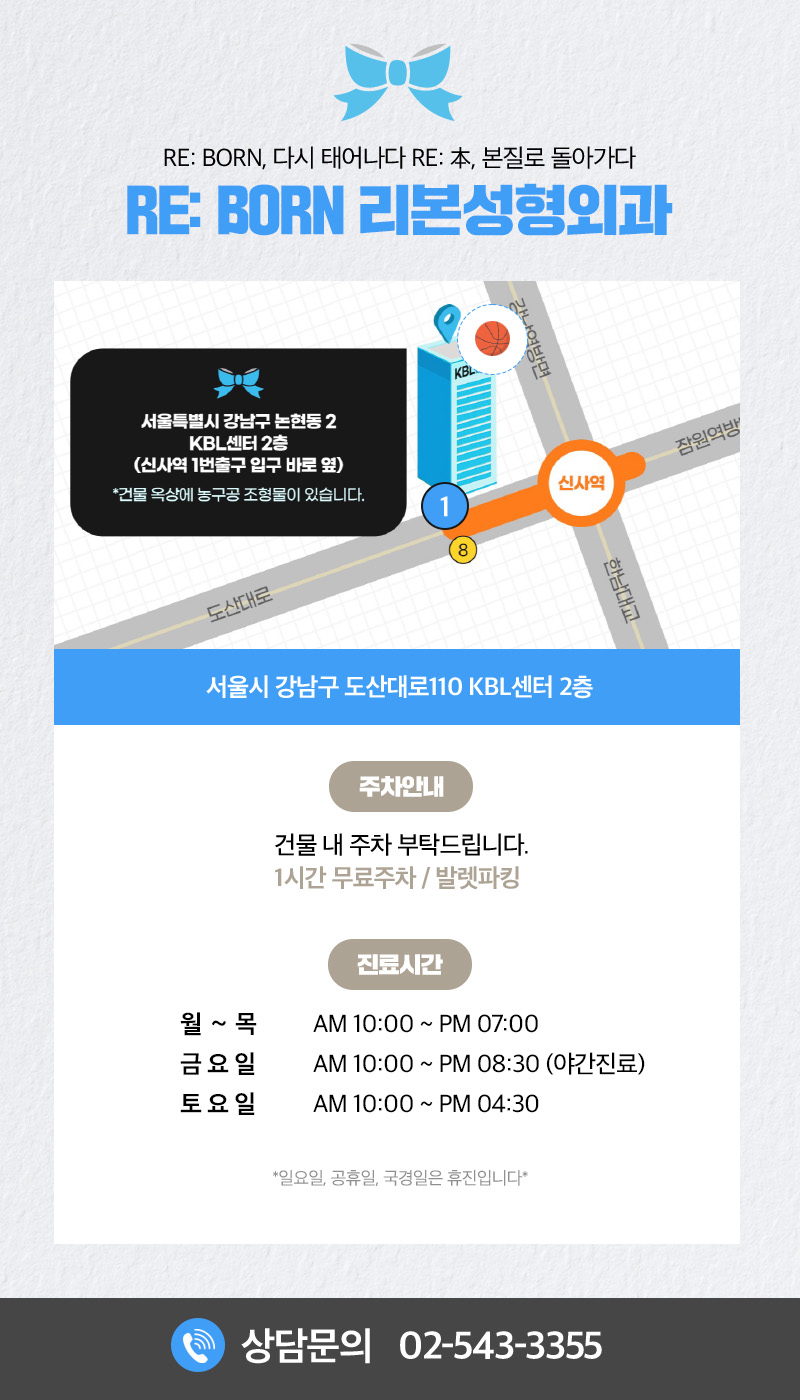
Hello. We are ‘Ribbon (Re:本) Plastic Surgery,’ meeting you at Exit 1 of Sinsa Station.

There is also fat in the face.
But as we age, the fat layer in each area gradually decreases or sags.
When the fat under the eyes diminishes, tear troughs appear, and when cheek fat decreases, hollows in the cheeks form.
The fat that has moved down like this collects underneath to form a fat pocket, and that fat pocket then sags downward.
This is sagging cheek fat.
When the cheek fat sags, the nasolabial folds look deeper, and the facial line appears uneven.
These deeper wrinkles and uneven lines make the face look older than it really is.
For this reason, many people visit us to address sagging cheek fat.
If the degree is not severe, we may recommend laser lifting such as InMode.
However, if the skin sagging is severe and it is difficult to improve simply by reducing fat and increasing elasticity, we recommend thread lifting, which can physically pull the skin tissue upward.
Thread lifting?
Thread lifting is a procedure that does not require an incision in the skin. Through tiny holes, dissolvable medical threads are inserted under the skin to physically lift sagging tissue.
Because it directly pulls the skin tissue using a physical method, results can be seen immediately compared to laser lifting.
In addition, since the burden of surgery is low, the downtime is short.
The threads used for lifting gradually dissolve after being inserted under the skin, stimulating the surrounding tissue and helping collagen production.
A major feature is that it can directly pull the skin for lifting while also offering some improvement in elasticity.
Types of lifting threads
In general, there are many types of threads used for lifting, but by ingredient and shape, they can be broadly divided into three types.
| POD mono thread | A plain PDO (Polydiocanone) thread, inserted into the dermis to induce collagen regeneration |
|---|
| POD cog thread | A PDO thread with various types of barbs, inserted into the dermis-subcutaneous fat layer to pull and lift the skin |
| PLLA cone thread | A cone-shaped PLLA (Poly L Lactic Acid) thread, inserted into the dermis-subcutaneous fat layer to lift the skin while helping increase volume through its own collagen-forming properties |
POD and PLLA refer to the ingredients.
The most commonly used thread is the POD thread.
This thread is considered safe enough to be used as a suture in heart surgery, and once inserted, it gradually dissolves and disappears.
POD threads can be divided into mono threads, which are thinner than a hair, and cog threads, which have barbs.
In the case of mono threads, rather than pulling the skin, they are inserted under the skin to stimulate surrounding tissue.
They are used for the purpose of improving overall skin elasticity and volume.
Cog threads directly pull the skin using their barbs.
What people commonly think of as “thread lifting” is often performed with cog threads.
PLLA threads are “collagen auto-inducing derivatives” that generate collagen on their own.
Compared to POD threads, they are more suited to the purpose of increasing volume.
A representative product is “Silhouette Soft.”
Silhouette Soft is made from PLLA and has cone-shaped barbs.
Because it has strong overall flexibility, it remains stable even when inserted into areas that move with many facial expressions, and its rounded shape also allows it to be inserted into curved areas.

Precautions for thread lifting
All procedures carry the possibility of side effects.
Except for PLLA threads, thread lifting threads themselves have a blue color.
For this reason, if they are used in people with very thin skin or inserted too shallowly, there may be a side effect where the bluish tint becomes visible through the skin.
Therefore, when receiving thread lifting, we strongly recommend finding a medical team with abundant clinical experience and strong knowledge of facial anatomy.
To lift the cheek fat, threads must be inserted around the mouth.
When you open your mouth wide, eat, or make facial expressions and speak, you may hear a “snap” sound as if the thread has broken.
In the past, the thread itself would actually break and become exposed outside the skin.
The threads currently manufactured are fixed by the surrounding tissue and have good tension, so the thread itself almost never breaks, so there is no need to worry.
Another side effect is that the cheekbones appear larger.
The reason the cheekbones appear larger is that the existing thread is too short.
When inserting threads to improve sagging cheek fat or problems in the lower face such as nasolabial folds and marionette lines, the thread is generally inserted to the side of the cheekbone and pulled.
As a result, force becomes concentrated on the cheekbones, causing the problem of the cheekbones appearing larger.
To solve this problem, Ribbon Plastic Surgery custom-produces and uses threads that are longer than conventional threads.
Ribbon Plastic Surgery’s Ribbon Thread uses only ingredients approved by the Ministry of Food and Drug Safety, and inserts threads from the hairline using threads that are longer and have better tension than conventional threads.
Thanks to this, force is not concentrated on the cheekbones but distributed evenly, and the insertion site is hidden by the hair, so one advantage is that it is not noticeable immediately after thread lifting.
Of course, before the procedure, we perform a suitability test to determine whether the thread is appropriate for the skin before proceeding.
In thread lifting, the type, thickness, and ingredient of the lifting thread are important.
But more important than that is the practitioner’s skill and know-how.
This is because the results can vary greatly depending on the direction and amount of force used to pull.
Even a difference of just 1 mm or 1 degree can change the result, so from the design stage onward, individual facial condition, the direction of aging, skin type, and thickness must all be considered.
If these factors are ignored and the focus is only on pulling, or if procedures are repeated using only one method, the effect will diminish.
At Ribbon Plastic Surgery, a medical team composed of board-certified plastic surgeons personally consults with you and provides 1:1 customized treatment.
If you are concerned about sagging facial features, deepening nasolabial folds, and uneven contours, please visit Ribbon Plastic Surgery.
Thank you for reading this long post.