Hello. We are Re:본 Plastic Surgery, meeting you at Exit 1 of Sinsa Station.

Thread lifting is a lifting procedure that has been steadily popular since the early 2000s because it can produce results quickly without the burden of other surgical procedures.
When thread lifting first became available, there were actual cases of the inserted threads breaking and protruding through the skin, so many people became concerned.
However, the products currently on the market have been developed to sufficiently address these issues, so threads rarely break.
That said, thread lifting is a procedure in which the results vary greatly depending on the practitioner’s skill.
Today, we would like to talk about how to receive thread lifting properly without side effects.
We hope this article will be helpful to those who are worried about sagging facial skin or who are curious about thread lifting procedures.
What Is Thread Lifting?
Thread lifting is a procedure that primarily uses dissolvable medical threads to physically lift stretched and sagging skin tissue.
It is a procedure many people seek because, without surgical intervention, it allows you to feel a noticeable change right away compared to laser-based procedures.
The threads used for lifting can be broadly divided into two types by ingredient and three types by shape.
First, by ingredient, they can be divided into PDO threads and PLLA threads.
PDO threads are threads whose safety has long been proven and are also used as a material for heart sutures.
Since they dissolve and disappear over time, there is no need for separate removal.
Unlike PDO threads, PLLA threads have the advantage of independently creating collagen.
Of course, PDO threads also help somewhat with collagen remodeling.
While PDO threads slowly dissolve and stimulate surrounding tissue to help collagen production, PLLA threads contain ingredients that form collagen on their own.
They are similar to Sculptra, a collagen booster.
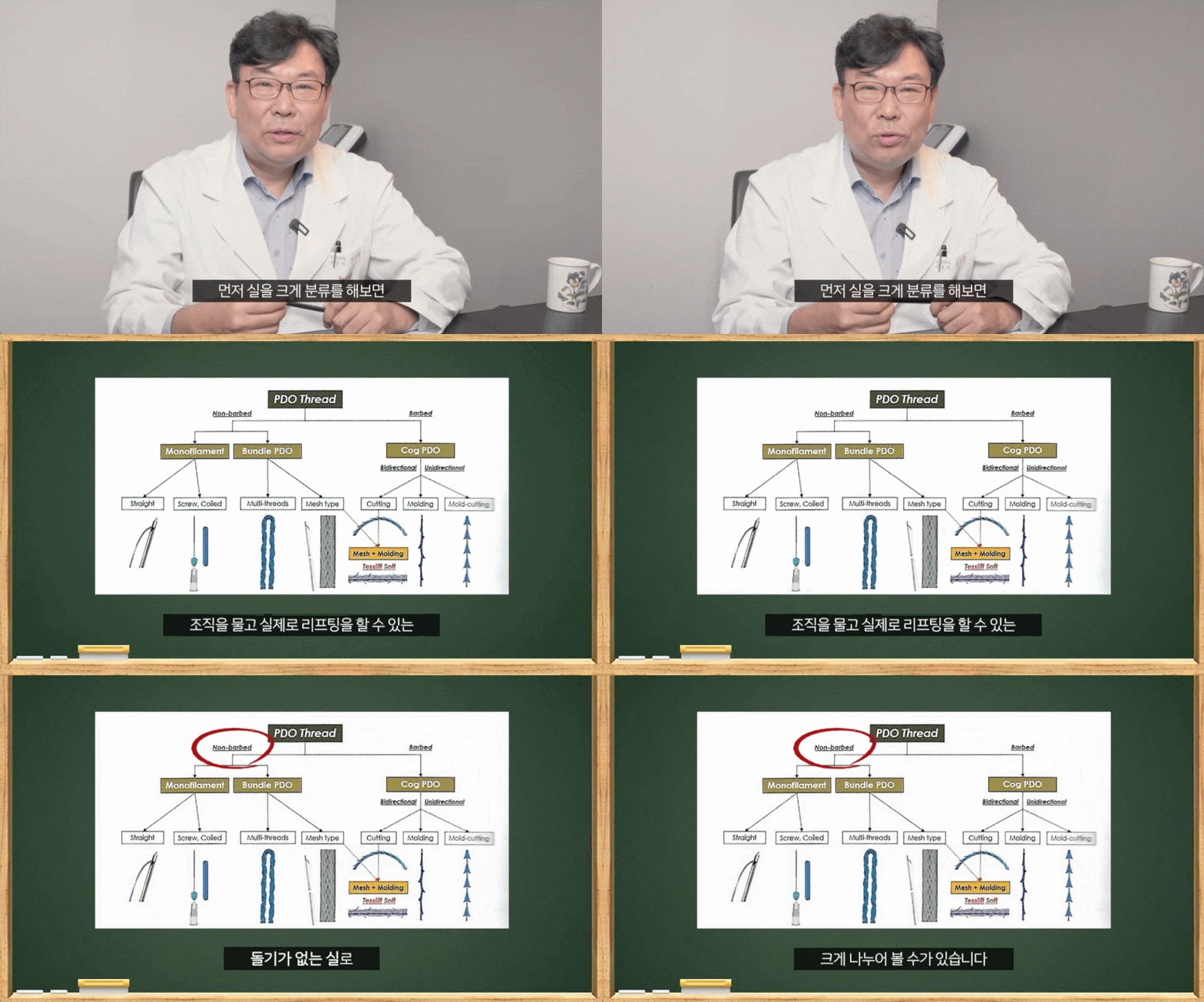
By shape, they can be divided into cog threads, mono threads, and cone threads.
Cog threads, which are commonly used for lifting, refer to threads with barbs.
They lift by hooking the barbs directly onto the skin tissue and pulling it upward.
When people think of “thread lifting,” they usually mean using these cog threads.
Mono threads are thinner than a hair and are used not so much for lifting itself, but for being inserted into the skin to stimulate tissue and promote collagen regeneration.
Cone threads, represented by Silhouette Soft, are made of PLLA.
They have a shape in which round, cone-shaped barbs wrap around the thread.
Because the area with the barbs is flexible rather than fixed, the procedure can be performed even in areas with thin tissue or areas that move a lot.
However, compared to PDO cog threads, their lifting force is weaker.
Which thread should be used must be determined comprehensively after a careful diagnosis based on each individual’s skin characteristics and condition.
If you simply approach it by saying one product is good or that a more expensive one is better, you may not get the results you want.

Thread Lifting Side Effects
Any procedure always carries a risk of side effects.
The representative side effects of thread lifting are dimpling, visible threads, and a broader cheekbone appearance.
First, dimpling refers to skin indentations.
This can occur for various reasons, such as which skin layer the thread is inserted into, how much force is applied when pulling the thread, and which thread is selected.
If the dimpling is mild, it will naturally resolve over time, but if it is severe, traces may remain even after the thread dissolves, so special caution is needed.
Except for PLLA threads, the threads used for lifting are blue.
Because of this, if the procedure is performed on someone with very thin skin or if the thread is inserted into a shallow layer, a side effect may occur in which the thread shows through the skin.
Therefore, before undergoing the procedure, you should first check whether thread lifting is suitable for your face.
Re:본 Plastic Surgery checks whether the procedure is appropriate through a suitability assessment before treatment, so you do not need to worry.

Why Does the “Pop” Sound Occur?
The “threads breaking” mentioned earlier is actually a side effect that is now very rare.
Once inserted, the thread is fixed by the surrounding tissue, so the thread itself is unlikely to break, and the “rustle” or “pop” sound is usually closer to the sound of the thread loosening and then being fixed again.
However, the force that re-fixes the thread after it loosens can become weaker.
Therefore, for about one month after the procedure, please avoid strong facial massage and actions such as opening your mouth wide.
If this happens, please be sure to visit the hospital where you received the procedure.
Does Thread Lifting Make the Cheekbones Bigger?
One of the main side effects often mentioned with thread lifting is this broader cheekbone appearance.
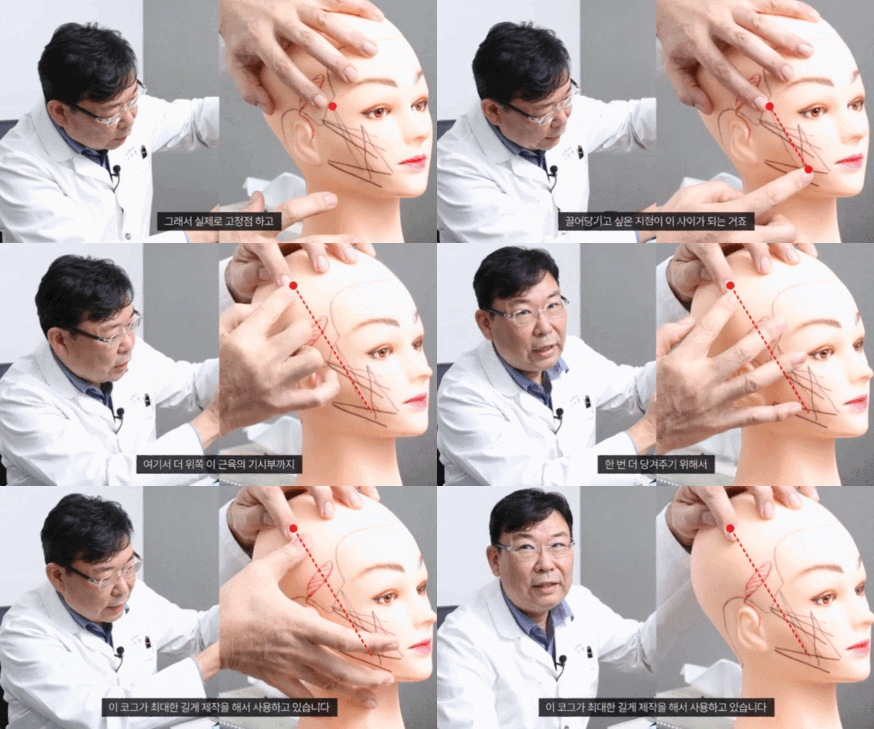
The reason the cheekbones appear larger is the position of the thread barbs.
In general, commercially available threads have barbs located about 6 to 7 cm apart, so when the thread is pulled, tension tends to concentrate on the cheekbones.
If this is not pulled once more to distribute the tension, the cheekbones may appear broader, and for this reason the face may look larger.
In other words, you may undergo a lifting procedure to create a smoother facial line, only to end up with a face that looks larger.
To prevent this, Re:본 Plastic Surgery produces and uses its own Re:본 Thread.
Made only with ingredients approved by the Ministry of Food and Drug Safety, the safe Re:본 Thread is slightly longer than conventional threads and has barbs designed to disperse force rather than concentrate it in one place.
Therefore, it can help prevent excessive force from being concentrated on the cheekbones.
It also has the advantage that the insertion area is hidden by the hair, so it is not very noticeable immediately after the procedure.
To receive thread lifting properly, it is most important to undergo the procedure at a place that fully understands each individual’s skin type, degree of aging, and the characteristics of lifting threads.
For this, it is important to receive a detailed consultation and a careful diagnosis from medical staff who have long experience with and have studied thread lifting before proceeding.
Sinsa Station Re:본 Plastic Surgery has board-certified plastic surgeons personally handling everything from consultation to the procedure and aftercare, which can reduce anxiety and burden about the treatment.
If you need help, please feel free to contact us at any time.
Thank you for reading this long post.