Readers of this article are likely considering thread lifting due to reduced facial elasticity, wrinkles, or sagging.
Especially because it can improve facial contours without an incision, thread lifting has been receiving a lot of attention.
Unlike other devices, thread lifting is a procedure that is especially dependent on medical devices and varies according to the practitioner’s technical skill.
That is because even with the same thread and the same procedure method, the results can vary completely depending on the operator’s skill and anatomical understanding.
Since this is a procedure that changes the contours of the face, even minor errors can have a major impact on your appearance.
Therefore, if you are looking for a good place for thread lifting, be sure to check whether it has the technical skill and accurate understanding of anatomy.

What Is Thread Lifting?
Thread lifting is a lifting procedure that inserts special medical threads into the skin to directly pull sagging tissue upward.
These threads are made of safe ingredients that are naturally broken down in the body over time,
and they not only physically lift the skin but also stimulate collagen production, contributing to medium- to long-term improvements in skin elasticity.

The threads used have different purposes depending on the type.
PDO threads, which are used most often, are absorbed relatively quickly and can provide an immediate lifting effect.
On the other hand, PLLA threads take longer to be absorbed and are focused on skin regeneration and volume improvement.
The application area and purpose also differ depending on whether the thread has barbs.
Threads without barbs are mainly used to induce collagen within the skin, while threads with barbs are used to actually hook and lift tissue to create a lifting effect.
Most of what we now call “thread lifting” refers to a procedure that uses barbed “cog threads” to pull tissue upward.
Because thread lifting does not require an incision, recovery time is shorter than surgery, and returning to daily life is relatively quick.
However, since thread lifting is a procedure that physically pulls the skin, the results can vary greatly depending on the practitioner’s technique.
This is because the outcome changes depending on how deep the thread is inserted, whether the pulling direction is appropriate, and whether the fixation points are set according to facial structure.
Even when the same thread is used, if the skin is thin, the thread may become visible or the surface may appear uneven,
and if the pulling direction is wrong, volume may gather toward the cheekbone area, making the face appear wider.
As such, thread lifting may look simple, but it is actually a complex procedure that affects the entire three-dimensional structure of the face.
Only when the design takes into account not just the skin, but also the fat layer beneath it, bone structure, and distribution of elasticity can stable and natural results be expected.
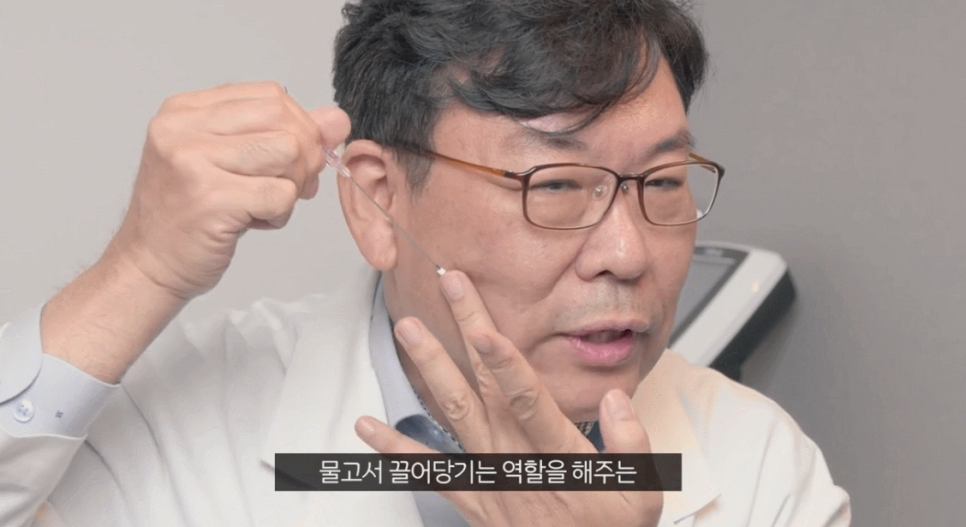
Preventing Side Effects Such as Prominent Cheekbones and Sunken Cheeks
One of the representative side effects patients sometimes experience after thread lifting is “prominent cheekbones.”
When threads are inserted to improve sagging in the midface, if the endpoints of the threads are concentrated toward the cheekbone area, force can gather there and make the cheekbones appear more protruded than they actually are.
This kind of issue depends less on the performance or material of the thread and more on whether the practitioner’s “design direction” was appropriate.
For example, if only one thread is generally used and the focus is solely on pulling the tissue, the flesh may gather toward the cheekbone area.
In addition, the fixation force may be weak, causing the lifting effect to disappear relatively quickly.
By carefully considering how to distribute the pull and where to set the fixation points, it is possible to reduce side effects such as tissue gathering toward the cheekbones or hollowing in the face.
In other words, the procedure must account for how the facial shape will change in order to achieve the desired result stably.
In this respect, it is important to carefully check the medical team’s experience, know-how, and skill level.

A good place for thread lifting cannot be judged by the thread brand, number of procedures performed, or review metrics.
Simply having used threads many times does not mean a place can create a precise design suited to the patient’s facial structure.
We recommend finding a clinic that has studied thread lifting over a long period of time, precisely diagnoses the patient’s skin condition, bone structure, and fat layer position, and then plans the appropriate thread type, insertion direction, and fixation points before performing the procedure.
If you are considering thread lifting, we encourage you to find a clinic that can handle everything consistently, from structural analysis to design and post-procedure care.
Because this is a procedure applied to the face, please proceed with caution.
Thank you for reading this long post.
| This post was written for informational purposes in compliance with Article 56, Paragraphs 1–15 of the Medical Service Act. All treatments carry the risk of side effects and complications depending on the individual. Before treatment, be sure to have a thorough consultation with a medical professional with extensive experience before making a decision. |