People do not really feel that they are getting older just by looking at fine lines and wrinkles.
It is only when deep nasolabial folds, sagging jowls, and the marionette lines they cause become clearly noticeable to anyone that they finally think,
'Oh, I’m getting older.'
When these changes appear, it means that the subcutaneous tissues of the face have already begun to sag,
and simply improving elasticity or caring for the skin’s surface will not make things better.
A method that can lift the tissue more directly is needed.
'Thread lifting' using dissolvable threads such as PDO is a procedure that physically pulls up and secures the skin tissue without surgical operation.
Compared with surgery, it is less burdensome, and relatively immediate changes can be expected.

Thread lifting
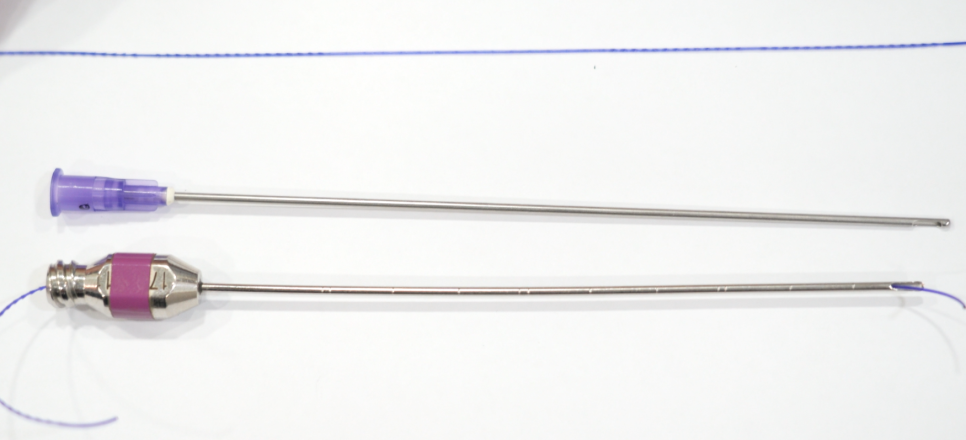
Thread lifting is a non-incisional lifting method that inserts special medical threads under the skin to pull up sagging tissue and induce collagen production.
Because it can provide lifting effects without using a scalpel, and because recovery is relatively faster than surgery, many people choose it without much burden.
In particular, it is a procedure that can be especially helpful for those concerned about facial sagging.
Most of the threads used are made of materials that are absorbed by the human body, so they naturally break down within the body after a certain period of time.
At that time, they help the surrounding skin tissue produce collagen and elastin.
Thanks to this, in addition to the immediate lifting effect, you can expect improved elasticity and density inside the skin over the medium to long term, along with a clearer facial impression.

PDO threads
PDO threads are made from the most representative material used in thread lifting.
They are highly safe threads used as sutures in various surgeries, including heart surgery, and are also medical-grade materials.
Threads made with PDO are dissolvable threads that naturally break down and are absorbed in the body.
As a result, the risk of side effects is relatively low, and because collagen production is promoted during the breakdown process, some elasticity can be maintained even after they dissolve.
PDO threads are broadly divided into two types: cog threads and mono threads.
Because each has its own characteristics and uses, the type of thread used varies depending on the individual’s facial condition and desired results.
First, cog threads have special 'barbs (cogs)' attached to the thread.
Thanks to this, they provide a relatively strong lifting effect.
Because these barbs physically lift and anchor the skin tissue, they are especially effective for those who want noticeable sagging improvement or a better jawline.
You can see an immediate change right after the procedure, and some people even say, after treatment, 'Does the change show up this quickly?'
However, because the effect is quite strong, the procedure must be performed with refined and careful technique.
Even a little too much force or a slightly wrong angle can make it difficult to achieve the desired result.
On the other hand, 'mono threads' are threads without barbs.
They are thinner than a strand of hair.
Rather than pulling and supporting tissue, they are intended to stimulate collagen production.
This is a procedure focused on improving skin texture and boosting elasticity, and many people in their 20s and 30s also undergo it for early aging prevention.
However, the role of 'mono threads' here is to stimulate the surrounding tissue and promote collagen production.
At present, skin boosters and other device-based lifting methods have been developed to perform the same role, so there are not many people who seek this option.
Things to note about thread lifting
Everyone has slightly different skin thickness and facial contour structure.
Because thread lifting is a procedure that directly pulls on skin tissue, even a 1 mm difference can change the impression of the face.
Therefore, in order to bring out the effects of thread lifting as naturally and safely as possible, sufficient understanding of the procedure and clinical experience are essential.
No matter how safe a procedure is said to be, it is still a medical procedure, so you must accurately understand the side effects and risks before deciding to proceed.
In particular, you need to seriously consider, 'Is this procedure right for me right now?'
This is because just because lifting is needed does not mean thread lifting is the optimal choice for everyone.
Depending on skin thickness, the degree of elasticity, fat distribution, and facial shape, some people show good results, while in other cases the results may be minimal or the risk of asymmetry may increase.
In particular, if the skin is thin and lacks elasticity, the skin’s response is more sensitive, making it more likely that the skin where the thread was inserted may become uneven or rippled, or that the thread may be visible in a bluish color.
Conversely, types with a lot of sagging fat must also be approached more carefully when doing thread lifting.
If you pull the thread too strongly, indentations like dimples can appear at the insertion area; if you pull too weakly, the effect may not appear.
Also, if a large amount of skin tissue gathers in one direction, that area may become overly prominent or the face may look larger, so special caution is needed.
One good way to address these side effects is not an I-shaped lift that relies on a single thread, but a V-shaped lift that can distribute the force placed on the thread.

In fact, thread lifting is one of the older procedures.
Because of this, not only the technology used to make the threads but also the procedure itself has continued to change in safer ways.
Compared with early thread lifting, today there has been steady progress in every aspect, from the thread material to the shape and insertion technique.
However, in order to properly benefit from these advanced technologies, the skill and experience of the medical staff must be supported above all else.
Therefore, before receiving thread lifting, please make sure to be treated by medical staff who have studied the procedure for a long time and have clinical experience and know-how,
and who carefully diagnose each person’s facial style and perform the procedure accordingly.
Thank you for reading this long post.
| This post was written for informational purposes in compliance with Article 56, Paragraphs 1 to 15 of the Medical Service Act. All treatments carry the risk of side effects and complications depending on the individual. Before treatment, be sure to have 충분한 consultation with medical staff with extensive experience and make your decision after that. |