One of the first areas where people notice changes as they age is the midface.
The midface refers to the area from below the eyes to above the mouth corners, in other words, the center of the face.
This area needs to maintain a certain level of skin elasticity for the face to look youthful and three-dimensional.
However, over time, as skin elasticity decreases and the fat layer and fascia descend, nasolabial folds deepen and the cheeks sag downward.
As a result, the face can look tired or older.
In particular, sagging in the midface brings changes beyond simply forming wrinkles.
When the center of the face loses support, the overall balance is disrupted, and the mouth corners can droop, creating a gloomy impression.
In such cases, lifting the sagging tissue upward through thread lifting can make the impression look softer and more lively.
It is not just about smoothing wrinkles; you can also expect an effect that re-establishes the overall centerline of the face.
However, receiving a lifting procedure does not automatically mean you will get satisfying results.
I will explain why below.
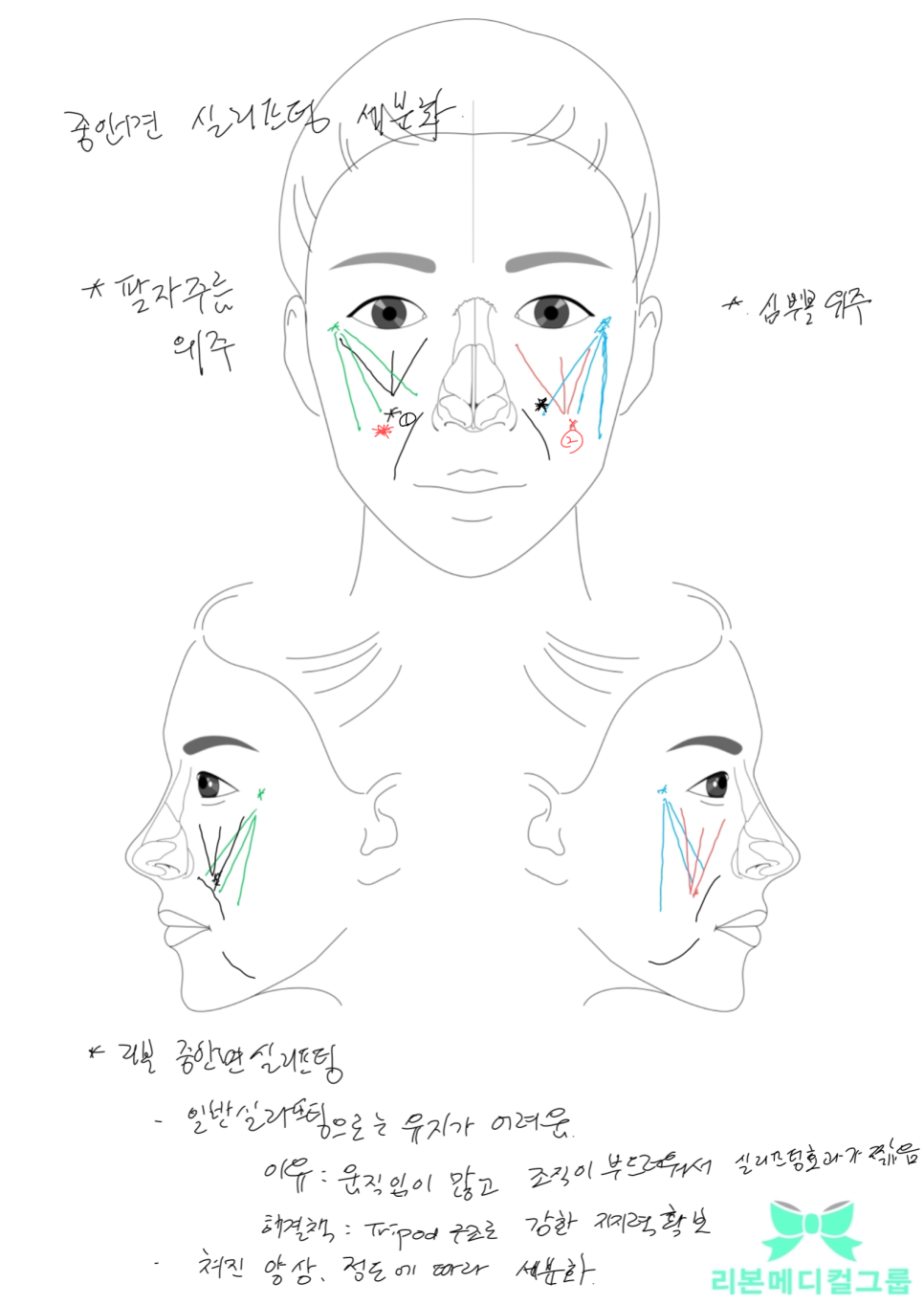
Risks of a procedure performed without personalized diagnosis
Every person’s face is different.
Individual skin thickness, amount of fat, muscle usage habits, and even bone structure all vary from person to person.
If a procedure is performed without considering these differences, simply along the lines of, “The nasolabial folds are deep, so let’s place threads here,” it is difficult to achieve satisfying results.
What matters is carefully analyzing the facial structure and designing the procedure accordingly.
Even for people of the same age, lifestyle habits, skin type, and degree of sagging are different, so thread lifting performed without a precise pre-procedure diagnosis increases the possibility of retreatment or side effects.

The key to midface thread lifting?
A detailed consultation is essential before the procedure.
First, each person’s skin layers should be checked.
This means assessing skin thickness, elasticity, and the condition of the fat layer to determine which thread is suitable.
It is also important to see in which direction and by how much the area has sagged.
You need to distinguish whether only the skin has descended or whether the fascia layer has sagged as well.
If the fascia layer has also sagged, the threads need to be anchored to deeper layers for longer-lasting results.
A person’s facial expression habits are also an essential part of determining the direction of thread lifting.
By checking how the face moves when smiling, speaking, and when at rest, the procedure can be designed so that facial expressions remain natural after treatment.
The procedure itself is not simply about inserting threads and pulling them up; they are fixed in a Tripod shape.
This is a method of supporting sagging tissue from three directions, allowing for a much more natural and stable result than pulling from only one direction.
It is also a good approach to use self-developed high-elasticity, high-density threads and apply them in a customized way according to skin type and condition.

Why you should not decide based only on thread type or price
As thread lifting has become more common recently, it is easy to see phrases such as “latest threads,” “celebrity thread lifting,” and “ultra-low-price event” in online ads.
Of course, the type of thread and the price are important factors.
However, a “good thread” does not guarantee a “good result.”
Even with the same thread, the outcome can differ completely depending on the doctor’s experience and design ability.
No matter how expensive or trendy the thread is, if the pulling direction is set incorrectly for each area, the effect may not last long or the impression may even become unnatural.
On the other hand, even older threads can produce excellent results when used appropriately by an experienced doctor.
Deciding based only on price is also risky.
In the case of low-cost procedures, the thread quality may be poor, or fewer threads may be used than necessary, leading to an effect that appears only at first and then quickly returns to sagging.
In the end, what matters most is who performs the procedure and how it is performed.

Criteria for choosing a good plastic surgery clinic
When considering midface thread lifting, I recommend checking the following three points carefully.
- Whether detailed consultation and personalized treatment are provided
- Procedure experience
- Aftercare system
Before the procedure, make sure the clinic analyzes skin condition, degree of sagging, lifestyle habits, and so on through sufficient consultation.
It should not end with a consultation that only covers things like “Which thread will be used?” and “How much does it cost?”; you need a consultation where your skin condition is thoroughly diagnosed and an appropriate treatment plan is established.
Because the midface is the center of the face, even subtle changes can greatly alter the overall impression.
You should definitely check whether the clinic has actual before-and-after patient photos and experience with various cases.
Aftercare is very important after thread lifting.
Please check whether the clinic also provides care to manage swelling and bruising and to help achieve satisfying results.

Midface sagging is not simply a wrinkle issue; it is an important factor that changes the overall impression of the face.
Thread lifting is a good way to improve the impression and restore a natural youthful look without surgery, but if it is performed without individualized analysis and careful design, the results may fall short of expectations.
At our clinic, we carefully analyze the facial structure and condition to find the threads, direction, and depth that suit each person.
If you want to regain a youthful and soft impression, do not look only at the thread and the price; please make your decision after 충분히 consulting with medical staff who have experience and trustworthiness.
Thank you.
| This post was written for informational purposes in compliance with Article 56, Paragraphs 1 to 15 of the Medical Service Act. All treatments carry a risk of side effects and complications depending on the individual. Before treatment, please make sure to have a thorough consultation with experienced medical staff before making a decision. |