The midface of our face has a meaning that goes beyond simple sagging of the skin.
This area accounts for more than half of our facial expression when we smile, and it is also an important part that shapes a person’s impression.
However, there is one thing many people do not realize.
That is, the midface has a complex network of very important blood vessels and nerves.
Even if it looks like nothing more than sagging skin and cheek volume on the outside, blood vessels and nerves run densely underneath.
If thread lifting is performed without considering this, it can lead not only to poor results but also to side effects such as numbness, bruising, and asymmetry.
That is why midface lifting must be planned and performed by an experienced board-certified plastic surgeon.
I will explain in more detail below.
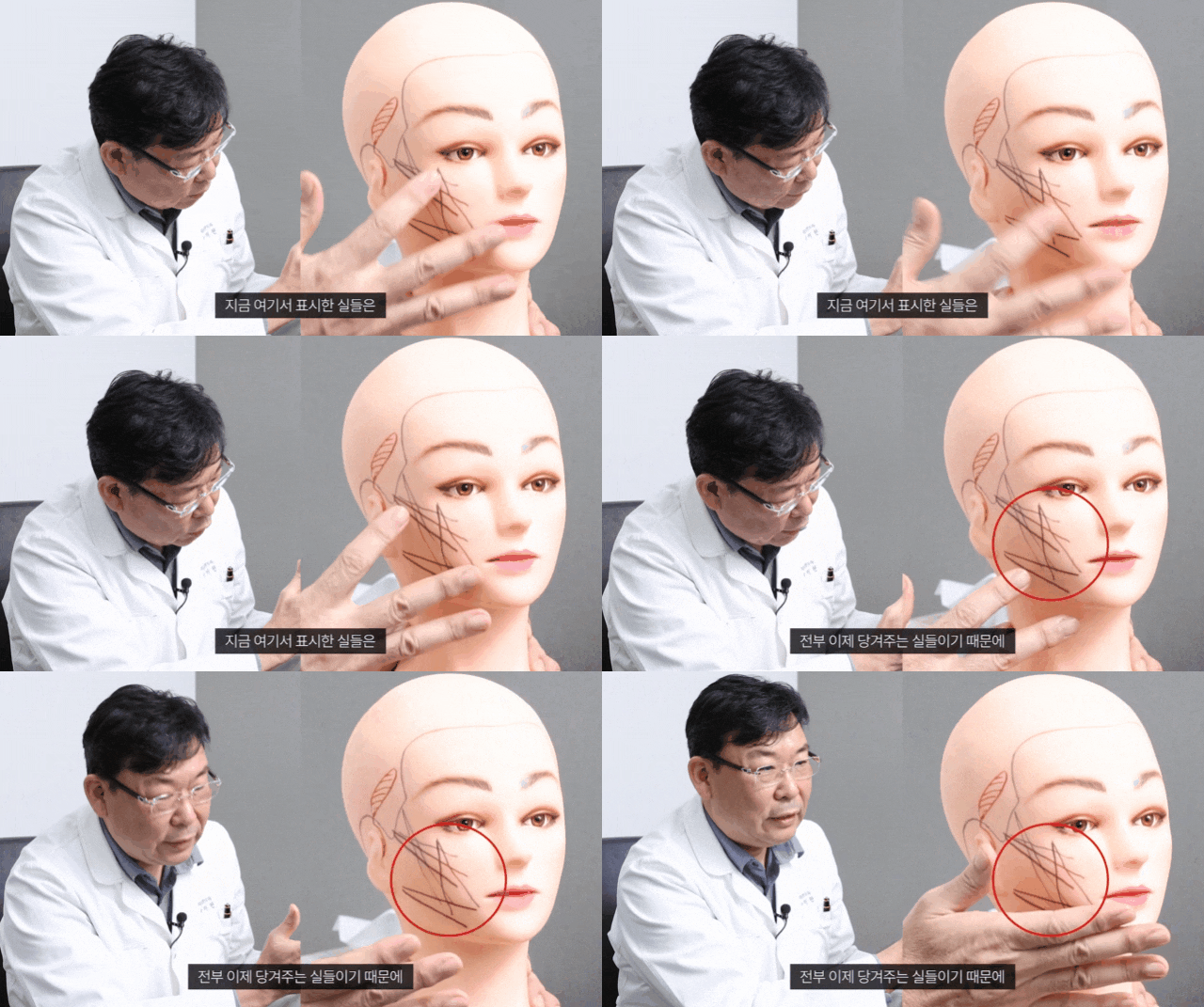
How midface sagging changes your impression
As we age, everyone loses skin elasticity and fat gradually descends.
In particular, when the midface sags, it gives the impression that the center of the face is heavily drooping downward. As a result, the following changes become noticeable.
□ Nasolabial folds
As cheek fat shifts downward, nasolabial folds become more pronounced. This can make you look much more tired and older than your actual age.
□ A heavy and downcast impression caused by sagging cheeks
When elasticity decreases and the cheeks begin to sag downward, the overall expression can look drooped and lose vitality.
□ Loss of facial definition
When the midface becomes sunken and saggy, facial volume decreases and the three-dimensional balance is disrupted.
In other words, midface sagging is not simply a matter of “loose skin”; it significantly changes your impression and can also affect your confidence.
For these reasons, many people seek thread lifting.

What kind of procedure is thread lifting?
Thread lifting is a procedure in which dissolvable medical threads are inserted under the skin to lift sagging tissue upward.
The threads themselves act as support structures within the skin, improving elasticity while also stimulating collagen production, allowing for combined skin-improvement effects.
In particular, midface thread lifting can improve nasolabial folds and sagging cheeks at the same time, so noticeable results can be expected in a relatively short period.
However, as mentioned earlier, this area has a complex structure, so it is not a procedure that ends with simply inserting threads.
Depending on the anatomical structure, it must be customized to each person’s facial structure and degree of sagging in order to achieve natural and long-lasting results.
Thread lifting is often known as a “simple” procedure.
But just because a procedure looks simple does not mean anyone can do it safely.
In particular, midface lifting can produce major results from even small errors.
If the threads are placed too superficially, they may loosen quickly or produce only minimal effect.
On the other hand, if the threads are placed too deeply, side effects may occur due to nerve or blood vessel damage.
If the direction or position of the threads is incorrect, the face may be pulled asymmetrically, resulting in an awkward appearance.
Therefore, you must receive consultation and treatment from an experienced board-certified plastic surgeon who has a precise understanding of facial anatomy.
During the consultation, it is important to receive sufficient explanation and confirm how the threads will be inserted, what results are expected, and what the recovery process will be like.
 What is the key to thread lifting?
At our clinic, we use threads that are manufactured in-house.
What is the key to thread lifting?
At our clinic, we use threads that are manufactured in-house.
These threads are optimized for the facial structure and skin thickness of Korean patients, based on know-how accumulated through many years of experience.
In addition, the method we use is tripod-type thread lifting.
Rather than pulling in only one direction, it supports from three directions at the same time, more stably securing the sagging tissue and lifting it naturally.
Thanks to this, the effects last longer, and the expression remains smooth and not awkward even after the procedure.
 What should you be sure to keep in mind before and after the procedure?
If you are considering the procedure, the two things you must check first are the surgeon’s experience and which threads are being used.
What should you be sure to keep in mind before and after the procedure?
If you are considering the procedure, the two things you must check first are the surgeon’s experience and which threads are being used.
Because the midface contains a complex network of blood vessels and nerves, it is safest to receive treatment from a doctor with extensive anatomical knowledge and experience.
Also, depending on which threads are used, the duration of the effect and the naturalness of the result can vary, so you should not simply look at whether they are commonly used products; you must make sure they are proven threads.
After the procedure, systematic aftercare is also necessary to maintain the results for a long time and prevent side effects.
For 2–3 weeks immediately after the procedure, the threads are settling into place under the skin, so you should avoid excessive facial movements and exercise, and it is also best to reduce the habit of sleeping on your side.
In addition, it is necessary to visit the plastic surgery clinic periodically to check whether the threads have settled properly and whether there is any asymmetry.
Simply following these two things can help you experience much more satisfying and stable results.
Today, I wrote this article to help those who are planning thread lifting because of midface sagging.
If you are concerned about midface sagging, rather than making a hasty choice, I hope you will find the method most suitable for you through a consultation.
We will help you experience safe and natural changes.
Thank you.
| This post was written for informational purposes in compliance with Article 56, Paragraphs 1–15 of the Medical Service Act. All treatments carry a risk of side effects and complications depending on the individual. Before treatment, be sure to have a thorough consultation with experienced medical staff before making a decision. |