The midface is the central area of the face and is often the first place where changes are noticed as we age.
The cheeks descend, nasolabial folds deepen, and the entire face can begin to look heavy and tired.
Many people think of a lift procedure to improve these changes.
However, a lift procedure requires incisions and also comes with a long recovery period, which can feel burdensome.
At our clinic, for people with these concerns, we recommend thread lifting so that they can experience a relatively lower burden and a natural-looking improvement.
Today, I would like to explain in detail the thread lifting procedure that people worried about midface sagging should definitely know about.

What kind of procedure is thread lifting?
Thread lifting, as the name suggests, is a procedure in which special medical threads are inserted into the skin to lift sagging tissue upward.
Because the threads are inserted through small needle holes, there is little concern about scarring and recovery is generally quick.
The threads do more than simply pull tissue upward; as they are placed under the skin, they also promote collagen formation.
As time passes, the skin’s own elasticity improves as well, so you can feel changes beyond simple lifting.
In other words, the face line can look more refined immediately after the procedure, and over the course of several months, skin texture and elasticity may also improve, creating a dual effect.
 Why thread lifting stands out: why recommend it instead of a lift procedure?
A lift procedure directly lifts the skin and muscles through incisions, so it has the advantage of producing more dramatic changes.
Why thread lifting stands out: why recommend it instead of a lift procedure?
A lift procedure directly lifts the skin and muscles through incisions, so it has the advantage of producing more dramatic changes.
However, it naturally comes with concerns about incisions, recovery time, and scarring.
In particular, it is a difficult option for people with busy daily lives or those who are afraid of major surgery itself.
Thread lifting can reduce these burdens while still being effective for improving midface sagging.
Above all, it is well suited for people who want a natural change.
Rather than a face that suddenly looks completely different, many people want results that are so natural that others simply think, "Your face looks better lately."
Of course, depending on the patient’s condition, a lift procedure may be more necessary in some cases.
But in most cases, especially for people in their 30s to early 50s, you can expect a satisfying change with thread lifting alone.
Because it reduces the burden while delivering natural-looking results, this is why I recommend thread lifting first.
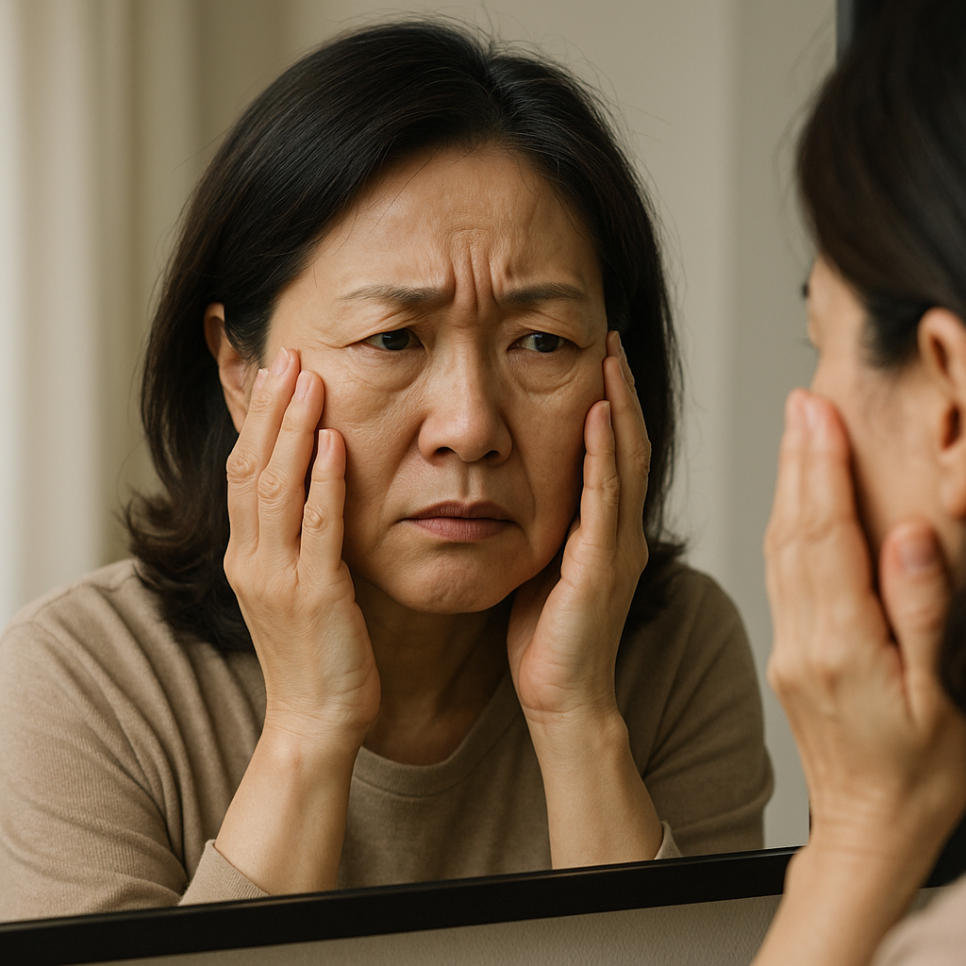
Midface thread lifting method
At our clinic, we do not simply insert threads; we first create a customized design based on the facial structure and skin condition.
Since everyone’s bone structure, skin thickness, and fat distribution are different, a one-size-fits-all approach cannot produce good results.
To focus on improving the midface, we insert threads primarily around the deep cheek area and the nasolabial fold line, where sagging begins.
By lifting the sagging cheeks upward, we help soften the nasolabial folds and make the face look brighter.
However, this area is one where facial expressions change frequently in daily life, so the duration of the results can naturally be shorter.
That is why we insert the threads in a tripod structure to provide stronger retention.
We segment the placement according to each person’s pattern and degree of sagging, and by pulling from three directions, we can secure stronger support.
The threads used also vary depending on the purpose.
Depending on the patient’s condition, we use different types and numbers of threads—for cases that need an immediate lifting effect, cases where recovery of skin elasticity is more important, and cases where both are needed at the same time.
In particular, our clinic also has threads that we manufacture ourselves, and they are longer than general threads, which can provide stronger traction.
 Why uniform thread lifting should not be done
Some people think of thread lifting as a simple procedure where "you just insert threads and pull the skin up."
Why uniform thread lifting should not be done
Some people think of thread lifting as a simple procedure where "you just insert threads and pull the skin up."
But this is a major misconception.
Because the degree of skin sagging, skin type, amount of fat, and treatment area vary from person to person, a treatment plan must be made with careful consideration of these factors.
Also, because nerves and blood vessels are likely to be located in the treatment area, it is important to receive the procedure from a plastic surgeon with extensive knowledge of anatomical structures.
If this is overlooked and the procedure is performed uniformly, there is a very high risk of complications, so special caution is needed.
Only when an experienced plastic surgeon analyzes each individual’s facial structure and performs a customized procedure can good results be achieved.
 What to pay attention to during a plastic surgery consultation
If you are considering thread lifting, I recommend checking the following points during the consultation process.
What to pay attention to during a plastic surgery consultation
If you are considering thread lifting, I recommend checking the following points during the consultation process.
First, the doctor’s experience and expertise.
Thread lifting requires delicacy beyond simply inserting threads.
The more cases a doctor has experienced, the better they can find the optimal method suited to the facial structure.
Second, it is good to hear a thorough explanation of the types of threads and their pros and cons.
Rather than a plastic surgery clinic that uses only one type of thread, a place that can combine several types of threads according to the situation is more advantageous from the patient’s perspective.
Third, the aftercare system is also important.
You should check whether swelling management and follow-up checks are handled carefully after the procedure, and whether there is a system in place to respond quickly if any problems arise, so that you can feel reassured.

Midface sagging is not simply an appearance issue; it also has a major effect on confidence and vitality in daily life.
If your face looks more saggy than before, you may hesitate to appear in front of others, and taking photos can become burdensome.
A lift procedure is a powerful option, but it comes with the burden of incisions and recovery.
In comparison, thread lifting is a relatively simple and natural way to improve midface sagging.
At our clinic, we carefully analyze each patient’s facial structure and skin condition to find the most suitable procedure.
If you are concerned about midface sagging, I encourage you to come in for a thorough consultation.
Thank you.
| This post was written for informational purposes in compliance with Article 56, Paragraph 1 through Paragraph 15 of the Medical Service Act. All treatments carry the risk of side effects and complications depending on the individual. Before treatment, please be sure to have a thorough consultation with medical staff who have extensive experience before making a decision. |