Many people feel that their eye shape has changed as they enter middle age.
As the eyelids droop and the eyes look heavy, or the under-eye area becomes puffy and sagging, the face can appear tired.
These changes are not simply a cosmetic issue. They are a natural process that occurs as the skin, muscles, and fat tissue all change with aging.
However, the concern is not limited to appearance. If the sagging and drooping become severe, they can also cause functional problems such as visual obstruction and irritation around the eyes.
At this point, improvement may be expected through midlife eye surgery such as upper blepharoplasty and lower blepharoplasty. You may also be looking for information because you are interested in midlife eye surgery.
Before surgery, please remember that it must be approached from a completely different angle than simple cosmetic eye surgery. Because it targets sagging and drooping tissue, it is more delicate and complex.
If surgery is performed in a uniform way without accurately identifying the tissue that has drooped due to aging, it can lead to unnatural results such as eyes that look overly pulled up or facial expressions that seem awkward.
In this article, I will explain the representative procedures and precautions that people considering midlife eye surgery should know.
 What Are Upper and Lower Blepharoplasty?
■ Upper blepharoplasty
Upper blepharoplasty is one of the 대표 procedures in midlife eye surgery.
As people age, the skin of the upper eyelids becomes loose and droops over the eyes, making the eyes look smaller or giving a sleepy impression.
In severe cases, some people may even feel discomfort in daily life because their field of vision is obstructed.
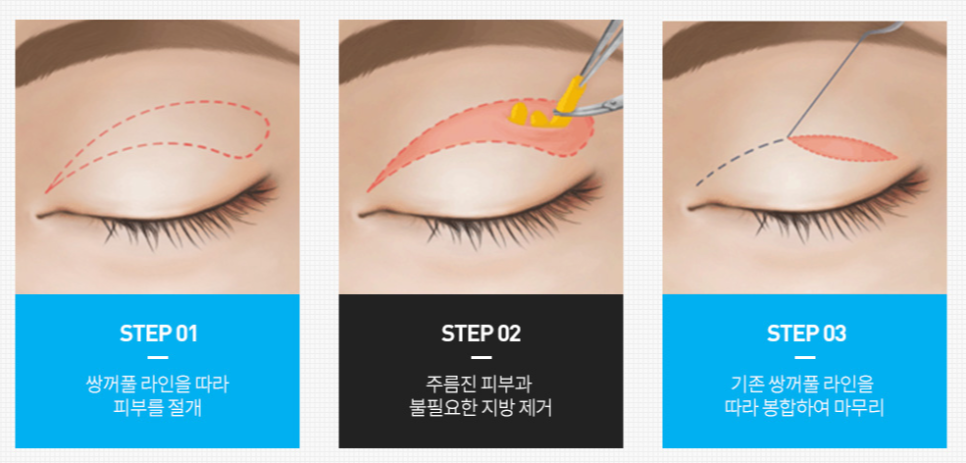
Upper blepharoplasty is a procedure that trims the sagging skin and muscle of the upper eyelids to make the eye shape appear clearer and more defined.
The important point is that the goal is not simply to remove a large amount of skin.
Because each person differs in eye-opening strength, eyebrow position, and the degree of skin drooping, all of these factors must be considered together to expect a natural result.
If correction is excessive, the eyes may appear too wide open, so especially in midlife eye surgery, careful design is needed.
■ Lower blepharoplasty
Lower blepharoplasty is also an essential procedure in midlife eye surgery.
When the under-eye area becomes puffy or sagging, a person can look older than their actual age and always appear tired.
This change occurs when the under-eye fat shifts forward or as skin elasticity decreases.
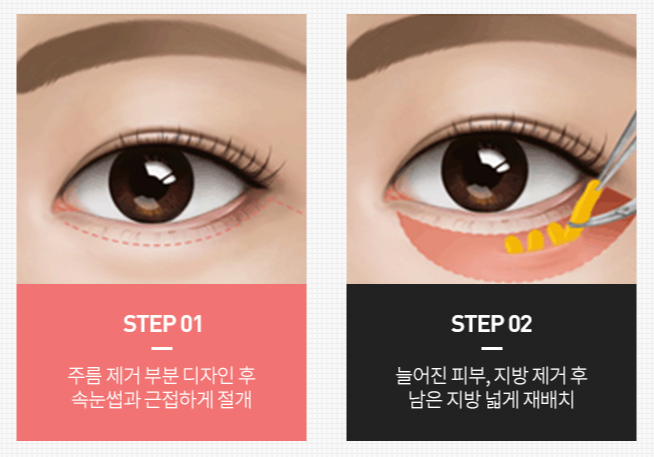
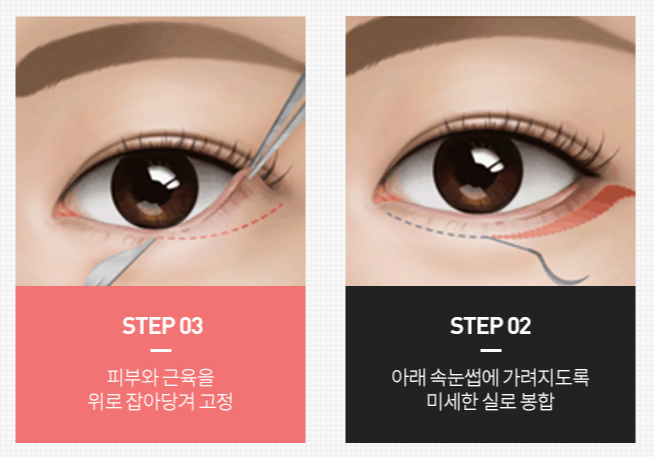
Lower blepharoplasty is a procedure that removes unnecessary fat under the eyes and improves the sagging skin for a firmer, cleaner under-eye line.
Rather than simply removing fat, the procedure should also include repositioning or supporting the under-eye structure, which can lead to a more natural result.
The under-eye area in middle age often has thin and sensitive skin, so delicate surgery is especially important.
Why Is Midlife Eye Surgery More Careful?
Midlife eye surgery requires consideration of far more factors than general cosmetic eye surgery.
This is because skin elasticity, muscle strength, fat position, and even differences between the left and right eyes can all vary.
The goal is not simply to make the eyes look younger, but to make them look naturally refreshed within the harmony of the entire face.
That is why it is important to make the decision after 충분한 consultation with a plastic surgery specialist who has extensive surgical experience.
During the consultation, instead of a simple explanation such as “it will change like this,” there should be a detailed analysis of the current condition of the eyes and a realistic explanation of the changes after surgery in order to expect a satisfying result.
At our clinic, we do not approach midlife eye surgery as a simple cosmetic procedure.
We analyze the overall aging condition around the eyes and create a surgical plan while considering the individual’s impression and facial expressions.
Upper and lower blepharoplasty may also be performed separately depending on the need, or planned together to improve the overall eye shape.
Above all, the most important thing is to create change that is not excessive, but natural.
To achieve this, we provide careful management from consultation to surgery and the recovery process.

How to Avoid Trial and Error with Midlife Eye Surgery
To avoid unsatisfactory results in midlife eye surgery, there are two key points you must check before surgery.
First, whether the cause of aging in your eyes is diagnosed accurately.
Changes in middle-aged eyes are often not caused by skin sagging alone, but by a combination of weakened muscle strength, fat displacement, and drooping eyebrows.
If the causes are not properly distinguished, unnecessary surgery may be performed, or overcorrection may result in an unnatural impression.
During the consultation, it is important to see whether the doctor explains in detail what the current condition is and which surgery is appropriate.
Second, whether a natural surgical direction that is not excessive is suggested.
The purpose of midlife eye surgery does not end with simply organizing the sagging areas and lifting them.
In addition to aesthetic improvement, functional problems caused by aging must also be addressed comprehensively.
Also, rather than making drastic changes, surgery should be planned with harmony with the entire face in mind so that there is less dissatisfaction after surgery and fewer mistakes.

Midlife eye surgery is not simply a procedure to change appearance; it is a process of organizing the traces of aging that have accumulated over time and restoring a softer impression.
That is why greater caution is needed, and why judgment from a more experienced medical team is necessary.
If you feel that your impression has changed because of your eyes, rather than worrying alone, I hope you will start by getting an accurate diagnosis of your current condition.
Thank you.
| This post was written for informational purposes in compliance with Article 56, Paragraphs 1 to 15 of the Medical Service Act. All treatments carry a risk of side effects and complications depending on the individual. Please be sure to have a thorough consultation with a medical professional with extensive experience before deciding on treatment. |