Thread lifting is one of the procedures that many people are interested in these days and choose with relatively little burden.
However, we do not recommend approaching it lightly for reasons such as “it looks simple,” or “many people around me have done it.”
This is because our faces have a much more complex structure than you might think. Skin thickness and elasticity, the amount and location of fat, and the direction in which sagging begins all differ from person to person.
If the procedure is carried out in a uniform way without fully considering these differences, the face may look awkward after the procedure.
Thread lifting is not simply a procedure that involves inserting threads. A natural result can only be expected when the procedure takes into account the overall balance of the face and the current skin condition.
Therefore, rather than approaching it as a “simple procedure,” it is important to understand it as a treatment that absolutely requires a personalized plan. The results can vary greatly depending on how this difference is approached.
Today, I would like to share information that may be helpful for those planning thread lifting due to concerns about facial sagging and fine wrinkles. I hope this helps you achieve satisfying results after reading.
Why the face sags over time
As we age, changes in the face are a natural phenomenon. This is not simply a problem that occurs on the surface of the skin. It is caused by changes throughout the skin’s internal structures.
First, collagen and elastin in the dermal layer gradually decrease. These components help keep the skin firm, and when their amount decreases, the skin gradually loses elasticity.
Beneath that is the fat layer. The face’s fat shifts downward as we age. This is why the cheeks sag and the nasolabial folds become deeper.
Another important structure is the fascia layer. Fascia acts like a frame that supports the entire face. As time passes and this fascia loosens, it can no longer hold the skin and fat in place together. At this point, the facial contours collapse and sagging becomes more noticeable.
In other words, facial aging is not a problem of just one layer of skin, but the result of multiple layers changing together.
At this stage, home care alone cannot restore sagging and wrinkled skin, and procedures such as thread lifting are needed to expect visible results.

Why thread lifting is effective
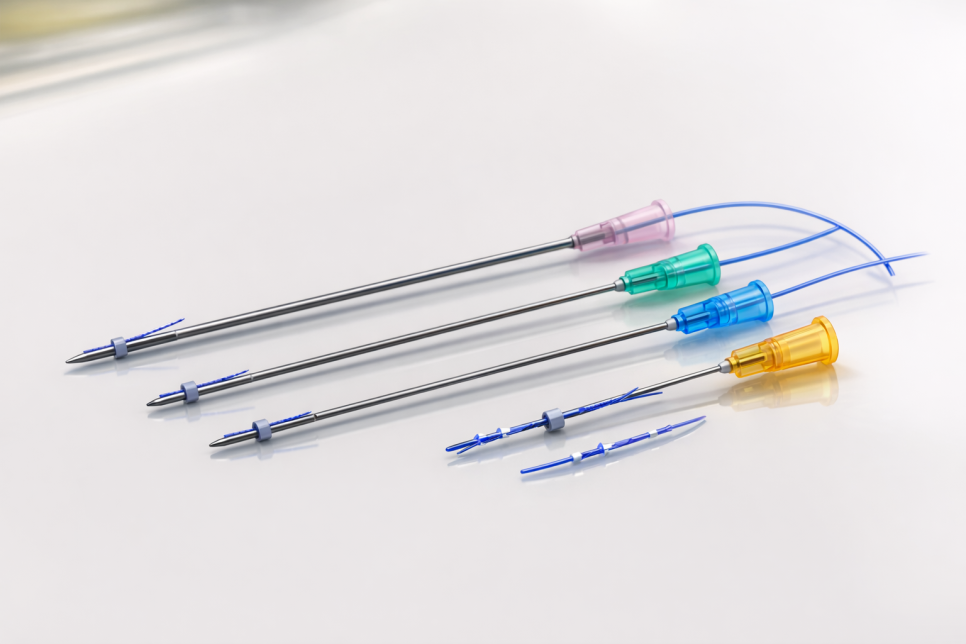
Thread lifting is a procedure in which dissolvable medical threads are inserted into the skin to lift sagging tissue upward. Its advantage is that it does not simply pull on the skin surface, but can directly address the layer where sagging begins.
Once the threads are inserted, an immediate lifting effect can be expected. At the same time, collagen production is induced around the threads over time. Through this process, improvement in skin elasticity can also be expected.
The threads are naturally absorbed by the body after a certain period of time. Because nothing is left behind, the burden is relatively low and it can lead to a natural change.
In addition, thread lifting can be performed by inserting and lifting the threads according to the direction of sagging. When designed to match an individual’s facial structure, a soft lift is possible without an artificial look.
However, one thing to be careful about is that the procedure is not minor just because it does not involve an incision.
This is because the face contains a very complex distribution of fine nerves and blood vessels, and even a slight mistake in the direction, depth, or tension of the threads can lead to discomfort or unnatural facial expressions.
In addition, the left and right sides of the face are not completely symmetrical. In many cases, sagging is more severe on one side. If these differences are not taken into account, asymmetry may become even more noticeable after the procedure.
For these reasons, thread lifting must be performed by a board-certified plastic surgeon with extensive understanding and experience in facial anatomy.
Also, even at the same age, everyone’s skin structure and condition are different. Some people have thin skin, while others have a thicker fat layer. The starting point of sagging and the speed at which it progresses also differ.
That is why establishing an individualized treatment plan is very important. Using a large number of threads does not always lead to better results. The key is to place and lift them where they are needed, in the amount that is needed.
Thread lifting approach
At our clinic, we place great importance on the consultation process before the procedure. We do not simply look at the face as a whole; we carefully examine skin type, thickness, and elasticity. After analyzing the starting point and direction of sagging, we create a plan tailored to the individual.
The type and design of the threads are also selected according to the condition of the face. They are applied precisely only to the necessary areas to avoid excessive pulling, with the goal of achieving a natural change in appearance.
During the procedure itself, we consider the anatomical structure and approach a safe layer. We proceed in a way that reduces unnecessary stimulation and minimizes the burden of recovery.
The thread lifting we pursue is not a striking change, but a face that naturally looks better.

Thread lifting is certainly an attractive procedure. However, it is not something that can be applied in the same way to everyone. Facial structure and patterns of aging differ from person to person.
Rather than deciding based only on cost or convenience, it is important to choose a place that provides a suitable plan through sufficient consultation and explanation.
If you are considering thread lifting, we hope you will find a place that can think through the process with you and decide on the procedure after sufficient consultation.
Thank you.
| This post was written for informational purposes in compliance with Article 56, Paragraphs 1 through 15 of the Medical Service Act. All treatments carry a risk of side effects and complications depending on the individual. Before treatment, please be sure to make a decision only after sufficient consultation with medical staff who have extensive experience. |