Many people, when considering lifting procedures, first worry about eye wrinkles or the jawline.
But at some point, when they look in the mirror, they start to feel that the area under the eyes looks more hollow than before and the shadows below the cheekbones have become deeper.
They may also hear that the nasolabial folds become deeper when smiling and that the face looks longer.
The area at the center of these changes is the midface.
The midface is the area that extends from under the eyes to the cheekbones, the center of the cheeks, and the nasolabial line.
This area is a key region that determines the vitality of facial impressions and a youthful appearance.
When the midface begins to sag, the face looks tired and gives the impression of being older than the person’s actual age.
That is why, recently, rather than simply pulling up the jawline, how the midface is restored is considered an important factor that determines how natural the lifting result will be.
So why does midface sagging happen, and how can it be improved?
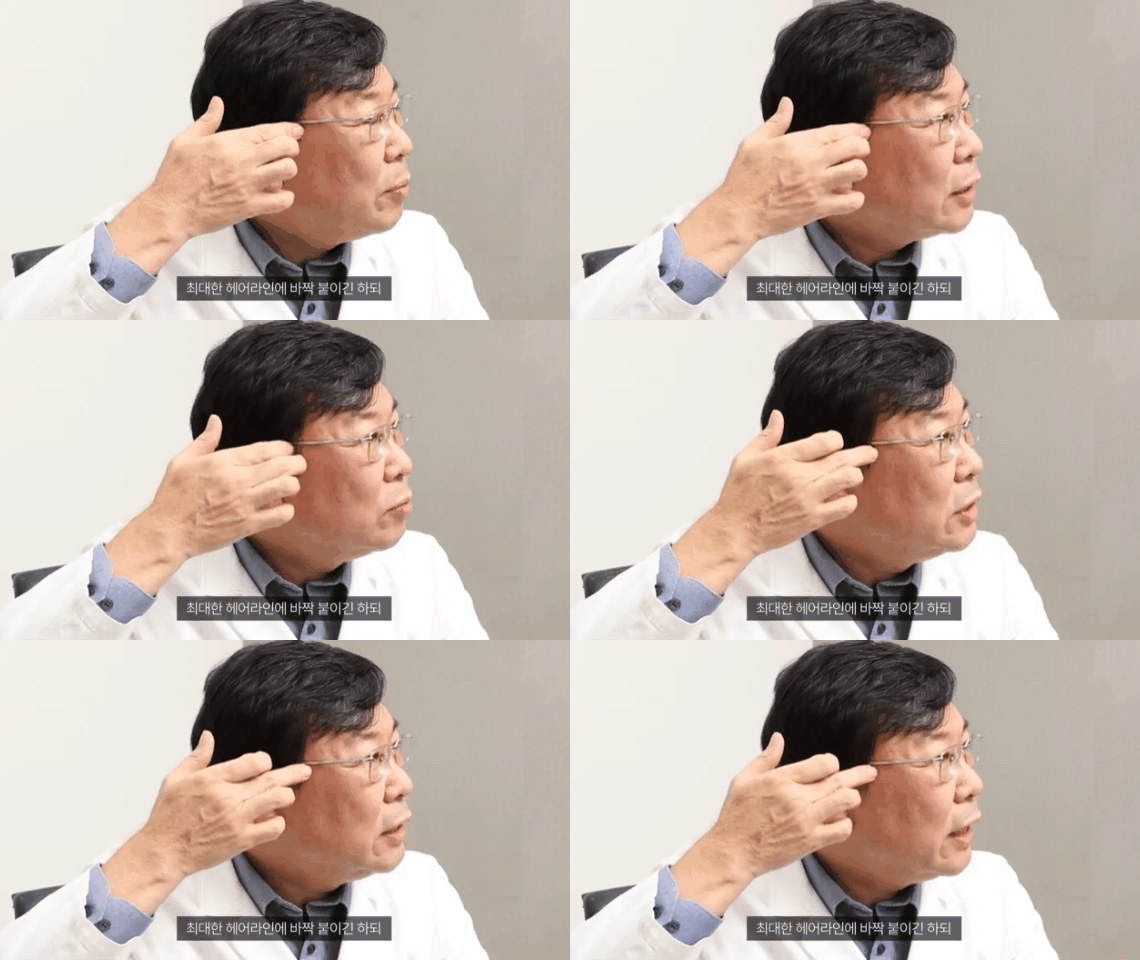 Why Does Midface Sagging Change the Appearance of the Face
The midface is a complex area where skin, fat, fascia, and ligament structures are layered together.
When we are young, these structures are firmly supported upward, maintaining natural volume and elasticity in the center of the cheeks.
But as we age, the supporting ligaments loosen and the fat layer shifts downward.
As a result, the area below the cheekbones appears hollow, the nasolabial folds deepen, and the area under the eyes takes on a shadowed look.
At this point, if only the skin surface is pulled, the outside may look tightened.
However, the facial expression may become awkward, or the volume may appear even more hollow.
That is why midface lifting should be approached as a process of restoring the sagging structure to its original position.
There are various methods for midface lifting, including incision-based lifting surgery, endoscopic midface lifting, and thread lifting.
It is important to select the appropriate method by comprehensively considering the current degree of midface sagging, skin thickness, fat distribution, and whether there is hollowing under the eyes.
In particular, in the early stages of midface sagging, there are many cases where thread lifting alone can produce sufficient improvement without incision surgery.
However, even in that case, the naturalness of the result and how long it lasts can vary greatly depending on which thread is used, in what direction, and at which point it is fixed.
So what principle does midface thread lifting use, and what kind of results can be expected?

Midface Thread Lifting: Factors That Determine Naturalness and Durability
Midface thread lifting is a method that restores volume and elasticity to the center of the face by repositioning the fat and tissue that have descended under the eyes and into the center of the cheeks in an upward direction.
What matters here is not simply pulling upward, but setting the direction while taking into account the facial skeleton and muscle movement.
If the direction is wrong, the expression may look unnatural when smiling, or the cheeks may feel excessively pulled.
The midface has relatively thin skin and a dense distribution of blood vessels and nerves.
Therefore, the insertion depth and tissue layer must be accurate so that fixation remains stable and unnecessary bruising and swelling are reduced during recovery.
Durability varies depending on the type and structure of the thread, the fixation points, and each person’s skin elasticity.
In general, thread lifting provides an immediate lifting effect, and over time it also promotes collagen regeneration, further improving skin elasticity.
However, if excessive facial movement, strong facial massage, or sleeping face down are repeated after the procedure, fixation may weaken.
That is why lifestyle management is needed for a certain period of time.

The midface is the area that shows aging on the face first and the key region that determines the completeness of lifting results.
When this area sags, the face can look tired, the impression can seem heavy, and even facial proportions may appear different.
So when considering midface lifting, it is important to understand the procedure as one that restores the structure of the center of the face to how it used to be.
The appropriate method will differ depending on whether the cause of the sagging is the skin, fat displacement, or loosening of the supporting ligaments.
To get a diagnosis of your facial condition and set up a lifting plan suited to it, please consult a board-certified plastic surgeon with extensive procedure experience and expertise.
Thank you.
| This post was written for informational purposes in compliance with Article 56, Paragraphs 1 to 15 of the Medical Service Act. All treatments carry the risk of side effects and complications depending on the individual. Before treatment, be sure to make a full consultation with medical staff with extensive experience before making a decision. |