When people think of ways to improve drooping eyes, they often naturally think of just one type of surgery. In particular, many people know only eyelid surgery that removes skin as the representative method, but there are far more varied approaches. Aging around the eyes cannot be explained simply by skin sagging alone, so it is important to take a customized approach depending on each person’s condition.
As we age, the changes around the eyes are more complex than you might think. Not only does the eyelid skin loosen, but the muscles that open the eyes also weaken, making the eyes look heavy or giving a sleepy impression. In addition, as the eyebrows gradually descend, the eyes may appear more drooped than they actually are, and some people develop the habit of opening their eyes by overusing the forehead muscles. These changes can go beyond a simple cosmetic issue and lead to everyday fatigue or even visual discomfort.
Because these various causes work together in combination, it is better to first identify the current condition of the eyes rather than conclude that “one surgery is the best.” Even for people in the same age group, the suitable method can differ depending on skin thickness, the degree of sagging, skeletal structure, and the form and satisfaction level of any existing double eyelids.
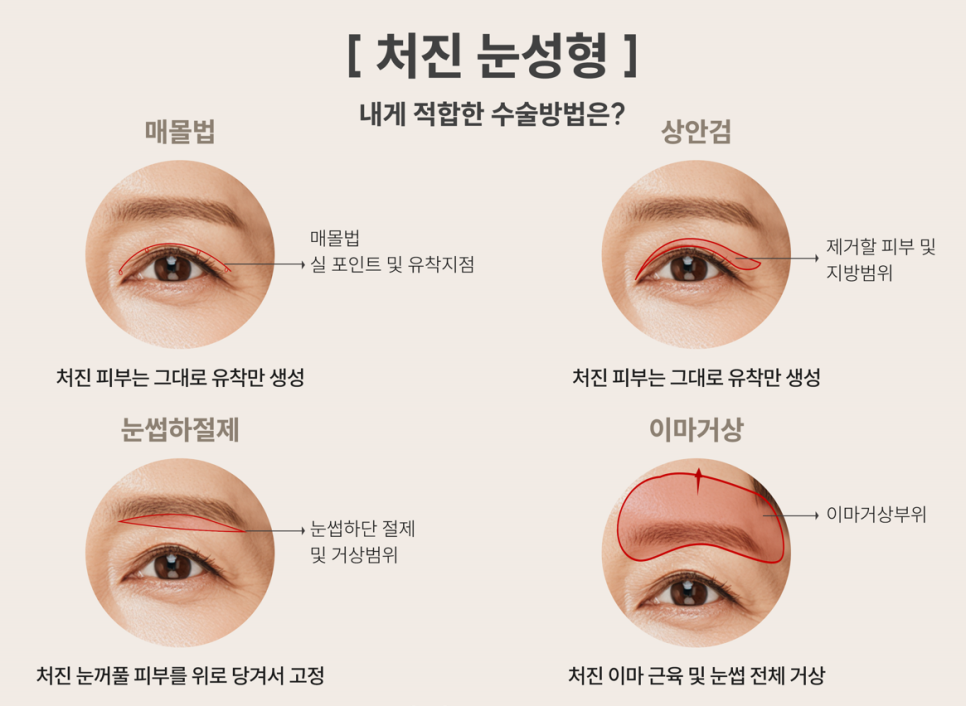
Midlife eye surgery is not simply a matter of “drooping skin.”
As people age, several changes occur around the eyes at the same time. Skin elasticity decreases, the eyelid skin stretches, and fat may shift or become hollow. In addition, the eyebrow position drops and compensatory action from the forehead muscles is added, changing the overall impression.
These changes often cannot be resolved simply by “recreating the double-eyelid line.” That is because the approach must differ depending on whether the problem is in the eyelid itself, the position of the eyebrows and forehead, or a combination of factors.
■Non-incisional method
The non-incisional method creates a double-eyelid line using sutures without making an incision.
It can also be applied to middle-aged patients in some cases, but only when skin sagging is not severe and the eyelid skin is thin. It is also suitable when there is already a double eyelid but the line has become faint, or when minor correction is desired.
However, if the non-incisional method is applied forcefully in the presence of skin sagging, the line may loosen over time and satisfaction may decrease. Therefore, rather than choosing it simply because it is “easy,” it is important to accurately evaluate the current condition of the eyes.
■Upper blepharoplasty
Upper blepharoplasty removes stretched eyelid skin and, if necessary, can strengthen muscle function. It is the most widely performed method in midlife eye surgery and is relatively effective at improving sagging.
In particular, it can also help functionally when there is skin sagging that covers the field of vision or when the eyelids have become heavily drooped.
However, because it is a surgery involving an incision, it may take time for it to settle naturally, and the initial impression may look somewhat strong. For this reason, as the preference for more natural results has increased recently, there are also more cases of considering a combined approach with other methods or alternative approaches rather than upper blepharoplasty alone.

■Subbrow lift
A subbrow lift makes an incision just below the eyebrow and pulls the sagging skin upward. Because the eyelid itself is not directly removed, it has the feature of improving sagging while preserving the existing double-eyelid line.
It is especially considered when a person is highly satisfied with their existing double eyelids or when they are concerned about changes in appearance caused by eyelid incision. It is also one of the methods that has recently attracted growing interest among middle-aged people because it can provide relatively natural results.
However, whether it can be applied depends on factors such as eyebrow position, skin thickness, and skeletal structure, and a sufficient understanding of scar location and care is also necessary.
■Forehead lift
A forehead lift improves sagging around the eyes by lifting the eyebrows and forehead as a whole. It is an effective approach when the eyebrow position has dropped rather than the eyelid itself.
When the eyebrows descend, the eyelids appear more drooped, so improving the forehead and eyebrows together rather than correcting only the eyelids can be a more fundamental solution.
In particular, if there is a habit of opening the eyes by overusing the forehead muscles, a forehead lift can reduce this compensatory action. As a result, it is a method that can affect not only the eyes but also the overall impression.
The key to midlife eye surgery is not applying a single surgical method uniformly, but taking an approach tailored to the individual’s condition.
Various factors such as the degree of eyelid sagging, skin thickness, skeletal structure, eyebrow position, and whether there is an existing double eyelid and how satisfied the person is with it must be considered comprehensively. Even if the eyes are all described as “drooping,” the appropriate surgical method differs if the cause is different.
In particular, as the recent tendency to value a natural impression and faster recovery has increased, more people are reviewing various methods such as subbrow lifts and forehead lifts together rather than considering only upper blepharoplasty.
Ultimately, what matters is not which surgical method is superior, but establishing the combination and plan that best suit the individual. It would be best to proceed with surgery in a direction that matches your own condition through sufficient consultation and diagnosis.
Thank you.
| This post was written for informational purposes in compliance with Article 56, Paragraph 1 through Paragraph 15 of the Medical Service Act. All treatments carry a risk of side effects and complications depending on the individual. Before treatment, please be sure to make a decision only after sufficient consultation with medical staff who have extensive experience. |